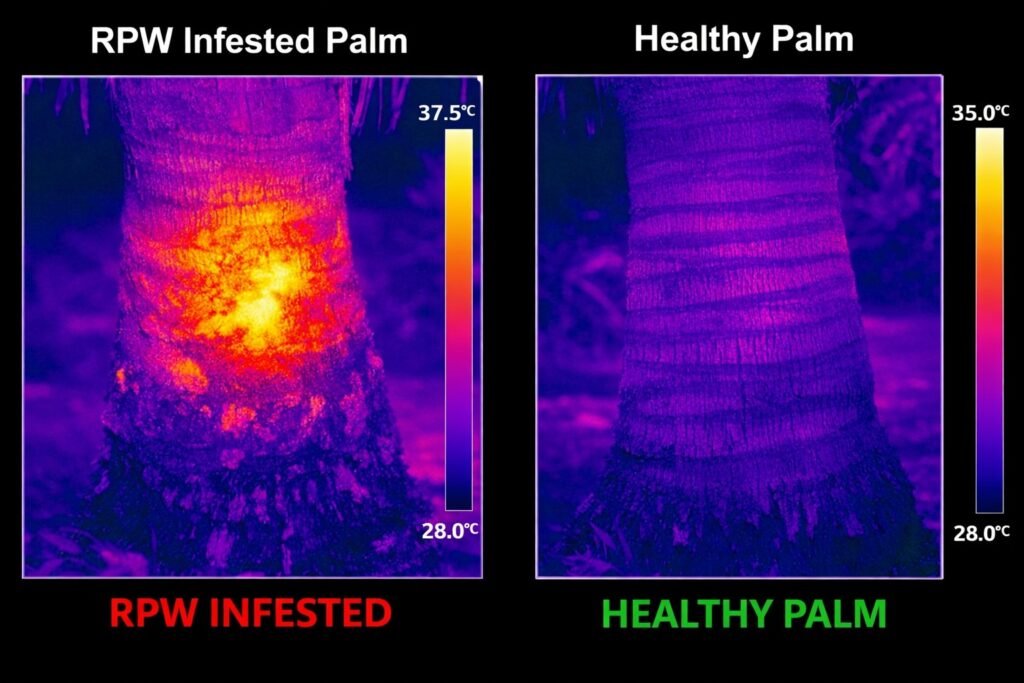
How can AI and thermal cameras help farmers detect hidden pest infestations before serious crop damage occurs?
AI and thermal cameras can help farmers detect hidden pest infestations by identifying subtle heat changes in plants before visible damage appears. In the case of Red Palm Weevil (RPW), the larvae feed inside palm trunks, making early infestation difficult to detect through visual inspection. However, their internal activity generates abnormal heat patterns on the trunk surface. In this system, a low-cost setup using a Raspberry Pi and a long-wave infrared (LWIR) thermal camera captures thermal images of palm trees under real field conditions. These images are preprocessed to reduce the effects of sunlight and wind, ensuring accurate temperature normalization. A deep learning Convolutional Neural Network (CNN), trained on 6,000 labeled thermal images (healthy and infested), learns to recognize specific heat signatures and texture patterns associated with infestation. The trained model runs directly on the Raspberry Pi, enabling real-time, on-site detection without the need for complex infrastructure. Through an IoT-enabled web interface, farmers and agricultural officers can access results easily and make timely decisions. By combining thermal imaging, AI-based classification, and IoT deployment, this approach provides a low-cost, non-invasive, and scalable solution for early pest detection, reducing crop loss, minimizing pesticide overuse, and supporting sustainable agriculture.
How does your AI-based thermal imaging system work?
Our AI-based thermal imaging system detects early Red Palm Weevil (RPW) infestations by identifying subtle temperature changes on palm tree trunks. Since the larvae feed inside the trunk, visible symptoms appear only at advanced stages. However, their metabolic activity produces slight heat variations that can be captured using a long-wave infrared (LWIR) thermal camera under real field conditions.
The captured thermal images are first preprocessed through resizing, enhancement, and ambient temperature normalization to reduce the effects of sunlight and wind. The system then extracts important thermal texture patterns and hotspot features associated with internal infestation. A Convolutional Neural Network (CNN) is trained on a large dataset of healthy and infested palm images, enabling it to accurately distinguish between normal and abnormal heat signatures.
The trained AI model runs directly on a Raspberry Pi, allowing real-time, on-device classification with minimal delay. Through IoT integration, the results can be accessed via a web-based interface, enabling farmers and agricultural officers to monitor plantations continuously and make timely management decisions.
Why is early pest detection crucial for farmers and food security?
Early pest detection is essential because it allows farmers to act before infestations cause irreversible crop damage and major economic losses. Many pests, such as the Red Palm Weevil, remain hidden during the early stages of infestation, silently reducing plant health and productivity. Detecting them early helps protect crop yield and prevents severe production losses. Timely identification also reduces farmers’ financial burden by preventing large-scale crop failure and minimizing income loss. When infestations are detected at an early stage, targeted treatment can be applied, which helps prevent pests from spreading across large agricultural areas. Moreover, early detection reduces the overuse of pesticides by enabling precise and localized intervention rather than blanket chemical spraying. This supports sustainable agricultural practices, protects environmental health, and ensures safer food production. In essence, early pest detection safeguards crops, stabilizes farmer livelihoods, controls pest outbreaks efficiently, reduces chemical dependence, and strengthens long-term food security for communities.
How can this technology be applied in real-world farming conditions?
This AI-based thermal imaging system can function as a smart early warning tool in real farming environments, enabling the detection of hidden pest infestations such as Red Palm Weevil (RPW) before visible damage occurs. Using portable thermal cameras, farmers or field officers can capture on-site images of tree trunks under natural conditions. The embedded CNN model then performs real-time classification, distinguishing between healthy and infested trees within seconds.
Through IoT integration, the system allows continuous farm surveillance and remote monitoring via a user-friendly interface. This enables timely decision-making and targeted pest control, reducing unnecessary pesticide application and preventing large-scale spread. The technology can be scaled across various plantation systems, including coconut, oil palm, sago palm, and date palm farms, as well as large agricultural estates.
In the future, integration with drone-based thermal imaging could further enhance large-area monitoring and precision agriculture practices. Overall, this technology provides a non-invasive, rapid, cost-effective, and scalable solution that supports early pest detection, minimizes crop loss, and strengthens farm management under real-world conditions.
How can similar approaches be extended to other crops and pests?
AI-based thermal imaging can be extended to other crops because pest and disease attacks often cause hidden physiological stress that leads to measurable temperature changes before visible symptoms appear. These stress signals show up as thermal hotspots, enabling early detection. The same AI pipeline can be adapted by training crop-specific models using new thermal datasets. This approach can be applied to crops such as rice, wheat, tomato, banana, sugarcane, and grapes, as different pests create distinct thermal patterns.
By building crop-specific and potentially multi-modal AI systems, this technology can support early detection, reduce crop loss, and promote sustainable agriculture across diverse farming systems.