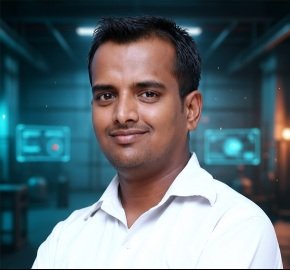
From your experience spanning Sweden, Germany, NASA JPL, and now IIT Jodhpur, how do you see optical diagnostics shaping the next decade of clean energy and biomedical technologies?
I spent over 12 years abroad working at world-leading institutes and learning from pioneers in photonics and ultrafast science. During that time, I stayed connected with India through collaborations with IIT Indore and IIT Kanpur, which ultimately drew me back. My experience showed me that optical diagnostics are no longer just tools for observation they are becoming drivers of transformation. Light-based technologies can probe energy conversion, reveal quantum behavior, and improve biomedical imaging with remarkable precision. In the coming decade, optical diagnostics will reshape industries from cleaner combustion and smart energy systems to early, non-invasive disease detection. My goal is to use precision optical science to advance sustainable energy, personalized healthcare, and a data-driven future.
Could you tell us about your current research focus at IIT Jodhpur and its impact?
At IIT Jodhpur, I’m building a team of young researchers working to bridge fundamental science with real-world benefits. We use the power of light to create sustainable technologies covering laser diagnostics for engines, fuel and solar cells, ultrafast light–matter studies, space optics, quantum technologies, biomedical imaging, and AI-enabled photonics. My long-term goal is to develop the world’s fastest cameras and microscopes in India to study light-induced chemical reactions, biological systems, and quantum materials. We aim to make affordable, non-invasive diagnostic tools and cleaner energy solutions for a greener and healthier future.
Laser diagnostics have evolved rapidly. What do you think will be the next big leap after LS-CUP and CUP2AI?
LS-CUP and CUP2AI imaging technologies I co-invented with colleagues at Caltech and NASA-JPL represent a new era in ultrafast imaging. LS-CUP captures soot formation that affects air quality and climate, while CUP2AI records molecular dynamics at tens of billions of frames per second. The next big leap will merge ultrafast timing with super-resolved spatial imaging, enabling real-time visualization of atomic and molecular events. This will help us study hydrogen combustion for clean energy and biomarkers linked to cancer and neurological disorders. By pushing the limits of light, we open new paths for sustainable energy and precision medicine.
What optical technologies will most influence India’s innovation by 2035?
By 2035, light-based technologies will drive growth in healthcare, defense, and energy. Quantum photonics, ultrafast laser diagnostics, and compact optical sensors will merge with AI and nanotechnology, moving us from measuring with light to engineering with light building industries that are faster, cleaner, and smarter.
What advice would you give young Indian researchers aiming for global excellence in optics and photonics?
Master the fundamentals, then question them boldly. Collaborate across disciplines innovation often happens where fields meet. Don’t chase publications; focus on impact. Choose problems worth solving and work with people driven by curiosity and courage. Global excellence doesn’t mean leaving India it means bringing world-class ideas here and building meaningful solutions.
What skills and mindsets will be vital for Ph.D. students entering interdisciplinary fields like photonics, AI, and quantum science?
I grew up in a small village with limited resources but unlimited curiosity. That taught me adaptability and courage to learn from every opportunity. Today, curiosity and adaptability matter more than ever. In fast-evolving fields like photonics, AI, and quantum science, researchers must think beyond equations learn to code, communicate, and collaborate. Most importantly, embrace uncertainty. True innovation comes from exploring the unknown and daring to find answers. Growth begins with asking difficult questions.