
When Indigo Inspired Innovation: Creating the Future of Sulfur-Based Dyes

Published on
April 25, 2026

Department of Chemistry, Indian Institute of Technology Madras, Chennai, Tamil Nadu, India

Areas of Expertise
Organic Synthesis, Sustainable Catalysis, Homogeneous Catalysis, Metal Nanocatalysis, Halogen-Bonding Catalysis

For centuries, indigo has been known as the dye of deep blue beauty, coloring fabrics, art, and history itself. But in our laboratory, indigo inspired something beyond color: a new way to create its sulfur-rich chemical cousins in a cleaner and greener way. Thioaurones and thioindirubins, structurally close relatives of indigo dyes, are prized not only for their vivid chemistry but also for their potential in medicines, smart materials, and advanced technologies, yet making them has long been troublesome. Traditional methods often involve unpleasant sulfur smells, expensive chemicals, and harsh reaction conditions, making large-scale production difficult and inefficient.
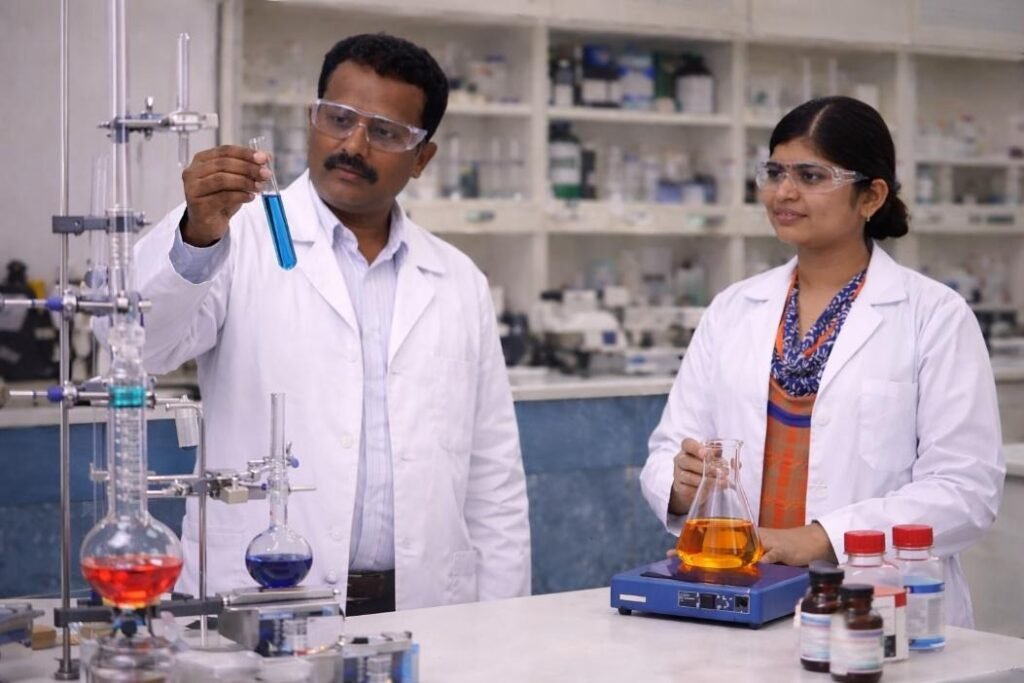
What changed the story was a simple idea: replacing foul-smelling sulfur reagents with an odorless alternative, potassium ethyl xanthate, a stable and easy-to-handle sulfur source (as sulfur surrogate) that became the heart of our patented invention. With the help of a copper catalyst and iodine, we found a way to transform simple starting materials into valuable sulfur-based dye molecules in one smooth step under open-air conditions.

By replacing unpleasant sulfur source with an odorless alternativ, this process makes sulfur chemistry safer and more practical for both laboratories and industry. What once required complicated multi-step procedures can now be done in a simpler, cleaner process that reduces waste and improves efficiency.

For the first time, the copper catalyst and xanthate have been combined to synthesise both thioaurones and thioindirubins through a unified strategy. More than a laboratory success, it is a step toward sustainable chemistry, where innovation protects both efficiency and the environment. From the ancient legacy of indigo to the future of green molecular design, this work gives new meaning to a timeless color story.


References

Cu-catalyzed practical domino synthesis of thioaurone and thioindirubin from commercially available starting materials using odorless xanthate as a sulfur surrogate, Indian Patent No: 402159.

Science Factors.

Plastic Recycling: A lost cause or a reversible healing in the development

0
Plastics are deeply woven into modern life. From packaging and healthcare to transportation and construction, they offer a unique combination of durability, light weight,...

Sustainable Piezocatalyst for Clean and Green Hydrogen Production

0
The world is currently facing a severe energy crisis driven by the excessive and rapid consumption and depletion of non-renewable fossil resources and the...

A Solar-Enabled Charging System for Mobile Phones: Toward a Self-Sustaining Future

0
Mobile phones have become an essential part of modern life. From communication and education to healthcare, navigation, and financial transactions, smartphones play a central...

Targeting Inflammation at Its Core: A Novel Potent IKKβ Inhibitor for Chronic Inflammatory Diseases

0
Chronic inflammatory diseases (CIDs) have emerged as one of the most pressing global health challenges of our time. Responsible for nearly 41 million deaths...

A Biosensor for Detection of Dopamine

0
Scientific inventions in biosensing are important in enhancing early detection and monitoring of diseases. Dopamine is a neurotransmitter, which is an important biomolecule in...

Closing the Loop: Converting Municipal Solid Waste into Functional Soil Amendments

0
Modern societies are confronting a paradox at the intersection of waste management, agricultural and environmental sustainability. While agricultural productivity must increase to support a...

From Dots to Decisions: Transforming Point Clouds to Meaningful Insights

0
Across the globe, the natural and man-made infrastructure systems are becoming more interconnected and complex, leading to a greater need for analysis-ready spatial data...