
Modern societies are confronting a paradox at the intersection of waste management, agricultural and environmental sustainability. While agricultural productivity must increase to support a growing global population, enormous quantities of food are simultaneously discarded as municipal solid waste (MSW). According to global estimates, food waste accounts for a significant share of MSW streams, contributing to greenhouse gas emissions, landfill overburden, and resource inefficiency. At the same time, agricultural soils are progressively losing organic carbon, nutrient balance, and moisture-retention capacity due to intensive farming practices and excessive reliance on synthetic fertilizers. These parallel challenges highlight the urgent need for technologies that move beyond waste disposal toward resource recovery and circular utilization.
Scientific attention has therefore shifted toward thermochemical conversion processes capable of transforming organic residues into functional materials with agricultural and environmental value. Among these approaches, biochar production has emerged as a promising strategy because it simultaneously enables waste valorisation, soil restoration, and long-term carbon sequestration. However, conventional biochar production methods often require homogeneous feedstocks, prolonged heating durations, and energy-intensive operations, limiting scalability under real MSW conditions. Addressing these limitations requires innovations that combine process efficiency, feedstock flexibility, and engineered functionality of the final material.
In this context, our patented technology produces nutrient-rich biochar from commingled food waste termed as FertoChar, via co-activation and microwave-assisted co-pyrolysis (MACP) — a rapid, energy-efficient alternative to conventional pyrolysis. Unlike traditional waste-processing methods that rely on prolonged external heating, microwave-assisted systems generate volumetric heating, enabling faster reaction kinetics and uniform thermal conversion.
Designed specifically for real-world MSW conditions, the process accepts commingled food waste typical of the Indian waste stream, including rice, pulses, breads/rotis, and fruit and vegetable peels. Notably, the technology tolerates the presence of low-density polyethylene (LDPE), eliminating the need for labour-intensive segregation. Microwave susceptors, such as granular activated carbon, silicon carbide, or zirconium–silica alloy, enhance energy absorption, enabling efficient conversion at controlled microwave power (600–900 W) over short processing time of 10 – 30 minutes.
Ferto-CHAR is not merely a carbon residue but a functional soil-engineering material. Characterized by near-neutral pH (~6.5) and porous structure spanning 0.5–50 µm, FertoCHAR acts as a micro-reservoir for water and nutrients. With water absorbance exceeding 41% and augmented bulk density (~0.48 g/cm³), FertoCHAR significantly improves soil physical properties. Experimental validation demonstrates that adding approximately 8 wt% FertoCHAR enhances soil water-holding capacity by nearly 62.5%, a critical advantage for water-stressed agricultural regions.
The nutrient delivery characteristics of the FertoCHAR were further examined through controlled modification using urea intercalation, enabling its application as a controlled-release fertilizer. The modification increases nitrogen content while largely preserving the inherent pore structure, enabling gradual nitrate release over extended periods. Nitrogen release behaviour from the modified FertoCHAR approaches levels observed in conventional fertilizers, indicating its suitability as an alternative nutrient source under controlled conditions. Phosphorus release performance remains comparable to that of conventional diammonium phosphate (DAP), achieving similar equilibrium availability. Together, these release characteristics suggest that FertoCHAR can support balanced nutrient supply while potentially improving nutrient retention within soil systems. From a carbon management perspective, FertoCHAR exhibits an oxygen-to-carbon ratio (~0.31), indicative of high aromatic stability and corresponding to an environmental persistence of 100–1000 years. Such longevity allows the material to function as a carbon sink, linking agricultural productivity with climate mitigation. Biological assessments further confirm negligible phytotoxicity, with germination indices approaching 93%, demonstrating compatibility with plant growth systems.
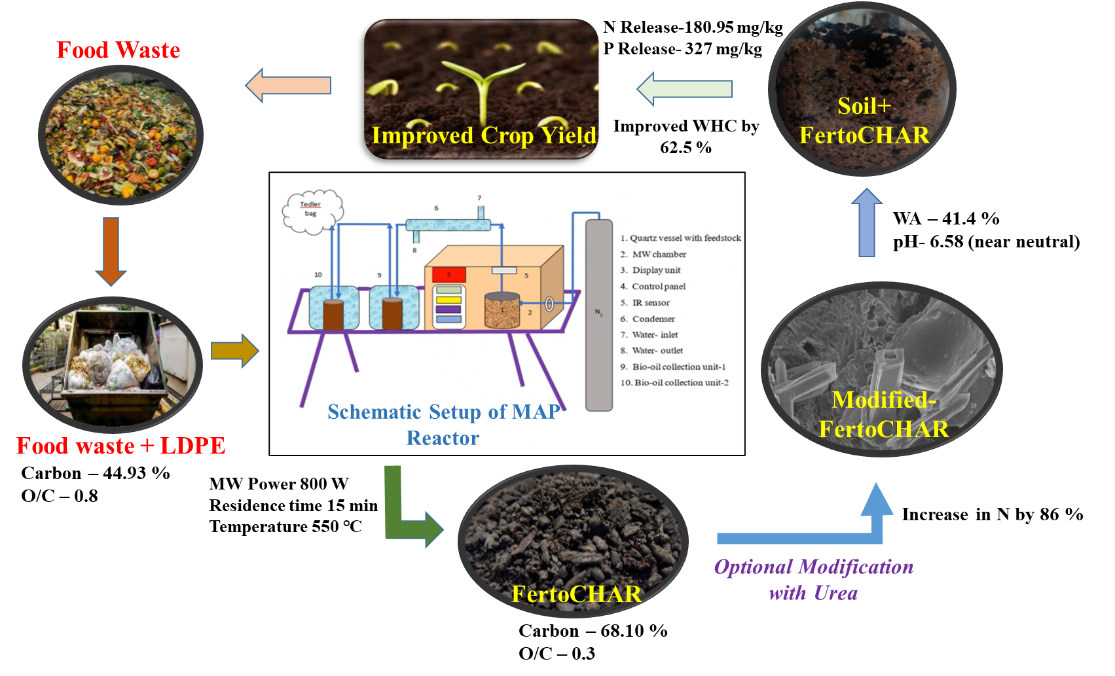
Beyond material innovation, this approach highlights a systems-level model that transforms MSW streams into resources for regenerative agriculture. By combining microwave engineering, material science, and nutrient management, this invention redefines commingled food waste as a resource capable of restoring soil health, improving fertilizer efficiency, and contributing to long-term carbon sustainability. This patented process integrates waste conversion and resource recovery within a compact microwave-based pyrolytic system that produces FertoCHAR alongside bio-oil and syngas streams. This multi-product valorisation enhances overall process efficiency and supports decentralized waste management models aligned with circular economy principles.
In an era demanding climate-resilient agriculture and sustainable resource cycles, such innovations signal a transition from waste disposal toward waste-driven soil regeneration — turning yesterday’s leftovers into tomorrow’s productiveness.