
Mobile phones have become an essential part of modern life. From communication and education to healthcare, navigation, and financial transactions, smartphones play a central role in everyday activities. However, one persistent challenge remains battery life. Despite rapid advancements in mobile technology, users still depend heavily on frequent charging, which can be inconvenient and limiting. This issue becomes more critical in situations where access to electricity is limited, such as during travel, outdoor activities, or emergency conditions. Additionally, increasing energy consumption contributes to environmental concerns, including higher carbon emissions. These challenges highlight the need for innovative, sustainable, and self-sufficient energy solutions in mobile devices.
To address this challenge, we have developed a novel system that integrates renewable energy generation directly into mobile devices. This innovation combines three key components: a transparent solar-enabled glass film on the mobile screen, a solar-enabled fiber-based material forming the phone’s structure, and an internal power management system. Together, these elements allow the device to generate electrical energy from two complementary sources solar energy from sunlight (external source) and heat and radiation produced during device operation (internal source). This dual-source energy approach enhances overall efficiency and reliability compared to conventional single-source systems, offering a promising pathway toward self-sustaining mobile technologies.
The working principle of the system is based on dual energy harvesting. The outer surface of the mobile phone, including the screen and body, is integrated with embedded solar cells that capture sunlight and convert it into electrical energy. Simultaneously, the inner side of the glass film and fiber-based body harnesses heat and radiation generated during regular phone usage. These two energy sources are then processed through an internal power management system comprising rectification circuits, voltage regulators, and charge controllers. This system ensures that the harvested energy is converted into a stable and usable form, enabling safe and efficient charging of the device’s battery. Through this continuous process, the phone can generate and utilize energy during normal operation and sunlight exposure, thereby reducing dependence on conventional external charging methods.
This system stands out due to its integrated and hybrid approach to energy generation. Unlike conventional solar chargers or power banks that rely solely on external sunlight, this innovation utilizes both external solar energy and internally generated heat, effectively converting waste heat into useful electrical energy. The energy-harvesting mechanism is seamlessly integrated across the entire body of the device, enabling continuous operation without the need for additional accessories. By combining principles from solar energy engineering, thermoelectric energy conversion, and smart power management systems, this technology represents a compact and efficient hybrid renewable energy solution embedded directly within the mobile device. To evaluate the feasibility of this system, a typical smartphone screen size of 15 cm × 7 cm was considered. Under average outdoor sunlight conditions, with approximately six hours of exposure, the system can generate around 1.7 to 3.5 watt-hours (Wh) of electrical energy. This output corresponds to approximately 9% to 18% of a standard 5000 mAh smartphone battery capacity. In practical terms, this additional energy can extend mobile usage by up to two hours under light usage conditions and approximately 40 to 85 minutes under normal usage. Even under indoor conditions, although the energy generated is lower, it remains useful for trickle charging, helping to slow down battery discharge when the device is not in heavy use. While this system may not fully replace conventional charging methods, it can significantly reduce charging frequency and enhance overall battery efficiency.
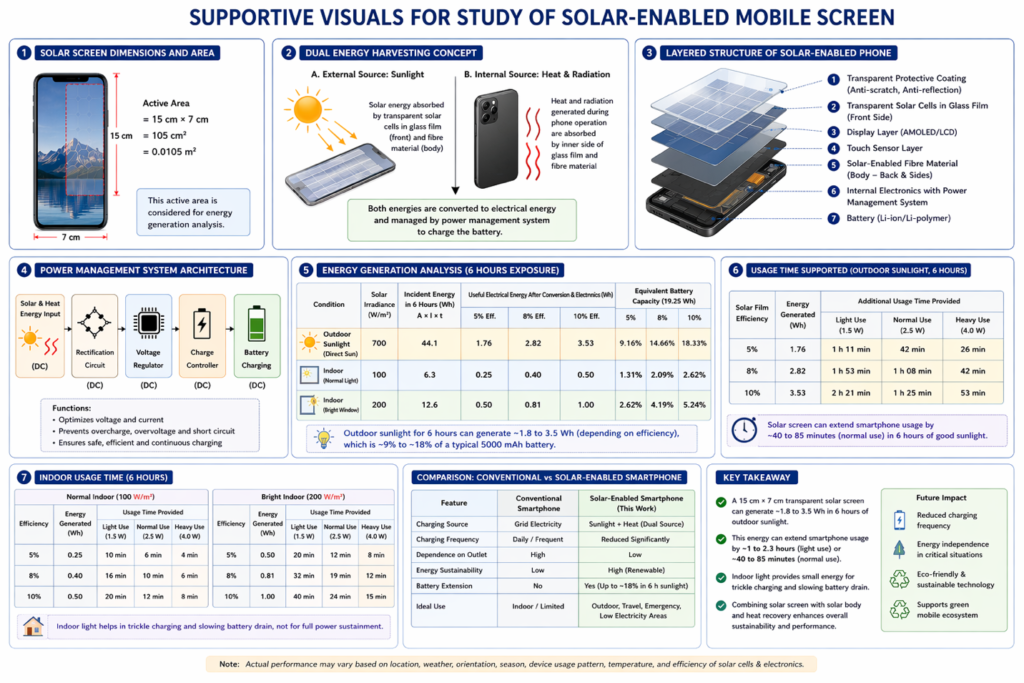
The solar-enabled charging system offers several practical benefits, making it a promising solution for modern mobile technology. By reducing dependence on conventional charging sources, users can rely less on electrical outlets, particularly during daytime use. The system also promotes environmental sustainability by utilizing renewable energy, thereby lowering reliance on grid electricity and reducing carbon emissions. Continuous energy generation helps maintain battery levels, improving overall efficiency and extending battery life. Additionally, the technology proves especially useful in remote locations or emergency situations where access to electricity is limited. Over time, reduced electricity usage can also contribute to cost savings.
From an engineering perspective, this system represents a significant step toward self-sustaining mobile devices. While the current energy output provides supplementary support, future advancements in transparent solar cell efficiency, thermoelectric energy conversion, and smart power management systems have the potential to enhance performance further. Expanding energy-harvesting surfaces, such as integrating solar and thermal elements into the back panel or edges of the device, could also increase overall energy generation capacity. In conclusion, this solar-enabled charging system introduces an innovative hybrid energy-harvesting approach that addresses the persistent challenge of battery dependency in smartphones. By combining solar energy with heat recovery, it enhances battery performance, reduces charging frequency, and supports sustainable energy use. Although it does not entirely replace traditional charging methods, it marks an important step toward the development of self-sustaining, energy-efficient mobile devices, contributing to a greener and more connected future.