
Plastics are deeply woven into modern life. From packaging and healthcare to transportation and construction, they offer a unique combination of durability, light weight, versatility, and cost-effectiveness. In many cases, plastics even reduce overall energy consumption and greenhouse gas emissions compared to traditional materials like glass or metals. Yet, this very durability has created one of the most pressing environmental challenges of our time. Today, more than 430 million tons of plastic are produced annually, and nearly two-thirds of this becomes waste after a single use. If current trends continue, global plastic waste is expected to nearly triple by 2060, posing serious threats to ecosystems, wildlife, and human health.
Completely eliminating plastics is neither practical nor desirable given their societal benefits. Instead, the focus is shifting toward designing smarter, more sustainable materials, plastics that can be reused, repaired, and recycled efficiently. One promising approach is “benign-by-design,” where materials are engineered from the beginning to minimize environmental impact
A key concept driving this innovation is dynamic covalent chemistry. Unlike conventional brittle plastics, which are permanently set once formed, materials based on dynamic bonds can break and reform under specific conditions. This allows them to be reshaped, repaired, and recycled without losing performance, effectively extending their lifecycle and reducing waste.
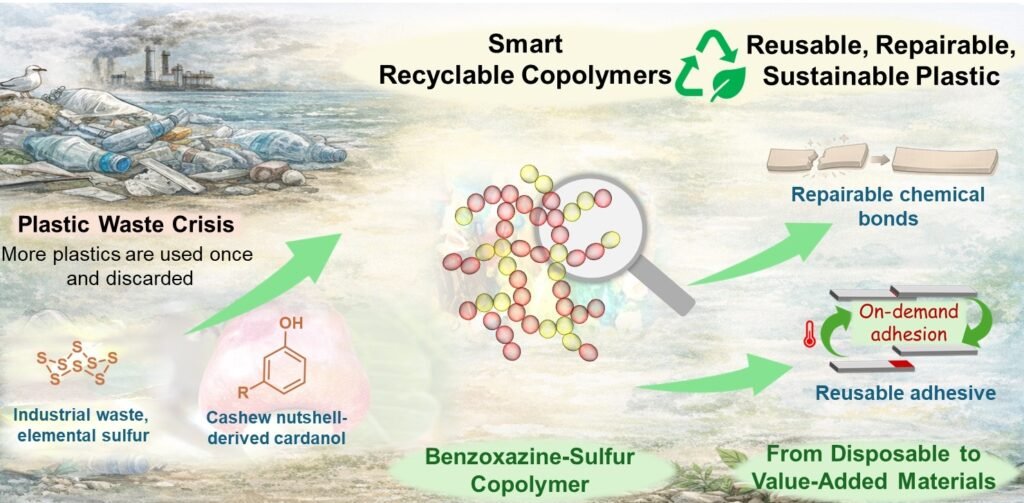
The use of biobased and underutilized waste resources is another critical component of this transition. In this context, cardanol, derived from cashew nutshell liquid (CNSL), offers a sustainable alternative to petroleum-based chemicals. It is a non-edible industrial byproduct generated in large quantities during cashew processing. Cardanol possesses a phenolic structure with a long aliphatic chain, making it highly suitable for polymer synthesis, especially in thermosetting systems like polybenzoxazines. In parallel, elemental sulfur, an abundant byproduct of petroleum refining and natural gas processing, represents another valuable yet underutilized resource. Millions of tons of sulfur are produced annually, often exceeding industrial demand, resulting in large stockpiles. Incorporating sulfur into polymer networks not only provides functional advantages but also helps transform industrial waste into a useful material. The patented work builds on the idea of developing a benzoxazine-sulfur copolymer synthesized from renewable feedstocks, such as cardanol and cystamine, and waste-derived sulfur. The resulting polymers exhibit dynamic sulfide linkages, enabling recyclability and reprocessability, allowing them to be reshaped and reused, as well as self-healing behavior, where damage can be repaired. The copolymer also demonstrates shape recovery and can function as a debondable adhesive (on-demand glue), enabling easy disassembly in applications where reuse or repair is desired. Such a material design is particularly valuable in advancing a circular materials economy, where commodities are designed to remain in use for as long as possible and then recovered and reused efficiently.
This work demonstrates that plastic sustainability is not a lost cause. By rethinking materials at the molecular level and integrating renewable resources with waste utilization, plastics can transition from a linear “use-and-dispose” model to a circular system. In this sense, recycling becomes more than waste management, it becomes a reversible healing process for both material and the environment.
Funding
This work was supported by the Shiv Nadar Foundation (SNF), India.