What inspired you to investigate how water interacts with small molecules found in interstellar space?
If asked about the importance of water, almost anyone can write a thesis, as water is the very foundation of life. If the responder has a background in chemistry, the importance of water as a solvent would also be highlighted. We know water can dissolve many polar molecules and even several non-polar molecules under suitable conditions.
The mechanism of dissolution is fascinating. A polar solute is surrounded by water molecules that form a primary hydration shell, where the water molecules orient themselves according to the charges of the solute. This shell is stabilized by hydrogen bonds between the water molecules themselves. Beyond this lies a secondary hydration shell, which is more flexible because its water molecules interact mainly with each other rather than directly with the solute.
When the solute is very small, fewer water molecules are needed to build these hydration shells. This naturally leads us to ask how such tiny hydrated systems behave, particularly under the extreme conditions of interstellar space.
Why are these molecules important for understanding the chemistry of the universe and the origins of life?
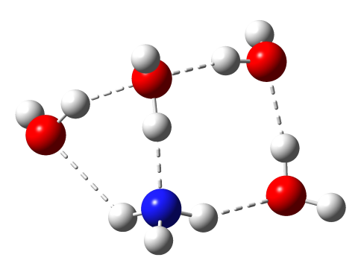
Instead of bulk solvation, we study the solvation of individual molecules, a process known as micro-solvation. Here, a finite number of water molecules surround a single solute to form molecular clusters.
These clusters become especially important in interstellar space, where temperatures are around 10 K and water cannot exist as a liquid. Instead, water molecules accumulate around small molecules frozen onto dust grains, creating hydrated clusters.
Scientists recreate these conditions in the laboratory by depositing molecules such as ammonia and carbon monoxide onto cold dust grains inside ultra-high vacuum chambers. Surprisingly, these experiments have shown that complex molecules—including sugars and peptides, the building blocks of proteins—can form under such conditions. This raises exciting possibilities that some of the ingredients necessary for life may have existed long before planets formed and may have been delivered to young planets by comets and meteorites.
In simple terms, what are non-covalent interactions, and how do they help molecules stick together in space?
The chemical forces responsible for forming these clusters are called non-covalent interactions, with hydrogen bonding being one of the most important examples. These are relatively weak attractive forces that hold molecules together without forming permanent chemical bonds.
Although individual non-covalent interactions are weak, collectively they stabilize molecular clusters. In the cold environment of space, when reactive molecules collide, they lack sufficient thermal energy to separate again. Instead, they remain attached through these interactions, allowing chemical reactions to proceed.
What were the most surprising discoveries about the hydrogen bonds formed in these hydrated molecular clusters?
When we studied the formation of these clusters, we found that the processes are both exothermic and spontaneous. Even more surprisingly, they are driven by a positive change in entropy, which is contrary to the usual expectation that association processes decrease entropy.
This occurs because two opposing effects determine the entropy change. While clustering reduces molecular flexibility, it also greatly increases the number of possible energy arrangements, known as microstates. In these systems, the increase in microstates outweighs the loss of flexibility.
Your study found that some hydrogen bonds have partial covalent character. Why is this finding important?
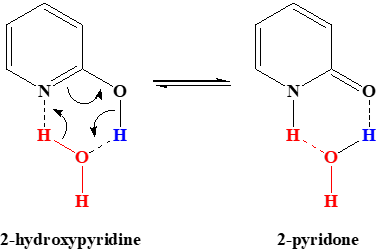
Hydrogen bonding does more than simply hold molecules together. It can also promote chemical reactions through proton transfer.
Normally, isolated molecules require energy to switch between different tautomeric forms. However, when surrounded by water molecules, proton transfer can occur with an extremely small energy barrier. As a result, stable molecules can be converted into highly reactive forms even at temperatures close to absolute zero. This provides a mechanism by which complex chemistry can occur in deep space despite the lack of thermal energy.
How does water influence the stability and behavior of molecules in the interstellar medium?
Water stabilizes molecular clusters through hydrogen bonding and other non-covalent interactions. These interactions make cluster formation energetically favorable and help molecules remain associated long enough for chemical reactions to occur.
In this way, water acts not only as a passive environment but also as an active participant that influences molecular stability, promotes proton transfer, and enables reactions that would otherwise be impossible under interstellar conditions.
What are the next major questions you hope to answer about molecular interactions and chemistry in deep space?
One of the most exciting implications of this work is the possibility that the building blocks of life formed in dark molecular clouds before stars and planets existed. If meteorites and comets transported these molecules to young planets such as the early Earth, they may have contributed to the origin of life.
Future research aims to understand these molecular interactions in even greater detail, identify additional reaction pathways, and determine how widespread such chemistry may be throughout the universe. If these mechanisms are common, the probability of life emerging on habitable planets beyond Earth could be much higher than previously thought.