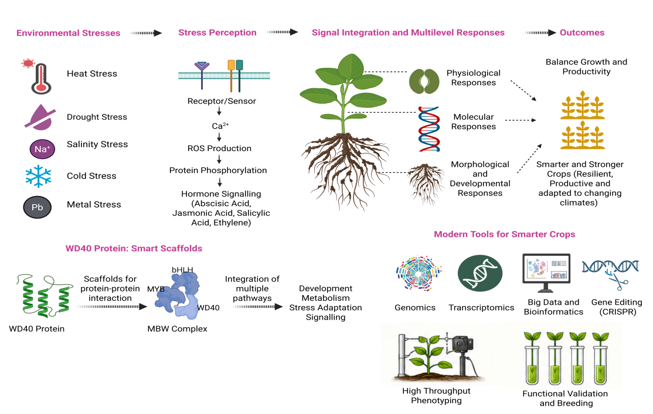
Plants cannot move away from heat, drought or salty soil. How do they protect themselves when conditions become difficult?
Plants are remarkably adaptable organisms. Unlike animals, they cannot move to a more favorable environment when drought, heat, salinity or other stresses occur. Instead, they must sense the changing conditions and rapidly adjust their physiology, metabolism and growth. One of the first responses is to control water balance. During drought, plants reduce water loss by closing microscopic pores on their leaves, called stomata. They can also increase the production of protective molecules such as osmolytes, antioxidants and stress-related proteins. These molecules help maintain cellular water balance and protect proteins, membranes and other cellular components from damage. At the same time, plants modify their root systems to explore available water more efficiently and alter their metabolism to conserve energy. They also activate sophisticated molecular defense systems that regulate gene expression and cellular signaling. So, plant stress tolerance is not regulated by a single gene or protein mechanism. It is a coordinated response involving stress perception, signaling, gene regulation, metabolism, growth adjustment and cellular protection.
What happens inside a plant when it first senses environmental stress?
The first step is stress perception. A plant cell continuously monitors its surroundings, including water availability, temperature, salt concentration and changes in cellular conditions.When an environmental disturbance occurs, it triggers rapid changes inside the cell. These may include alterations in calcium levels, production of reactive oxygen species (ROS), changes in protein phosphorylation and activation of hormone signaling pathways. Plant hormones such as abscisic acid (ABA), jasmonic acid (JA), salicylic acid (SA) and ethylene can participate in coordinating these responses, depending on the type and severity of stress.These early signals eventually reach the nucleus and influence transcription factors and other regulatory proteins. As a result, specific stress-responsive genes are activated or repressed. What makes this system particularly fascinating is that plants do not simply respond passively. They continuously integrate different signals and adjust their responses according to the intensity and duration of the stress.
Why can protecting itself from stress sometimes come at the cost of plant growth and crop yield?
A plant has limited resources. Energy and carbon that could be used to produce new leaves, roots, flowers and seeds may instead be redirected toward survival.For example, under severe drought, plants may close their stomata to reduce water loss. This protects the plant, but it also restricts carbon dioxide entry into the leaves and can reduce photosynthesis. Similarly, plants may invest energy in producing antioxidants, osmoprotectants, protective proteins and other stress-response molecules rather than biomass.This creates an important biological trade-off: Survival and growth are often competing priorities. A highly stress-responsive plant may survive a difficult environment but produce less biomass or fewer seeds. Conversely, a rapidly growing plant may perform extremely well under favorable conditions but become vulnerable when environmental conditions deteriorate.Therefore, one of the major goals of modern plant science is not simply to make plants “stress resistant.” It is to develop plants that can balance stress protection with continued growth and productivity.
Your recent work discusses WD40 proteins. In simple terms, what are these proteins, and why are they important for plants?
WD40 proteins can be thought of as molecular platforms or scaffolds inside cells. The name comes from the presence of characteristic WD repeats, which often contain tryptophan (W) and aspartic acid (D). Rather than acting like a single-purpose enzyme, many WD40 proteins help bring other proteins together. They can therefore participate in protein–protein interactions and help organize molecular complexes involved in diverse cellular processes. In plants, WD40 proteins are associated with processes including development, hormone responses, transcriptional regulation, protein modification, metabolism and responses to environmental stresses. Their importance comes from their ability to act as molecular coordinators. A WD40 protein can help connect different regulatory components, allowing a plant cell to integrate information from several signaling pathways.
This makes WD40 proteins particularly interesting when we think about environmental stress. Plants must coordinate their stress responses with growth and development, and molecular scaffolds such as WD40 proteins can contribute to this complex regulatory network.
Can understanding how plants naturally respond to stress help us develop crops that survive drought, heat and salinity better?
Absolutely. Nature has already provided plants with an enormous toolbox for coping with environmental challenges. Different plant species, and even different varieties of the same crop, can possess different levels of stress tolerance. By understanding the molecular mechanisms behind these natural differences, researchers can identify genes, proteins and regulatory pathways associated with improved resilience.For example, we can investigate how tolerant plants regulate water use, root development, antioxidant defense, osmotic adjustment and stress-responsive gene expression. The next step is to determine which mechanisms can be translated into crop improvement without causing undesirable effects on growth or yield. This is especially important because stress tolerance is usually a complex trait controlled by many genes and interacting pathways, rather than by one “stress-resistance gene.” The ultimate goal is therefore to understand the regulatory networks that allow plants to remain productive under stress, rather than simply allowing them to survive.
How are modern tools such as gene editing and genomics helping scientists develop stronger and more resilient crops?
Modern genomics has transformed the way we study plant stress responses. Genome sequencing, transcriptomics, proteomics and other “omics” approaches allow scientists to examine thousands of genes and molecular changes simultaneously. These approaches can reveal which genes become activated when plants experience drought, heat or salinity and can help identify naturally occurring genetic variation associated with stress tolerance.Gene-editing technologies, particularly CRISPR-based approaches, provide another powerful opportunity. Once an important regulatory gene or pathway has been identified, researchers can precisely modify it and test whether the change improves plant performance under stress.However, the objective should not simply be to switch stress-response genes permanently on. That could impose a substantial energy cost on the plant. A more promising strategy is to understand when, where and how strongly a stress response should be activated. In this way, future crop improvement could focus on fine-tuning regulatory networks so that plants respond rapidly when stress occurs but maintain normal growth when conditions are favorable.
As climate change creates new challenges for agriculture, what developments in plant science give you the most hope for protecting future food production?
What gives me the most hope is the growing ability to connect fundamental plant biology with practical crop improvement. We are moving from simply identifying stress-responsive genes toward understanding complex molecular networks that coordinate growth, development and environmental adaptation. The integration of genomics, gene editing, computational biology, high-throughput phenotyping and advanced molecular biology will allow us to examine plant responses at unprecedented resolution.
I am particularly optimistic about approaches that combine natural genetic diversity with modern molecular technologies. Instead of looking for a single universal solution to drought or heat stress, we can identify mechanisms that are naturally successful in different environments and use that knowledge to develop crops suited to changing climates. The future of crop resilience will likely depend on precision rather than simply stronger stress responses-developing plants that can sense environmental changes, adjust their physiology efficiently, protect themselves when necessary, and return to normal growth when conditions improve. Climate change presents an enormous challenge, but plants have already evolved sophisticated mechanisms for surviving environmental stress over millions of years. Our task as plant scientists is to understand these mechanisms and translate that knowledge into sustainable agricultural solutions. Ultimately, the science of stronger crops is not only about helping plants survive. It is about helping them remain productive, efficient and resilient in an increasingly unpredictable environment.