What is leptospirosis, how is it transmitted, and why is it an important public health concern?
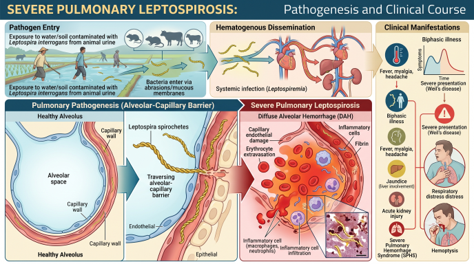
Leptospirosis is a bacterial infection caused by Leptospira species. The bacteria are commonly shed in the urine of infected animals, particularly rodents and livestock, and can contaminate soil and water. People become infected mainly through contact with contaminated water or wet soil, especially when the bacteria enter through cuts or abrasions in the skin or through the eyes, nose, or mouth.
Farmers and agricultural workers are particularly at risk because of frequent contact with soil, standing water, crops, and animals. Heavy rainfall and flooding can increase the risk by spreading contaminated water over a wider area. This makes working in waterlogged fields after heavy rain an important exposure to recognise.
Leptospirosis can range from a mild febrile illness to severe disease involving multiple organs. In some patients, the lungs can be severely affected, leading to pulmonary haemorrhage and life-threatening respiratory failure.
Why can leptospirosis be mistaken for ordinary pneumonia, and what clinical clues should prompt doctors to look beyond the obvious diagnosis?
Leptospirosis can initially resemble pneumonia because fever, cough, breathlessness, and lung opacities can occur in both conditions. The warning sign is often how quickly the patient deteriorates.
In our patient, the initial chest X-ray showed left lower-zone consolidation and he was treated for pneumonia. Within 24 hours, he developed severe breathlessness, profound hypoxaemia, hypotension, and bilateral pulmonary opacities. His haemoglobin and platelet counts also fell, with evidence of liver involvement. Such rapid progression should prompt clinicians to reconsider the diagnosis. A history of heavy rainfall, flooding, agricultural work, or exposure to waterlogged fields can provide an important clue. In our case, the history of working in waterlogged wheat fields after heavy rainfall helped point towards leptospirosis.
How does exposure to contaminated water increase the risk of leptospirosis, and which groups are most vulnerable?
Leptospira can contaminate water and moist soil after being shed in the urine of infected animals. Heavy rainfall and flooding can spread this contamination through standing water and waterlogged fields.
Farmers and agricultural workers are particularly vulnerable because they may have prolonged contact with wet soil and standing water. People involved in flood-related work, sewage and sanitation, and animal handling may also be at increased risk. The risk is especially relevant during and after the rainy season. In our patient, exposure to waterlogged wheat fields following heavy rainfall was an important epidemiological clue.
What happens in the lungs during leptospirosis-associated pulmonary haemorrhage, and why can it become life-threatening so quickly?
In severe leptospirosis, inflammation can damage the small blood vessels of the lungs and increase the permeability of the alveolar-capillary barrier. Blood then leaks into the air spaces, causing diffuse alveolar haemorrhage. This is thought to result mainly from an immune-mediated process rather than direct destruction of lung tissue by the bacteria. As blood fills the alveoli, oxygen exchange becomes severely impaired, leading to profound hypoxaemia and respiratory failure. The bleeding can also cause a rapid fall in haemoglobin. In our patient, the initial localized lung opacity progressed to bilateral pulmonary opacities within 24 hours, accompanied by severe hypoxaemia and falling haemoglobin and platelet counts. This rapid progression is what makes pulmonary haemorrhage such a dangerous complication.
How did early diagnosis, antibiotics, respiratory support, and corticosteroid therapy contribute to the patient’s recovery?
Early recognition allowed us to address both the infection and the rapidly developing pulmonary complication. Leptospira IgM was positive, while investigations for important mimics, including dengue, malaria, tuberculosis, and pulmonary vasculitis, were negative. The patient received antimicrobial therapy, including doxycycline initially and ceftriaxone subsequently. Because of severe hypoxaemia, he required non-invasive ventilation with BiPAP and high inspired oxygen. Once severe pulmonary haemorrhage was established, intravenous methylprednisolone was given, followed by oral prednisolone. He improved substantially within 48 hours, was weaned from ventilatory support by day 5, and showed marked radiological improvement. The steroid response was encouraging, although a single case cannot establish the effectiveness of corticosteroids for all patients.
What practical lessons does this case offer to healthcare professionals when a patient deteriorates rapidly despite treatment for presumed pneumonia?
The key lesson is to reassess the diagnosis when a patient deteriorates much faster than expected.
Clinicians should review the exposure history and look for falling haemoglobin or platelet counts, worsening oxygenation, rapidly increasing bilateral infiltrates, and evidence of other organ involvement. These findings may indicate pulmonary haemorrhage rather than uncomplicated pneumonia.A few targeted questions about occupation, recent rainfall, flooding, and contact with standing or contaminated water can provide an important diagnostic clue. At the same time, conditions such as dengue, malaria, tuberculosis, and pulmonary vasculitis should be considered when clinically appropriate.
The practical message is simple: when presumed pneumonia progresses unusually quickly, stop and reassess the diagnosis.
Looking ahead, what improvements in awareness, diagnosis, or treatment could help reduce illness and deaths from severe leptospirosis?
Greater awareness among both healthcare professionals and communities could help identify leptospirosis earlier, particularly during and after periods of heavy rainfall and flooding. Farmers and others who regularly work in wet or waterlogged environments should be made aware of the risk. For clinicians, recognising leptospirosis when a febrile illness develops severe or rapidly progressive respiratory involvement can reduce diagnostic delay. Better access to timely and reliable diagnostic testing, particularly in rural and resource-limited settings, would also be valuable. In severe pulmonary haemorrhage, early respiratory support and appropriate antimicrobial treatment are important. The potential role of corticosteroids should continue to be studied, as our patient’s response was encouraging but cannot establish treatment efficacy.At the public health level, education before and during the rainy season, together with measures that reduce exposure to contaminated water and soil, may help prevent infection and encourage earlier medical attention.