What are nanopores, and why is controlling the movement of ions through these tiny channels important in science and technology?
Nanopores are extremely tiny openings, often just a few nanometres wide, in thin membranes made from biological or synthetic materials. While conventional membranes are widely used to filter and separate substances, nanopores open up an entirely different world of possibilities. At such remarkably small dimensions, the movement of ions and molecules can be controlled in unusual and sometimes counterintuitive ways, revealing physical phenomena that are hardly noticeable at larger scales.
Understanding and harnessing these phenomena could enable technologies that once seemed futuristic. For example, nanopores and their clusters could serve as building blocks for brain-inspired computing systems that process information through the movement of ions rather than electrons, potentially offering more energy-efficient alternatives to conventional electronics which can be directly embedded in the physical and bio-physical systems. Other promising applications include harvesting electricity from saline water or wasted heat in the exhaust systems, by harnessing the differences in salt concentration or temperature across the membranes, respectively. Nanopores had also been an important pillar for developing highly sensitive biosensors capable of detecting individual DNA or protein molecules.
The exciting prospect is that nanopores could evolve from simple passages for transporting species into intelligent, controllable components of future technologies.
How do electric fields influence the movement of ions through nanopores, and what makes this process challenging to understand?
Electric fields offer a powerful way to control ions i.e., electrically charged atoms or molecules. Within nanopores, these fields not only drive ions through tiny openings but also influence their distribution and interactions with the surrounding liquid and pore walls.
Interestingly, such electrical effects occur even in everyday liquids containing dissolved salts. However, at larger scales, their influence is largely confined to extremely thin regions near surfaces. At the nanoscale, these regions become comparable to the pore dimensions, allowing previously surface-confined phenomena to govern the behaviour of the entire fluid, giving rise to unusual transport characteristics.
Understanding these phenomena presents two major challenges. First, strong electric fields and molecular interactions among ions, water and pore surfaces make their collective behaviour difficult to predict. Second, precisely fabricating nanopores and experimentally characterizing their transport behaviour requires sophisticated nanotechnology and a deep understanding of nanoscale fluid physics.

Your research suggests that even a structurally uniform nanopore can behave differently in opposite directions. What causes this unusual behaviour?
Traditionally, directional ion transport in nanopores has been achieved by introducing asymmetry through cone-shaped geometries, patterned surface charges, or different salt concentrations across the pore. Such asymmetry enables diode-like behaviour, allowing ionic current to flow more readily in one direction than the other, a property valuable for future ionic circuits.
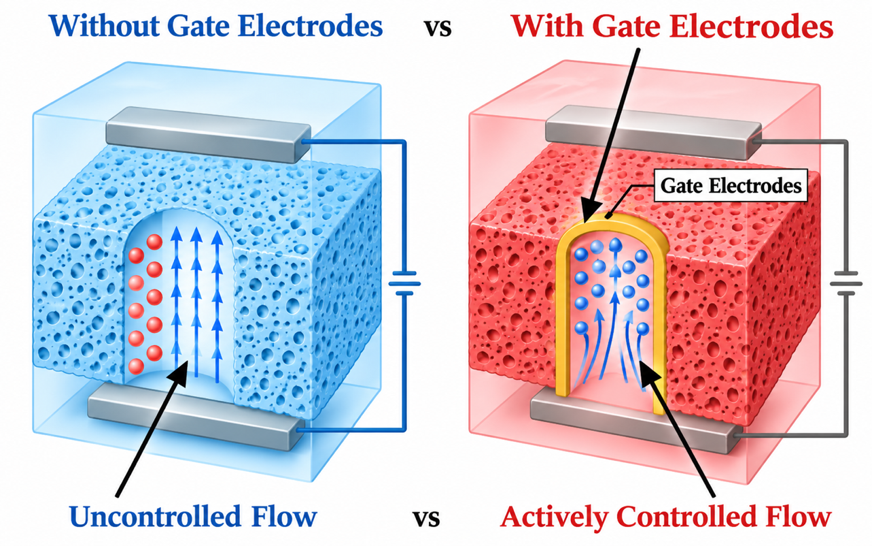
Our research explores an emerging alternative: voltage-gated nanopores, inspired by electronic transistors. An additional electrode, called a gate, surrounds the pore and controls its surface potential. While an axial electric field drives ions along the pore, the gate independently controls the electrical conditions across its width. Through mathematical modelling and simulations, we discovered that these electrical controls interact to create a nonuniform ion distribution along the pore, despite its uniform geometry and surface potential. Remarkably, adjusting the gate voltage can control directional ion transport and unusual fluid-flow patterns, opening possibilities for actively programmable nanopores.
What does it mean when a nanopore selectively allows certain ions to pass or permits electrical current to flow more easily in one direction?
The distribution of ions within a nanopore, and how they respond to an applied electric field, can become asymmetric along its length due to either the pore’s geometry or an externally controlled gate voltage. By manipulating this asymmetry, nanopores can act as extremely tiny, controllable filters, allowing certain ions to pass more readily than others. For example, a pore may favour positively charged ions over negatively charged ones. This property is known as ion selectivity. Even more interestingly, some nanopores allow electrical current to flow more easily in one direction than in the opposite direction, even when the applied voltage has the same magnitude. This phenomenon, called ionic current rectification, is similar to how an electronic diode works in conventional electrical circuits. Such behaviour in nanopores could serve as miniature ionic diodes, switches and other functional components for future technologies that process information or control molecular transport.
What were the most important findings of your study, and how do they change our understanding of ion transport at the nanoscale?
Our study revealed two important insights into how electric fields govern ion and fluid transport through nanopores.
First, we identified a novel mechanism through which electric fields acting along and across a nanopore interact to create an uneven ion distribution, even in structurally uniform pores. This hidden electrical asymmetry gives rise to unusual phenomena, including selective ion transport, diode-like electrical conduction, directional fluid-flow preferences, and even tiny circulating flows called vortices within the pores.
Second, we developed a mathematical framework that characterizes these transport behaviours through a single measure of electrical asymmetry parameter. This provides a common basis for understanding and potentially comparing disparate asymmetry mechanisms in nanopores with different geometries, surface properties, or gate voltages.
Together, these findings advance our understanding from observing unusual nanoscale phenomena to explaining and predicting their underlying mechanisms, enabling the rational design of nanopores with tailored functions.
Could these findings help develop better sensors, filtration membranes, or other nanotechnology-based devices? What practical applications do you foresee?
Absolutely. One of the most exciting advantages of voltage-gated nanopores is their ability to be actively controlled through electrical signals, rather than having functions fixed by their physical structure. Our mechanistic understanding, combined with predictive mathematical models, opens a promising path towards what we envision as intelligent nanopores.
Imagine a nanopore that detects a molecule passing through it and instantly adjusts its electrical conditions to capture, release or examine it further. Integrating nanopores with artificial intelligence or machine-learning controllers could eventually enable such adaptive, real-time operations at sub-micron seconds.
These capabilities could transform highly sensitive biosensors for detecting individual DNA or protein molecules, and brain-inspired computing systems that process information using ions instead of electrons. Integration with conventional semiconductor electronics could further enable compact, energy-efficient devices combining ionic and electronic functions.
Although still emerging, these possibilities offer an exciting glimpse into how fundamental discoveries could shape tomorrow’s intelligent technologies.
What challenges remain in translating these theoretical findings into real-world technologies, and what are the next steps in your research?
One of the biggest challenges is bridging the gap between designing nanoscale fluid transport systems and emerging advances in nanofabrication. Although sophisticated nanofabrication techniques exist, integrating them with predictive physical models to develop practical, reliable, reproducible and economically viable technologies remains challenging.
Our research addresses this gap in two complementary directions. First, we are developing advanced mathematical models that connect molecular-scale interactions with the collective movement of ions and fluids at continuum scale. Incorporating the influence of water molecules and their interactions with ions and surfaces could significantly improve the reliability of nanofluidic device design.
Second, we are exploring ways to integrate specialized nanofluidic device fabrication techniques with established semiconductor manufacturing processes, enabling affordable, large-scale production.
What excites us most is the opportunity to combine fundamental scientific discovery with technological innovation. Beyond understanding the fascinating physics of the nanoscopic world, we aspire to translate these insights into practical technologies with the potential to transform the future.