Memory, Ageing, Alzheimer’s Disease and Biotech Innovation: A Conversation with Dr. Mordhwaj Singh Parihar Founder & CEO Bioexons LLC, Seattle, Washington USA
What first drew you to ageing, brain health and mitochondrial biology?
I was fascinated by a simple puzzle: why does a brain that works well for decades slowly lose its edge? Ageing is the largest risk factor for neurodegenerative disease, yet it is often treated as background rather than biology. My work led me to mitochondria, which power every cell. Neurons are especially energy-hungry, and when mitochondria falter, calcium balance, oxidative stress and synaptic strength all suffer. Three questions drive me: what makes a brain resilient, what changes first with age, and can we intervene early enough to matter?
Over three decades, my research has examined how oxidative stress and mitochondrial damage build up in the ageing brain, and how that stress can impair the connections between neurons. This led me to see memory loss as the end of a long chain of small failures in energy, repair and communication. Understanding that chain, not only its final stage, has shaped everything I have worked on since.
What happens when we remember, and why does it matter for Alzheimer’s?
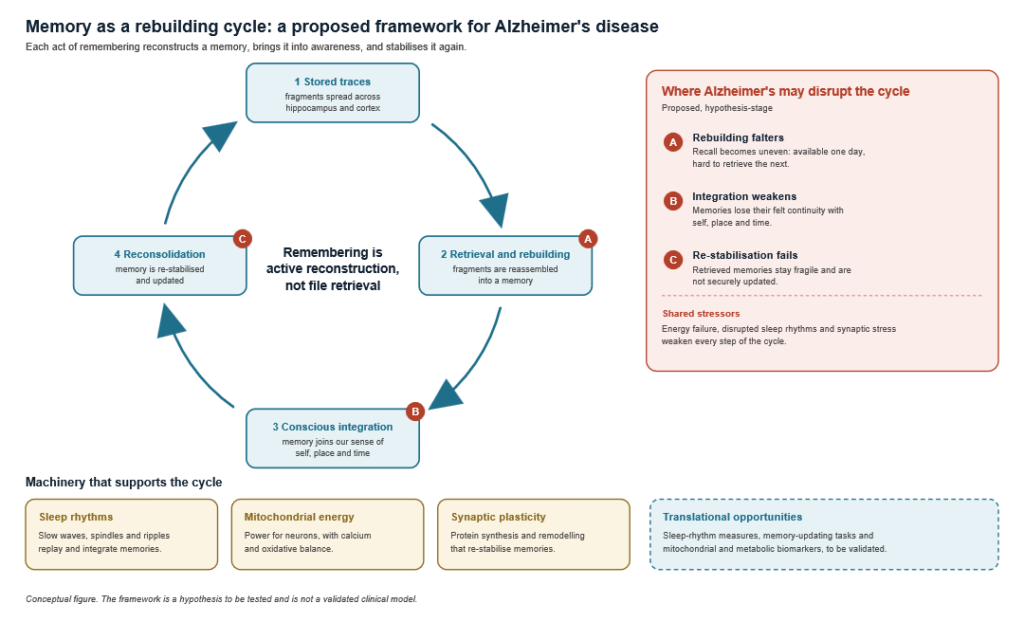
We tend to imagine memory as a filing cabinet. The evidence suggests otherwise. Each time we remember, the brain rebuilds the memory from distributed pieces and then stabilizes it again, a process called reconsolidation. Remembering is closer to performing music than playing a recording.
If memory were a static archive, Alzheimer’s would simply be lost files. If memory is active reconstruction, the disease can be seen as progressive failure of the machinery that rebuilds and re-stabilizes memories, which is a different research target.
Our review in Ageing Research Reviews (Parihar et al., 2027) adds a further step: a rebuilt memory becomes useful only when it is brought into conscious awareness and woven into our sense of self, place and time, which we call conscious integration. In Alzheimer’s, both stages may falter, so a person loses not only facts but the felt continuity between past and present. This remains a testable idea.
What evidence led you to see Alzheimer’s as a disruption of memory rebuilding?
Two observations. People with early Alzheimer’s disease often show uneven memory, accessible one day and not the next, which fits a rebuilding problem better than clean loss; and laboratory studies show that retrieval makes memories temporarily fragile, with re-stabilization depending on synaptic plasticity, protein synthesis and energy supply, systems stressed in Alzheimer’s disease.
Other findings point the same way. In animals, blocking protein synthesis shortly after retrieval can weaken a memory, while in Alzheimer’s mouse models some apparently lost memories can be recovered by stimulating the neurons that hold them, suggesting the trace is sometimes intact but hard to retrieve. Mitochondrial dysfunction, which I have studied for years, also limits the energy that synaptic remodeling needs.
In our article in Ageing Research Reviews, with Vihaan Goplani and Garima Sharma, we brought this evidence together and were candid about limits. Direct evidence of reconsolidation failure in patients remains thin, and inflammation, vascular factors and protein misfolding clearly contribute. It is a framework to test, not a replacement.
How are memory and the brain’s sleep rhythms connected?
During deep sleep, slow waves, spindles, and hippocampal sharp-wave ripples occur in tightly timed sequence, letting the hippocampus replay recent experiences to the cortex for long-term integration. Sleep is the brain’s overnight editing session.
In people at risk of Alzheimer’s, these rhythms are often disrupted. That matters twice: altered rhythms could be an early signal before obvious memory loss, and poor sleep may feed the disease by impairing memory reconstruction and waste clearance. Sleep measures are non-invasive and relatively inexpensive, making them attractive candidates for early detection.
Why do amyloid-lowering treatments give only modest benefit, and what else should we investigate?
Removing amyloid is a real achievement and confirms it is part of the story. But plaques are one visible product of a long process; by the time they are cleared, circuits, energy supply and synaptic health may already be compromised.
The next wave should include protecting mitochondrial function and metabolic resilience, restoring healthy sleep and network rhythms, supporting synaptic plasticity, addressing inflammation, and intervening earlier. Combination strategies matched to a person’s biology are likely to outperform any single approach.
How could this view change diagnosis and treatment evaluation, and what evidence is missing?
Diagnostics could ask not only whether someone remembers, but how well they reconstruct and update memories, combining such tasks with sleep electrophysiology and standard biomarkers. Trials could add measures of memory dynamics and network function to broad cognitive scales.
In practice, this could mean a short battery of memory-updating tasks at routine check-ups, paired with a home sleep recording, to flag people for further testing. In drug trials, it would show whether a therapy restores memory rebuilding itself, not only whether plaques fall. These measures should be tested alongside existing biomarkers to show what they add.
We still need long-term studies tracking memory reconstruction, sleep rhythms and biomarkers together, direct evidence of reconsolidation changes in patients, and proof that any new measure predicts real-world outcomes. Until then, this is a promising hypothesis, not a clinical tool.
How did Bioexons LLC begin, and what need was it created to address?
I founded Bioexons LLC in Washington State in 2018. After more than three decades in research, academic leadership and administration, I saw that many promising laboratory discoveries never progress toward products or solutions. The gap is often not innovation itself but translation: limited interdisciplinary collaboration, weak development strategy, and poor links between researchers and industry.
Bioexons LLC is a platform for life-science research and research-based technologies. As Founder and CEO, I provide scientific vision and strategy, evaluate opportunities, develop project concepts, explore collaborations, and keep our work rigorous and practical.
What does Bioexons LLC do, and what are its priorities?
Bioexons LLC is a life-sciences research and development company that helps translate scientific ideas into potential real-world applications. Our current interests fall into three areas.
First, neuroscience, memory, and Alzheimer’s: how memories are processed and reconstructed, and how this fails in ageing, with attention to synapses, mitochondria, and network dynamics. Second, artificial intelligence and integrative research: combining computational models with neuroscience to generate testable hypotheses. Third, translational biotechnology: evaluating research concepts and building collaborations toward practical applications. These are early-stage directions, not established products or demonstrated clinical benefits.
How does your mitochondrial research connect to Bioexons LLC?
Directly. Mitochondria govern neuronal energy, calcium regulation and redox balance, and when they fail, neurons become vulnerable to oxidative stress and synaptic dysfunction. Through Bioexons LLC I hope to develop three areas: biomarkers of mitochondrial and metabolic dysfunction; the link between mitochondrial health, synaptic resilience and the brain’s capacity to reconstruct memories; and AI-assisted analysis of how metabolic stress, network disruption and cognitive decline relate.
These remain areas for investigation. I would not describe them as validated diagnostics or proven treatments.
How do you decide which ideas to pursue, and what lesson stands out?
I ask four questions. Is the biology sound and reproducible? Does it address a genuine unmet need? Can it be tested realistically? Can it be protected and advanced with the resources available? An idea that fails may still be interesting, but it needs more academic work before it belongs in a company.
A key milestone was founding Bioexons LLC, which gave me a platform to combine neuroscience, molecular biology, and research leadership, and sharpened my focus on one connected theme: mitochondrial dysfunction, synaptic impairment, and brain ageing.
The main lesson: a good research finding is not necessarily a good product. It must first survive independent validation and a feasibility check, so I advance in stages and commercialize only when the evidence justifies it.
What challenges have you faced, and how have funding, collaboration and intellectual property shaped your decisions?
Biotechnology is slow, capital-intensive, and uncertain. Funding determines which questions you can test and how fast, so I prioritize by scientific importance, feasibility, and translational value rather than chasing many ideas at once. No small organization has every skill needed, so I rely on collaborations across neuroscience, computation, engineering, and clinical research.
Intellectual property forces clarity about what is truly new, and I prefer to consider it early while keeping appropriate scientific transparency. The hardest shift for an academic is that publication ends a university project but is only the beginning in a company.
What would meaningful progress look like, and what advice would you give scientists moving beyond the laboratory?
For Alzheimer’s research: earlier detection, treatments that preserve function and quality of life, and a deeper grasp of how memories are formed, reconstructed, and lost. For Bioexons LLC: advancing work on mitochondrial and synaptic resilience toward biomarkers and intervention strategies, and developing AI-enabled research tools. I would measure success by reproducible evidence, not project counts. To fellow scientists: maintain rigor and never present a hypothesis as an established result; build interdisciplinary collaborations; learn about intellectual property, funding and regulation early; and stay connected to your purpose, which is to understand important questions and ultimately improve lives.