Most people see beach plastics as litter that harms marine animals. What led you to investigate the invisible communities of bacteria living on this waste?
Plastic pollution is usually discussed in terms of visible litter and its effects on marine animals. But plastic also remains in the environment long enough for microorganisms to attach to it and form biofilms. These communities are important because some bacteria can carry genes associated with antimicrobial resistance or traits linked to colonisation and disease. We wanted to understand whether beach macroplastic debris larger plastic items commonly found on shorelines support bacterial communities that differ from those on natural materials found in the same places. Macroplastics have received less attention than microplastics in this context, even though they can persist on shorelines and provide extensive surfaces for microbial growth.
How do bacteria settle on plastic and form communities on its surface? What makes plastic a suitable habitat compared with natural materials such as driftwood, seaweed, and shells?
When plastic lies in seawater or on a beach, bacteria and other microorganisms can attach to its surface. They produce a surrounding matrix and form a biofilm a community of microbes living together on a surface. Plastic’s durability, surface texture and water-repelling properties enable it to persist in the environment and provide a suitable surface for microbial colonisation. Most plastics in the environment break down slowly and can persist as stable surfaces. However, plastic is not automatically a better habitat for every bacterium. Our study found that natural materials such as driftwood, seaweed and shells supported richer and more evenly distributed bacterial communities overall, while plastic communities tended to be more dominated by particular groups.
Your team studied four beaches along the Kochi coast. How did you collect the samples, and how did DNA sequencing help you discover which bacteria and genes were present?
We collected samples during the pre-monsoon season, from April to May 2024, at Fort Kochi, Cherai, Puthenthode and Puthuvypin. At each beach, we surveyed four 100 m × 50 m transects and collected plastic debris, including bottles, packaging and fishing-related items. We also collected natural inanimate materials driftwood, seaweed and shells—from the same transects for comparison. Samples from the transects were combined by substrate type to make eight composite samples: four plastic-associated samples and four natural-substrate controls. We extracted DNA from the biofilm material and used shotgun metagenomic sequencing, which reads DNA from the mixed microbial community. This allowed us to identify the organisms represented and screen for genes associated with antimicrobial resistance, virulence-related functions and other biological processes. It gives a broad picture of genetic potential, rather than proving that every detected gene is active.
What were the main differences between bacteria living on plastics and those on natural materials? Did beaches with more human activity show different patterns?
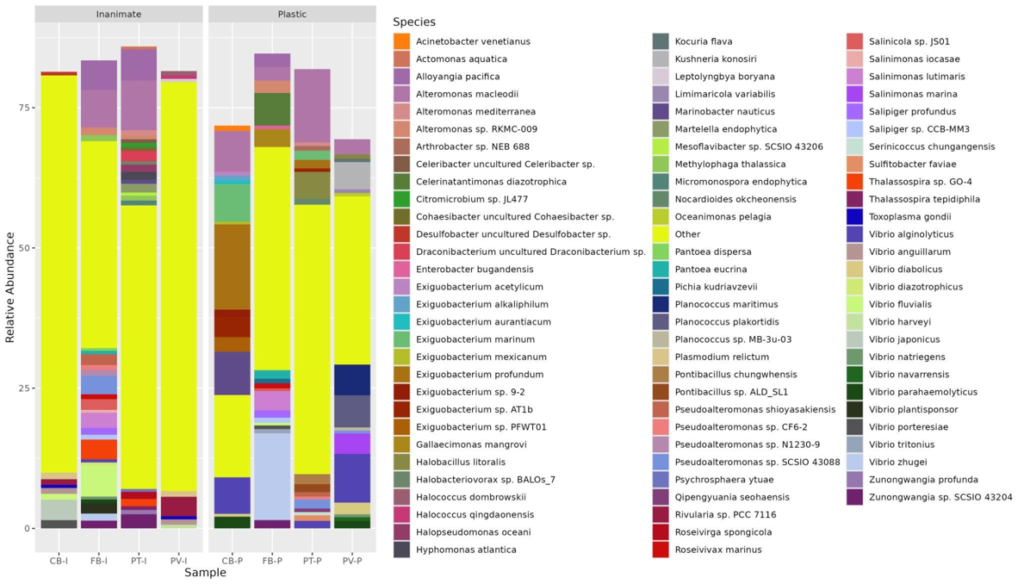
Across the samples, Pseudomonadota was the dominant bacterial phylum, followed by Bacillota, Actinomycetota and Bacteroidota. Plastic-associated communities were more strongly dominated by particular groups, including Vibrio, Alteromonas and Pseudoalteromonas. Natural substrates generally supported a more even mix of taxa, including groups such as Streptomyces and Marinobacter. Statistical analysis indicated that substrate type significantly influenced community composition, whereas differences between beach sites were not statistically significant in the beta-diversity analysis. We also observed broader antimicrobial-resistance gene profiles on plastics from the more urban-influenced beaches, Fort Kochi and Cherai, than at Puthenthode and Puthuvypin. These patterns are consistent with a possible influence of human activity, but the study was a limited, pre-monsoon comparison and does not establish that human activity alone caused the differences.
You found genes linked to antibiotic resistance. What does this mean in simple terms, and why might their presence on beach plastics be a concern?
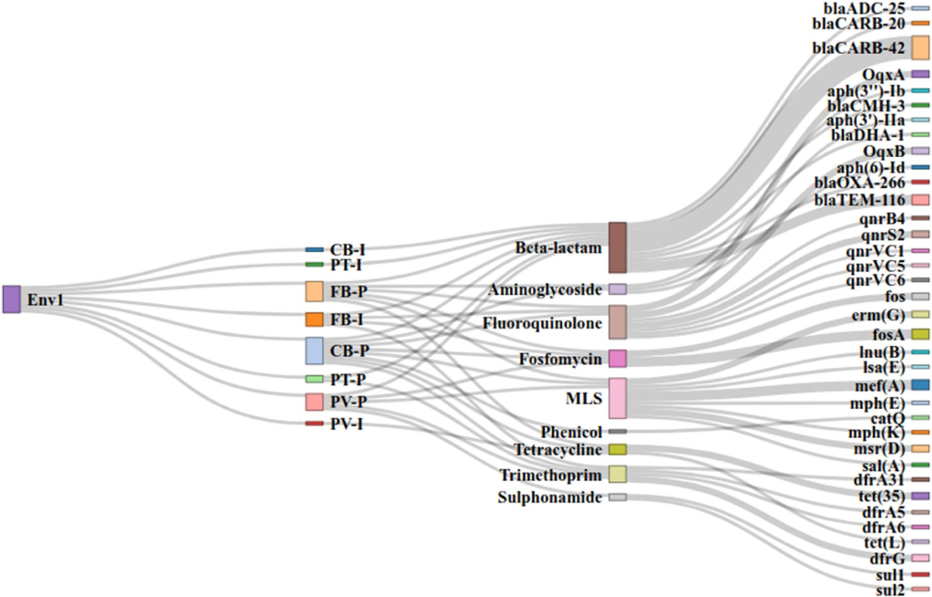
Antibiotics are medicines used to treat bacterial infections. Antimicrobial resistance occurs when bacteria have genetic or other traits that allow them to withstand antibiotics that would otherwise inhibit or kill them. We detected 42 distinct antimicrobial resistance genes across the eight composite samples, representing eight antibiotic classes. Beta-lactam resistance genes accounted for approximately 42% of the detected resistance genes. Plastic-associated communities generally had broader resistance-gene profiles than natural substrates. In simple terms, plastic surfaces can provide a place where bacteria carrying these genes are present together. This raises an environmental concern because coastal water, waste and microbial communities are connected. However, detecting a resistance gene does not by itself demonstrate that it can move to a pathogen, that the bacterium is resistant in a clinical test, or that an infection will occur. Those possibilities need further investigation.
Your study also detected genes associated with bacteria’s ability to attach to surfaces or cause disease. What can these findings tell us about potential health risks, and what further evidence is needed before linking them to human infections?
The study identified 73 distinct virulence-associated genes, including genes linked to attachment, biofilm formation, secretion systems, siderophore production and toxin-related processes. Across samples, the number of virulence-related gene hits ranged from 1,264 to 2,046 per site, with higher counts in plastic-associated samples than in natural-substrate samples. Such genes can help researchers identify microbial communities with traits that may be relevant to colonisation or interactions with hosts. They are indicators of potential, not proof that the organisms are causing disease. To connect these findings to human infections, further work would need to identify the host organisms carrying the genes, assess whether the genes are intact and expressed, test relevant bacterial isolates where appropriate, and investigate whether transmission pathways exist. Clinical or epidemiological evidence would also be needed before attributing infections to beach plastics.
What should happen next? How could your findings inform beach cleanups, waste and sewage management, and future monitoring of antibiotic resistance along our coasts?
First, preventing plastic waste from entering coastal environments remains essential, alongside regular beach cleanups and better collection and disposal of fishing gear, packaging and other plastic items. Cleanups should be paired with effective sewage treatment and solid-waste management, because land-based waste and wastewater can introduce both plastics and microorganisms into coastal systems. Second, monitoring programmes could examine plastic and natural substrates together and track bacterial communities and resistance genes across seasons and locations. Larger studies with more independent samples, repeated sampling and complementary laboratory tests would help determine how stable these patterns are and whether detected genes are carried by viable bacteria. Finally, environmental data should be interpreted alongside public-health surveillance. Our findings support treating beach macroplastics as microbial habitats worth monitoring, while avoiding the conclusion that gene detection alone proves direct risk to people.