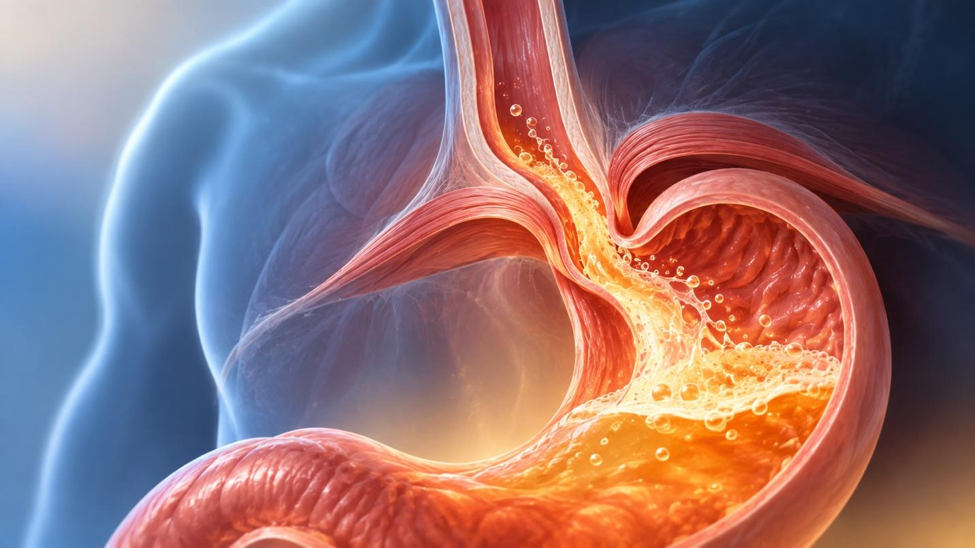
What causes acid reflux, and why is the barrier between the stomach and esophagus important?
Gastroesophageal reflux disease (GERD) is one of the most common gastrointestinal disorders worldwide. Although symptoms such as heartburn and regurgitation are familiar to many people, the reason stomach contents flow back into the esophagus is more complex. A key factor is the anti-reflux barrier at the junction between the esophagus and stomach, known as the esophagogastric junction (EGJ). This barrier is formed by several structures working together, including the lower esophageal sphincter, crural diaphragm, and gastroesophageal flap valve. Normally, these structures help prevent stomach contents from flowing back into the esophagus. When this junction becomes anatomically disrupted for example, through widening of the hiatal opening, upward movement of the stomach, or loss of the flap-valve mechanism the barrier becomes less effective and reflux can occur more easily. Upper gastrointestinal endoscopy allows doctors to directly examine this junction, but the findings need to be assessed in a consistent and clinically meaningful way. In our prospective study of 458 patients, we evaluated the American Foregut Society (AFS) classification of EGJ integrity to determine whether this structured approach could provide a more reliable assessment than conventional methods.
Why was a new classification needed?
For many years, endoscopists have used the Hill classification to describe the gastroesophageal flap valve. It grades the appearance of the valve from a relatively normal configuration to severe disruption.
The Hill system has been useful but focuses primarily on the visual appearance of the flap valve while other barrier components particularly hiatal diameter and hernia extent are less precisely incorporated.
The AFS classification was developed to make the evaluation more comprehensive and structured. Instead of asking the endoscopist to make a predominantly visual judgement about one component, it combines several anatomical measurements and provides a standardized framework for examining the junction.
What do the “L, D and F” components of the AFS classification mean?
One useful feature of the AFS system is that it breaks EGJ anatomy into three readily understandable components: length, diameter and flap valve—the LDF components.
Length (L) refers to the axial length of hiatal herniation. In practical terms, it evaluates whether part of the stomach has migrated upward through the diaphragm and, if so, by how much. Greater axial separation indicates increasing anatomical disruption.
Diameter (D) describes the width of the diaphragmatic or hiatal opening. The diaphragm normally surrounds the lower esophagus relatively closely. As the crura separate and the opening becomes wider, the external component of the anti-reflux barrier becomes progressively weaker.
Flap valve (F) assesses whether the gastroesophageal flap valve is preserved or lost. A well-formed flap valve provides an additional mechanical barrier to reflux. Flattening or disappearance of this valve is an early sign that normal EGJ anatomy has been disturbed.
The strength of the AFS approach is therefore not simply that it produces another grade. It encourages the endoscopist to examine the individual anatomical components that contribute to the anti-reflux barrier and then integrate them into an overall assessment.
How reproducible was the AFS classification in our study?
For any classification to be clinically useful, different physicians should be able to apply it consistently. We therefore made reproducibility an important part of our study.
We prospectively included 458 patients, and endoscopic recordings were evaluated independently by four experienced endoscopists who were blinded to one another’s assessments. The recordings were also reassessed to evaluate whether the same endoscopist would give a similar grade on a separate occasion.
The AFS classification demonstrated substantial reproducibility. Quadratic weighted kappa values for interobserver agreement ranged approximately from 0.65 to 0.79, with an average of about 0.72. Intraobserver agreement was similarly strong, indicating that individual endoscopists generally reproduced their own assessments when the recordings were reviewed again.
Importantly, the structured AFS approach showed better overall consistency than the conventional Hill classification. This is clinically relevant because a grading system becomes much more useful when a Grade II or Grade III assessment has approximately the same meaning regardless of which trained endoscopist performs the examination.
Why is the relationship with symptoms and esophagitis important?
One of the strongest findings was the relationship between AFS grade and GERD severity. The Spearman correlation with the validated GERD Health-Related Quality of Life score was approximately 0.88, exceeding the corresponding value for the Hill classification.
We also observed a striking stepwise increase in erosive esophagitis as EGJ disruption became more severe. Esophagitis was present in only about 8% of patients in the lowest AFS category, increasing progressively across grades and reaching approximately 84% in Grade IV.
This biological gradient is important. It suggests that the AFS classification is not merely describing anatomical differences that look interesting during endoscopy. Increasing structural disruption appears to parallel increasing clinical expression of reflux disease.
Could AFS grading eventually help guide treatment?
Potentially, yes but this is where careful validation is particularly important.
Most patients with GERD are managed initially with lifestyle measures and acid-suppressive therapy; more complex cases may require endoscopy, reflux monitoring, and manometry.
Most patients with GERD are managed initially with lifestyle measures and acid-suppressive therapy; more complex cases may require endoscopy, reflux monitoring, and manometry.
A standardized EGJ description could help integrate these findings, distinguishing patients with severe structural disruption and pathological reflux from those with intact anatomy and normal reflux testing.
AFS grade should not yet be used in isolation for intervention decisions. Prospective evidence linking grades to objective reflux measurements and treatment response will be essential.
What are the next steps for AFS classification, and how could it improve GERD assessment in the future?
Our study provides prospective evidence supporting the clinical relevance and reproducibility of the AFS classification, but broader validation is still needed before it can be widely incorporated into routine clinical practice. The first step will be multicentre studies involving endoscopists with different levels of experience. This will help determine whether the reproducibility we observed can be achieved across different clinical settings, particularly when supported by standardized training. AFS grades should also be systematically compared with objective physiological measurements, including prolonged pH or impedance-pH monitoring and high-resolution esophageal manometry. Such studies could clarify how the anatomical changes seen during endoscopy relate to the actual burden of reflux and the function of the anti-reflux barrier. Longer-term studies will also be important to determine whether AFS classification can predict clinically meaningful outcomes, such as response to proton-pump inhibitors, progression of reflux disease, and outcomes following endoscopic or surgical anti-reflux procedures. Emerging technologies may further improve the consistency of this assessment. High-quality video documentation, automated measurements, and eventually artificial-intelligence-assisted interpretation could reduce observer dependence and make EGJ assessment more standardized across centres. Traditionally, endoscopy in GERD has focused largely on its consequences, such as esophagitis or Barrett’s esophagus. A structured assessment of EGJ integrity shifts some of this attention toward the underlying anatomy that contributes to reflux. The AFS classification brings measurable anatomical features together with flap-valve assessment, and our findings show that it can be applied reproducibly, with increasing grades paralleling increasing disease severity. The next challenge is to integrate this anatomical information with symptoms, reflux monitoring, and esophageal physiology to support clinical decision-making. With further validation, standardized assessment of EGJ integrity could become an important part of how we understand, evaluate, and ultimately manage GERD.