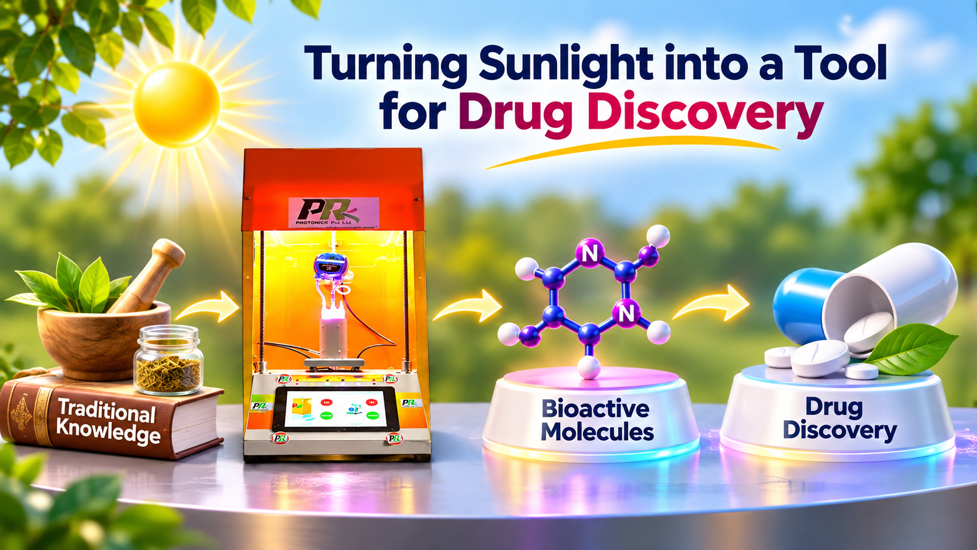
Turning Sunlight into a Tool for Drug Discovery
Drug discovery often begins with the traditional knowledge of Indigenous peoples, long before medicinal compounds are scientifically validated, developed, and commercialized in the market. For generations, people in villages have used sunlight to prepare natural remedies and preserve medicinal plants. Researchers first need to make diverse molecules, identify promising biological activity and then refine selectivity, safety and performance through repeated testing. How these molecules are made matters because it affects energy and material consumption, rigorous conventional synthetic routes, waste production, process safety, and the variety of molecules researchers can develop and study.
Could sunlight become a practical tool in this discovery?
Yes, sunlight offers an intriguing opportunity not as a universal replacement for conventional synthesis, but as an additional tool for constructing molecular interfaces. Sunlight-mediated studies involve chemical reactions and physical changes that occur when atoms or molecules absorb ultraviolet (100–400 nm), visible (400–750 nm), or infrared (750–2500 nm) radiation from the sun. Light absorption can promote a substrate or catalyst to an electronically excited state, changing its redox properties and enabling reaction methodologies that sometimes may not be possible under conventional conditions . Photochemical transformation comprises several mechanistic routes, including direct photoexcitation, photoredox catalysis, energy transfer, oxidative or reductive quenching, photoinduced charge-transfer interactions, single-electron transfer (SET), hydrogen-atom transfer (HAT) and excitation of electron-donor-acceptor (EDA) complexes. These methodologies proceed through radical or ionic intermediates under mild, selective conditions for carbon-carbon and carbon-heteroatom bond formation . So light-driven transformation and synthesis considered here demonstrate several routes to increasing structural diversity around bioactive molecule frameworks. Light can therefore be used not only as an alternative energy source but also to control reaction selectivity, intermediate formation, and bond construction.
A long-standing idea with growing relevance
The idea of using sunlight to carry out useful synthesis is not new. From 1889 to 1921, Prof. G. Ciamician pioneered sunlight-driven chemical reactions using a simple outdoor laboratory on the roof of the Chemistry building in University of Bologna, Italy. His pioneering work demonstrated the potential of sunlight to drive chemical transformations and laid the foundation for modern photochemistry and sustainable solar-driven synthesis. Another important outcome in 2009, “The sunny side of chemistry: green synthesis by solar light,” by Stefano Protti and Maurizio Fagnoni surveyed examples showing that sunlight could drive a wide variety of organic transformations. Their review covered photochemical processes such as cycloadditions and cyclizations, rearrangements and isomerizations, arylation and halogenation, oxygenation reactions, and the synthesis of organometallic or other specialised compounds. The breadth of these examples established an important principle: solar radiation can be a genuine source of photochemical activation, rather than merely a source of heat.
From molecular diversity to drug molecules
Some reports in the literature describe using direct sunlight to design and synthesize drug molecules. A study by Matsumoto and Takahashi demonstrated the synthesis of pyrrolo[2,3-d]pyrimidine-2,4-diones through the sunlight-induced cyclisation of suitably functionalised uracil derivatives. The method achieved 84–96% yields for the reported products, with reaction times ranging from 40 minutes to 5 hours. These fused heterocyclic scaffolds are particularly interesting because related compounds have reported antibacterial, anticancer, and antiviral activities. The approach highlights sunlight’s potential to drive efficient molecular transformations without metal catalysts or additional oxidising agents for the cyclisation step.
Another study demonstrated the sunlight-induced trifluoromethylation of (hetero)aromatic compounds and electron-deficient olefins using decatungstate photocatalysis and an inexpensive trifluoromethylating reagent. The method enabled the introduction of CF₃ groups into medicinally relevant molecular scaffolds, including caffeine and theophylline derivatives. Such modifications can influence important molecular properties, including lipophilicity, metabolic stability and biological activity.
A recent study demonstrated the solar-assisted synthesis of 3,4-dihydropyrimidin-2(1H)-one, achieving a 64% yield in 4 hours using aluminium-pillared montmorillonite as a reusable heterogeneous catalyst . This approach highlights the potential of solar irradiation to support sustainable synthesis while reducing reliance on conventional processing methods.
Our recent work illustrates how sunlight chemistry may contribute to this goal. This study described sunlight-mediated multicomponent synthesis of fused pyridopyrimidines from uracil derivatives, aldehydes, and cyanoacetic acid; however, without light, we observed only the bis-pyrimidine derivatives. The proposed pathway involves an EDA assembly formed from reaction-derived components; sunlight/visible-light absorption can activate this assembly and promote radical chemistry followed by ring formation. Under the reported conditions, the method did not require an added photocatalyst or an additional reaction-promoting additive. Selected products showed good preliminary bioactivity against Escherichia coli in the reported screening assay. This shows that photochemical synthesis can provide access to molecular scaffolds worth further investigation, and that synthesis, mechanistic evidence, and biological evaluation must remain distinct steps.
Sunlight is renewable but not automatically reproducible
Sunlight is attractive because it is widely available and renewable, yet its intensity and spectral distribution change with weather, location, season and time of day. A reaction that works on a clear afternoon may proceed more slowly under cloud cover or give a different result in another laboratory. Reliable solar synthesis therefore requires careful reporting of the location and conditions, exposure time, reactor geometry, illuminated area and temperature; where possible, solar irradiance or incident photon flux should also be measured. Dark controls and other suitable experiments are needed to confirm that the transformation is genuinely light-driven.
Is the reactor can determine the result?
Light is absorbed as it travels through a reaction mixture, so material deeper inside a large vessel may receive fewer photons than material near the illuminated surface. Simply increasing the size of a flask can therefore reduce efficiency and alter product distributions. Thin-film and flow photoreactors address this challenge by spreading the liquid into a shallower layer or moving it through a defined illuminated region, helping to manage photon delivery, heat transfer and mass transfer.
A falling-film looping photoreactor developed by our team with collaborators provides one example of this engineering approach. For more detail, see our own developed photoreactor company (photonicr.com). We evaluated this platform using benchmark photoreactions and different reactor modules, focusing on the photonic characteristics relevant to scale-up. It provides a practical framework for testing whether a reaction first observed at milligram scale can be translated to larger quantities while maintaining control over irradiation, as well as BASTR or CSTR mode.
What should happen next? Solar photoreactor
A hybrid solar-LED falling-film photoreactor, rather than a solar-only reactor, is an alternative solution. Use direct sunlight for experiments when conditions permit and photovoltaic-charged batteries to operate the LEDs when consistent illumination is required. Keep the two irradiation modes independently measurable so their performance can be compared scientifically. Over the next five to ten years, progress will depend on connecting molecular discovery with rigorous measurement and reactor design. Machine learning may help identify promising conditions, but only if datasets record details such as wavelength, light intensity, reactor dimensions and reaction volume.
Sunlight is a practical tool, not a magic solution
The future is likely to be a design and initial synthetic reactions can proceed under direct sunlight, and optimisation may then continue on controlled wavelengths with suitable photoreactors if needed. The most useful advances will combine selective photochemistry with reproducible photon management, accessible equipment, safer materials and meaningful biological evaluation. From a drug discovery point of view, selectivity and mild reaction conditions are very important in synthetic drug discovery, as production of side products and unwanted byproducts under conventional methods can cause additional disadvantages with detrimental effects on both the environment and human health. Sunlight will not solve every challenge in drug discovery, and some reactions will remain unsuitable for outdoor operation or industrial production. Yet solar photochemistry can broaden the ways chemists build and explore biologically relevant molecules. By bringing mechanistic chemistry, reactor engineering and biological validation together from the outset, we can turn sunlight from a symbol of green chemistry into a practical means of discovering which molecules are possible and which deserve closer study.