Can artificial intelligence help create safe and supportive spaces for mental health care?
The short answer to this question would be “yes”. The long answer, however, is comprehensive and convoluted. Let us answer this question by posing more questions, the age-old method of teaching and learning.
What is artificial intelligence, and how is it defined in modern science?
John McCarthy, known as the founding father of AI, in a very interesting technical report titled “Making Robots Conscious of their Mental States”, describes it as a process of creating machines that can act in ways that would be considered intelligent if exhibited by humans. In other words, the goal of artificial intelligence is to build systems that behave as though they possess intelligence.
How does artificial intelligence function, particularly in the context of healthcare applications?
Machine Learning (ML) is an important component of AI whereby the machine learns from the data by creating algorithms that continue to learn and perform. It is taught to recognise patterns and construct data points, which enable calculated future predictions. When it comes to health care, AI can analyse patient data and electronic health records (EHRs) to aid in diagnosis and customise treatment plans based on the information it is provided. AI has the invaluable advantage of not missing even the most minute of details and understanding connections that exist on the thinnest of threads, which the human eye and brain might not comprehend. Natural Language Processing (NLP) is another branch of AI which enables machines to interpret and generate natural language. It can analyse pages and pages of clinical data and a huge number of laboratory and radiology reports; extract information and learn from it; and provide clinicians with palatable and usable insights.
What role does artificial intelligence play in mental health care?
Apart from using digital phenotyping (personal sensing) and NLP to detect changes in the patterns of behaviour and mood of patients, another important use of AI in mental health care is through chatbots. Chatbots can identify mental health concerns by asking questions about aspects such as mood, stress, energy levels, and sleep patterns. In a country like India, where there is a huge care gap with only a handful of mental health professionals available for a section of the population, these chatbots can greatly help in bridging this gap. Based on the responses, the chatbot can analyse the information and recommend appropriate interventions, ranging from behavioural strategies (physical activity, meditation, relaxation techniques, etc.) to advising consultation with a healthcare professional when medication may be necessary. In situations where there is a potential risk to the patient or others, the chatbot may also alert a medical provider.
In what ways can artificial intelligence be used to create safe mental health environments?
AI-powered tools such as chatbots (Woebot, Talkspace, etc.), emotional health apps (Moodfit, Happify, etc.), and smart mental health tools (Kintsugi, Cerebral, etc.) are transforming the mental health landscape by providing accessible, stigma-free platforms for personalised assessments and customised care plans. These tools can offer continuous, on-demand support regardless of time or location. This helps bridge critical gaps in service availability, allowing individuals to seek assistance whenever needed. Crisis services have also begun integrating these tools, which can engage users empathetically, suggest coping strategies, and escalate to human professionals or helplines when necessary.
Additionally, AI-driven systems can simultaneously support multiple users and have been adapted for specialised populations, such as children and the elderly, where they assist in developing specific skill sets. Overall, advances in conversational AI allow these tools to provide empathetic engagement, emotional support, and a broader range of accessible mental health resources.
What precautions should be taken to ensure that AI-based mental health spaces are truly safe and effective?
Preserving the human aspect of therapy while using AI as a supportive tool is an important precaution to be taken. Rather than replacing mental health professionals, AI should complement and strengthen the therapeutic relationship. Achieving an appropriate balance between AI-based interventions and human involvement is therefore essential.
It is of utmost importance that the patients are clearly informed when AI tools are incorporated into their care. Such transparency enables them to make informed decisions about choosing or not choosing AI involvement and understand the extent of the involvement in their treatment. Additionally, although AI can continuously monitor and detect changes in behaviour, this process should be guided by human oversight. Clinicians must interpret and act on these insights, ensuring that care remains centred on human judgement and connection and not entirely left to the AI, which at its base is still a machine capable of errors.
What are the key concerns associated with the use of artificial intelligence in mental health care?
The use of AI in mental health care requires robust safeguards to protect patient data and maintain confidentiality. As it deals with sensitive information such as medical histories, therapy records, and behavioural data, it must be secured against unauthorised access and breaches. AI-based platforms should comply with regulations like the Health Insurance Portability and Accountability Act (HIPAA) of 1996 to ensure secure storage and transmission of patient data, thereby preserving privacy. Ethical implementation of AI also involves clarifying where the data stores and who owns it and obtaining informed consent, ensuring that individuals retain control over their information and understand how it will be used in AI-driven care.
AI systems can reflect and perpetuate biases embedded in their training data, which may result in unequal diagnostic outcomes or treatment recommendations. It is therefore essential to recognise and address these biases to promote fairness and ensure equitable care across all populations.
What is the future direction of artificial intelligence in mental health care, and how can it be integrated effectively?
Integrating AI tools into existing systems of mental health care can enhance clinical efficiency. For example, natural language processing can examine therapy conversations to identify subtle indicators of mental health conditions. AI can also support more precise treatment approaches by predicting patient responses based on patterns observed in similar cases, reducing reliance on trial-and-error methods.
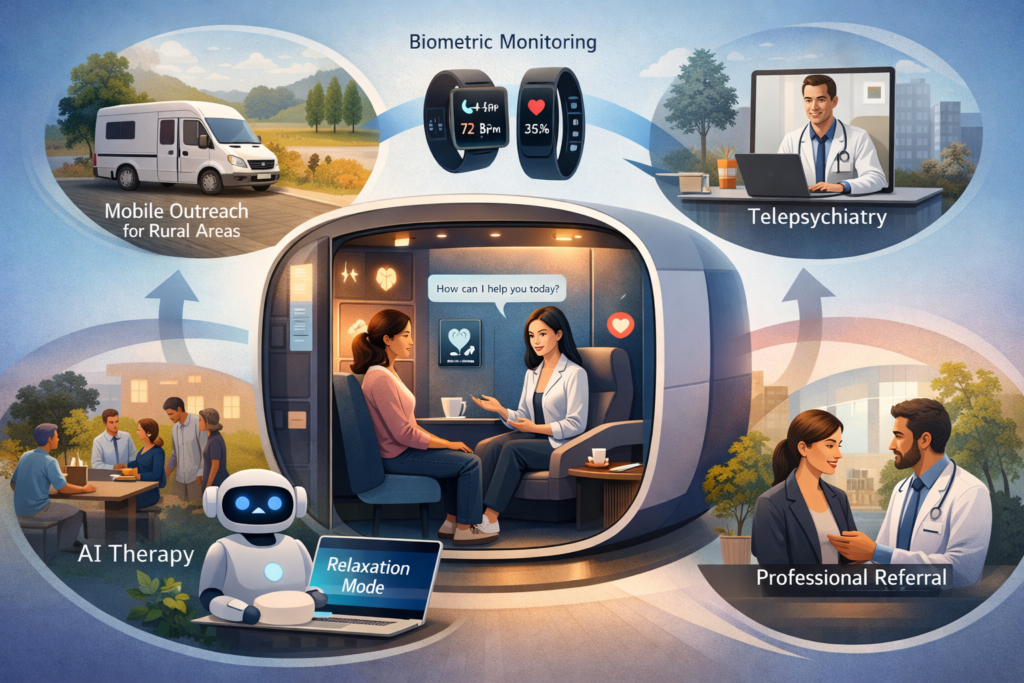
A few potential future directions in mental healthcare could involve hybrid models that integrate physical spaces with AI-enabled support systems. Within these environments, individuals might engage with multilingual, culturally sensitive interfaces capable of guiding them through their difficulties. These systems could incorporate multimodal features to enhance accessibility for users with varying levels of literacy or familiarity with digital tools. An AI-driven triage component could potentially help identify user needs and direct them toward appropriate forms of support. Interfaces integrating biometric feedback through wearable devices, enabling real-time adaptation of interventions based on physiological signals such as stress or sleep patterns. Additional possibilities include integration with telepsychiatry services, community-based outreach programs, and mobile versions for rural and underserved areas. While still speculative, such models reflect a broader shift toward combining technological innovation with human-centred design. They suggest a future in which mental healthcare becomes more accessible, adaptive, and context-sensitive, while still maintaining pathways to professional, human-led intervention when needed.