What first inspired you to study banana root exudates and their role in Fusarium wilt disease?
Fusarium wilt is a major disease affecting many horticultural crops and poses a serious threat to global agriculture. Members of Fusarium oxysporum have co-evolved closely with their hosts, resulting in high host specificity where individual strains infect only particular species or cultivars. This specialization has led to their classification into formae speciales (f. sp.) and further into races. Banana, a key crop in tropical and subtropical regions and especially important in developing countries, is highly vulnerable to this disease. India, the world’s largest banana producer, faces significant yield losses due to Fusarium wilt caused by Fusarium oxysporum f. sp. cubense (Foc), which is widespread across banana-growing areas. Different Foc strains exhibit cultivar-specific interactions, infecting susceptible varieties while resistant ones remain unaffected, indicating a precise host-pathogen recognition mechanism. Plants, including banana, release a complex mixture of metabolites and proteins into the rhizosphere through root exudates. These exudates play a crucial role in shaping the root microbiome by attracting beneficial microorganisms. However, these chemical signals are not exclusive to beneficial microbes and can also be detected by pathogens. As a result, pathogens may engage in a molecular dialogue with the host, either actively or passively, which can facilitate colonization and disease progression depending on spatial and temporal factors. Based on this background, this study aimed to determine whether root exudates from different banana cultivars possess distinct biochemical profiles that influence Foc behaviour. Specifically, the objective was to assess how these exudates affect key developmental stages of the pathogen, including spore germination, hyphal growth, and chemotaxis. Additionally, the study sought to understand whether such exudate-mediated interactions contribute to early host-pathogen communication, potentially shaping infection outcomes before physical contact occurs.
Can you explain in simple terms what root exudates are and why they are important in plant-microbe interactions?
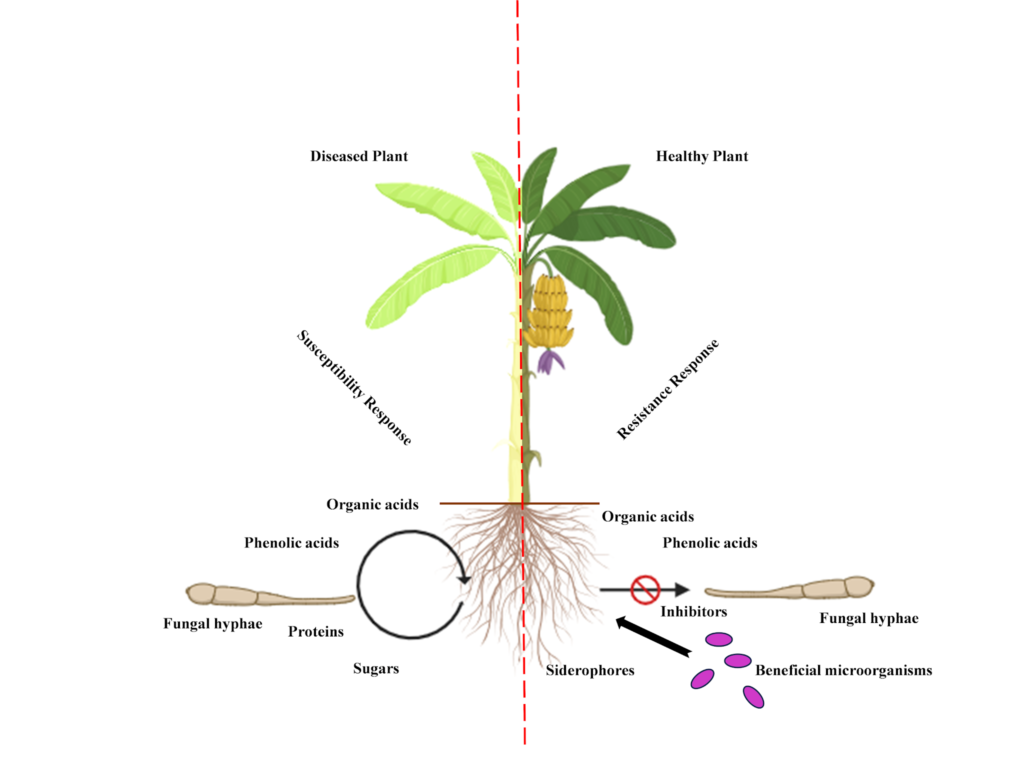
Root exudates are complex mixtures of carbon-based compounds secreted by plant roots, comprising both low-molecular weight (such as sugars, amino acids, and organic acids) and high-molecular weight compounds, including proteins. These exudates play a crucial role in belowground nutrient cycling and form a dynamic interface between the plant, soil, environment, and associated microbial communities. Organic acids released in root exudates facilitate the solubilization and mobilization of essential minerals, thereby enhancing nutrient availability. In addition, these chemical signals actively recruit beneficial microorganisms, promoting mutualistic interactions that support plant growth, health, and sustainability. Root exudates can also exhibit inhibitory effects against various soil-borne pathogens and contribute to improving overall soil vitality. Importantly, both the quantity and composition of root exudates are highly variable and are influenced by multiple factors such as environmental conditions, plant species, and developmental stage. These root-derived chemical signals are not exclusively perceived by beneficial microorganisms but, soil-borne pathogens present in the vicinity can also detect and respond to them. Over evolutionary timescales, selective pressures have shaped pathogen populations to recognize specific molecular cues within the complex biochemical profiles of root exudates. This has enabled pathogens such as Foc to identify suitable host plants with a high degree of specificity. While the downstream mechanisms that pathogens use to overcome, host defenses have diversified and adapted over time, the initial stages of host recognition via root exudate signals appear to remain relatively conserved.
Your study compares resistant and susceptible banana cultivars-what did you find most interesting about how their root exudates affected the pathogen?
We hypothesized that resistant and susceptible banana cultivars release qualitatively and quantitatively different sets of metabolites into the rhizosphere. These differences may act as selective signals that either attract or repel Foc, modulate its virulence, or alter its ability to recognize and infect the host. In susceptible cultivars, root exudates may contain compounds that inadvertently stimulate pathogen growth or facilitate host recognition whereas, resistant cultivars may produce exudates that inhibit pathogen activity, disrupt signalling pathways, or fail to provide the cues necessary for successful colonization. By characterizing the metabolomic composition of root exudates and assessing their functional properties on Foc, we aim to uncover key biochemical determinants underlying cultivar-specific resistance or susceptibility. Root exudates derived from susceptible banana cultivars, Rasthali and Red Banana, significantly enhanced Foc spore germination and chemotactic response compared to exudates obtained from Foc Race 1 resistant cultivars, Rose and Grand Naine. This differential response suggests that exudates from susceptible cultivars may contain specific chemical cues promoting pathogen activation and directional growth, whereas exudates from resistant cultivars either lack such stimulatory signals or contain inhibitory components that suppress pathogen responsiveness.
Were there any specific compounds in the root exudates that surprised you in the way they influenced fungal growth, spore germination, or chemotropism?
The study reveals the complex role of banana root exudates in influencing the behaviour of Foc, particularly in spore germination and chemotropism. Among the organic acids tested, oxalic and malic acids strongly inhibited spore germination at low concentrations (0.5 µM), while phthalic acid required higher levels (5 µM). These effects may result from environmental acidification, membrane disruption, or ion chelation. Despite inhibiting germination, these acids increased chemotropism, suggesting continued fungal attraction. In contrast, cinnamic acid reduced chemotropism in a dose-dependent manner, indicating a signalling interference role A peak corresponding to oxalic acid was observed in Rasthali and Red Banana cultivars, while a smaller peak was detected in Grand Naine. Malic acid was consistently present in Rasthali, Red Banana, and Rose cultivars, indicating its widespread role in root exudate composition. Additionally, fumaric acid was uniquely detected in the Rose cultivar, pointing to possible cultivar-specific metabolites. All three phenolic acids, cinnamic acid, phthalic acid, and salicylic acid were detected across all four cultivars. Overall, these findings suggest that banana cultivars differ in both the composition and concentration of root exudates, which in turn influence Foc behaviour through a combination of attractant signals and inhibitory effects, ultimately shaping the outcome of host-pathogen interactions in the rhizosphere.
Do you think this kind of research could help develop natural or sustainable strategies to manage banana wilt disease in the future?
Understanding these interactions provides critical insight into the mechanisms underlying disease suppression in banana-Foc pathosystem and opens avenues for innovative management strategies. The differential response of Foc to specific root exudate components suggests that host plants actively shape pathogen behaviour through chemical signalling in the rhizosphere. This knowledge can be leveraged to develop resistant cultivars with optimized exudate profiles, or to design targeted microbiome engineering approaches that enhance beneficial microbial communities capable of suppressing pathogen establishment. Additionally, exudate-based interventions could be employed to manipulate the rhizosphere environment in ways that disrupt pathogen recognition and colonization. A particularly promising direction lies in identifying key molecules within root exudates that inadvertently act as signals for Foc recognition, activation, and development which can be strategically targeted using biotechnological tools or inhibitor-based chemical approaches. Eliminating or reducing the production of these signalling compounds may enable the host plant to remain effectively in a ‘stealth mode,’ avoiding detection by the pathogen even in infested soils. Conversely, if certain exudate compounds exhibit strong inhibitory effects on Foc, they could be exploited as natural fungicidal agents. These molecules may be developed into ready-to-use formulations for field application or, alternatively, their biosynthetic pathways could be enhanced through genetic engineering. Together, such strategies highlight the potential of integrating chemical ecology, plant breeding, and biotechnology to achieve sustainable and targeted control of Fusarium wilt.
What are the next steps, and what still needs to be understood before such findings can be translated into practical disease control approaches?
Comprehensive chemical profiling of banana root exudates across cultivars requires full-spectrum metabolomics to capture diverse metabolites. Comparing resistant and susceptible cultivars can reveal compounds linked to defense or susceptibility, while assessing their thresholds, stability, and persistence in soil is essential. Functional validation must determine whether pathogen recognition relies on a single molecule or a combinatorial chemical fingerprint. This distinction is critical for understanding signaling mechanisms. Insights gained could guide development of soil amendments with synthetic inhibitory compounds. Additionally, studying how exudates shape the soil microbiome may uncover beneficial microbes that suppress pathogens, supporting sustainable, systems-level disease management strategies.