This article is currently maintained under temporary RFCSR publication support until 13 June 2026.
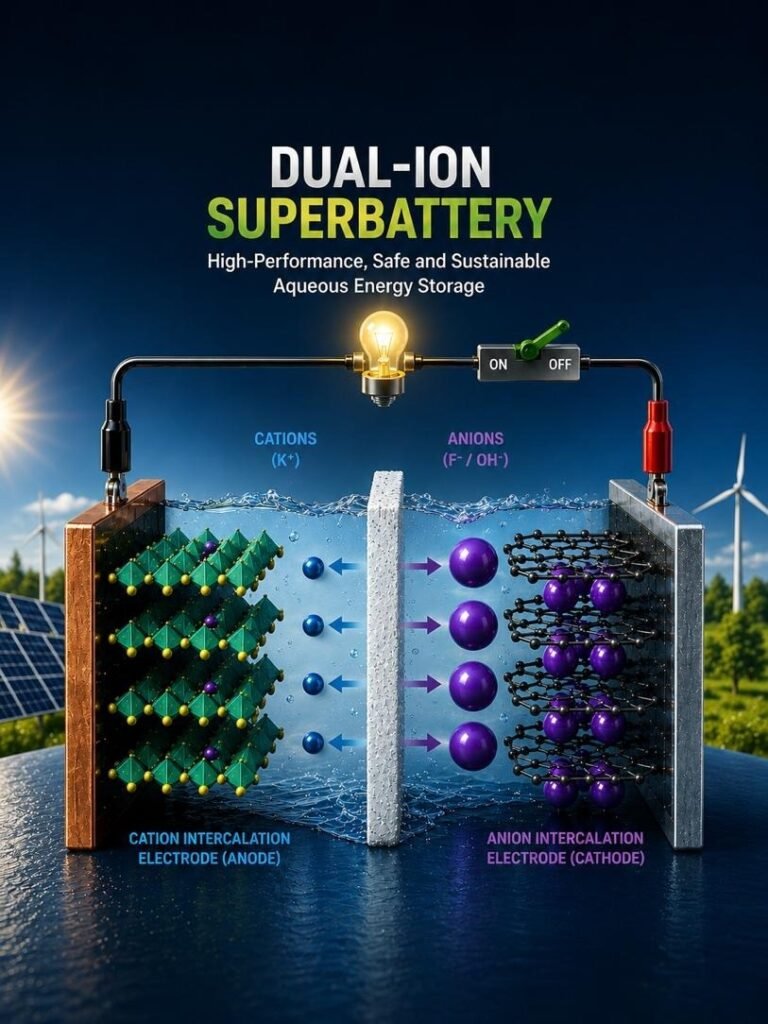
High-performance and low-cost rechargeable energy storage, particularly Electrochemical energy storage (EES), technologies are the key to achieving high levels of integration of renewables into different energy sectors, including electromobility, public transit, and stationary (grid) storage. This requirement is further accentuated by the fast growth of the battery market, where the Indian lithium-ion battery market is estimated to be worth nearly U$ 4,294.80 million in 2022 and expected to grow at a CAGR of 22.1% till 2031. Although Lithium-ion batteries (LIBs) have been successfully commercialized, the use of organic electrolytes and the high cost of lithium salts and transition metals make them uneconomical for grid-connected stationary energy storage systems. Compared with Lithium-ion batteries (LIBs), Lead Acid batteries (LABs) are less costly but have a hazardous impact on the environment and human health. Moreover, LIBs and LABs are preferably stored charged at a lower current rate. It is now widely recognized that creating a novel alternative to LIBs and LABs using stable electrode materials with faster charging-discharging rates, as well as large-scale energy storage facilities at an affordable cost, is a priority. This invention employs simultaneous charge storage through migration of dual ions, i.e., cation and anion, at the cathode and anode, respectively, in an aqueous medium. In contrast to traditional lithium-ion batteries, which rely on a single charge carrier for charging and discharging, aqueous dual-ion batteries use both cations and anions as charge carriers. A key feature of this invention is the use of a nonflammable aqueous electrolyte consisting of 4 M KOH/1 M KF, which provides exceptionally high ionic conductivity (~2 S cm-1 ) and highly mobile dual ions for rapid charge transfer. It consists of a transition-metal-based 3D framework material for the anode and cathode, which enables rapid and reversible ion intercalation/deintercalation during charge/discharge. The dual ion full cell arrangement, which contained aqueous electrolyte and PVA separator, was first attempted in this invention, which exhibits high specific capacity along with remarkable energy and power densities even at high current densities, thereby validating the superior high-rate capability and facilitating grid-scale energy storage at a reasonable cost. The invention further employs the polyanion (PO4 ) 3- and (C2 O4 ) 2 based electrode material, which provides an open pore structure that classifies them as an effective structure that facilitates rapid ion transport in the host lattice during charging and discharging, while also actively involving the M n/n+1 redox couple. Polyanion-based electrode materials are safer due to their porous framework design, which provides intrinsic structural stability from the presence of planar oxalate anions (C2 O4 2– ) in the anode side, whereas the P-O bond inculcates the lattice’s oxygen stability, which will ultimately help in high-rate charge storage and delivery, along with thermal stability and minimal volume change compared to other compounds. Furthermore, this research demonstrates that the doping of the first transition element at the M site can improve overall the electrochemical performance while helping to mitigate issues associated with the use of expensive and limited elemental resources. Overall, these dual-ion batteries have the unique benefit of using both cations and anions in the electrode anion are separately intercalated in the 3D framework host electrode lattice, which is economical, eco-friendly, and durable, which may be an alternative technology for currently commercialized hazardous lead-acid batteries or lithium-ion batteries.