Have you observed that wearing a black shirt on a hot summer day makes you feel hotter, whereas a white shirt helps keep you cooler? We’ve all learned the simple rule that dark colours absorb sunlight and trap heat, while light colours reflect it. But what if a surface appears pitch black or deep brown to our eyes, yet behaves like a shiny mirror reflecting the sun’s heat away?
Looking Beyond What the Eye Can See
Let’s look at sunlight. The light hitting a surface isn’t just the visible colours we that see; but a major part of the sun’s energy arrives as invisible near-infrared (NIR) radiation, which carries pure heat, particularly around 1100 nm. Pigments are coloured substances that give paints, inks, and other materials their colour by selectively absorbing and reflecting light. Pigments are used in paints, printing inks, plastics, textiles, cosmetics, ceramics, paper, construction materials, and art. Inorganic pigments are more stable under common environmental conditions than their organic counterparts. White pigments have high light-reflecting properties, which can produce excessive brightness or glare. This may cause visual discomfort, especially under strong lighting or sunlight. Hence, dark-shaded pigments are preferred and also for their aesthetic appeal. But in terms of functionality, commercial dark pigments often absorb both visible and near-infrared radiation, which limits aesthetic applications. Hence, buildings, pavement and automotive surfaces painted with conventional dark colours can become substantially hotter under intense sunlight. This creates a challenge for modern infrastructure: people require dark, attractive colours, but dark surfaces are often linked with greater heat absorption.
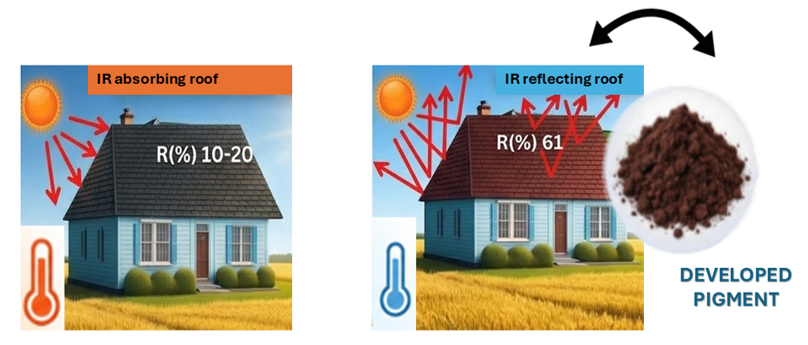
This challenge becomes increasingly important as cities experience rising temperatures, increasing energy demand for cooling, and more recurring extreme-heat events. Concrete jungles act as thermal sponges, exacerbating the “urban heat-island effect” documented in the cities worldwide. Buildings account for approximately 30% of the worldwide energy demand. Thus, buildings, both residential and commercial, and infrastructure need to become not only energy-efficient but also more resilient to solar heat. Many materials have been developed for their heat reflective properties. Numerous approaches have been explored to control solar heating, including reflective coatings, cool roofs, and passive radiative cooling technologies. However, the challenge lies in achieving a dark aesthetic while maintaining high solar-reflective efficiency.(Fig.1)
The present approach tackles this problem at the level of the pigment material itself.
Engineering Colour and Heat Reflection
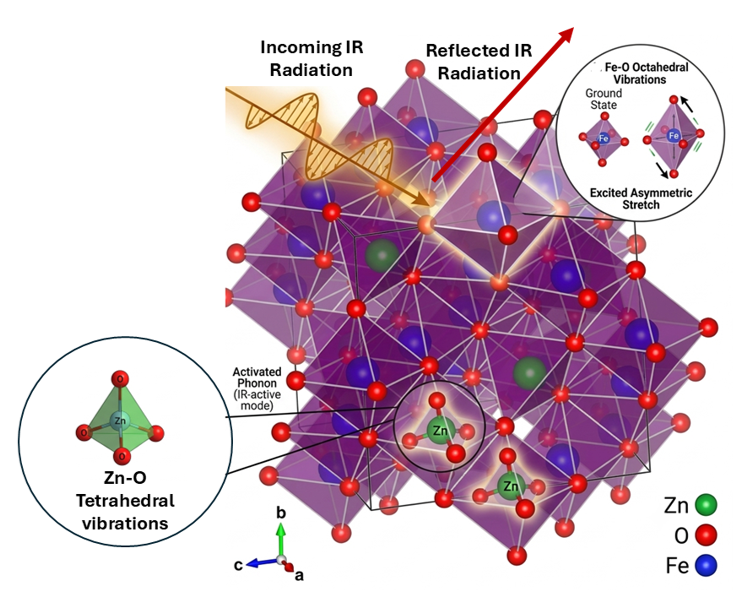
In the present work, we focus on engineering ceramic oxide materials, specifically transition metals. Instead of accepting the usual trade-off between dark colors and heat absorption, we precisely tweak the crystal lattice at the atomic level via controlled substitution of metal ions, resulting in a targeted crystal defect. By carefully replacing selected metal ions and controlling the defects in the crystal lattice, we can tune how the pigment interacts with sunlight; absorbing visible light for a rich dark colour while reflecting much of the heat-carrying NIR radiation out. Particle size tuning effectively optimizes Mie scattering specifically for NIR photons. This process is unique in that it allows the pigment to selectively absorb light in the visible region, producing vibrant dark hues while remaining aesthetically striking. This is the mechanism of the present patented technology. (Fig.2)
The innovation is highly suitable for industrial scalability. The developed colourants can provide efficient total solar reflectance, which is the fraction of incoming sunlight reflected by a surface, while retaining visually attractive dark shades. Importantly, the concept is not restricted to a single colour. It can be meticulously extended across a wider palette of dark shades, including brown tones, creating opportunities for applications where aesthetics is as important as thermal performance.
The pigments are primarily crystallographically designed so as to be heavy-metal-free and can be incorporated into a wide range of conventional coating formulations. Validated at TRL-4, the developed pigments easily blend into industrial acrylic and polyurethane coatings.
Thus, without requiring significant infrastructure expenditures, the present cool coatings offer an affordable, scalable urban climate adaptation technique that can greatly improve air quality, lowers peak electricity use, and increases community resilience to climate change.
The current market of infrared-reflective coatings enters a phase change of structural expansion across the construction, automotive, and defense sectors. Due to the adoption of automotive LiDAR and ADAS, industrial automation, and construction activities, the Asia-Pacific region is the largest and fastest-growing regional market. With growing demand for energy-efficient buildings and heat-resilient infrastructure, the present pigments can offer an exciting opportunity to bring dark, aesthetically appealing surfaces for the next generation of cool coatings. For industries, the present material offers a feasible path to delivering “dark by design, cool by function” solutions that could satisfy both consumer aesthetic demands and the rigorous energy mandates of the next decade.
The next stage is the transition from laboratory validation to larger-scale coating demonstrations, weather-accelerated testing, durability assessment, and optimization for different substrates and climates. Integration with building-envelope technologies and smart material design could further expand the impact. By employing low-cost raw materials and a scalable synthesis approach, this high-performance IR-reflective pigment provides an economically viable, energy-saving alternative to the current expensive commercial cool pigments
Ultimately, the objective is straightforward: A roof does not need to be white to be cool. A vehicle does not need to sacrifice its aesthetic dark colour to manage heat. And a building does not need to choose between aesthetics and energy performance.
The present patented technology offers a pathway towards the development of a new generation of materials in which appearance and thermal function are designed together—dark by design, cool by function.
All cool surfaces may therefore need not to be white in the next generation. It may be black, brown or any colour that the end users’ prefers.