Many advanced materials can only be created under extremely high pressures. What inspired your team to find an alternative approach to this long-standing challenge?
The evolution of logic throughout human history has taught humanity a timeless lesson: every problem appears complex until it is approached through a simple, correct approach. Another important realization is that almost everything we observe has its roots in philosophy and human behavior. Therefore, viewing chemicals as isolated and distinct entities is a fundamental mistake. Like humans, chemicals exhibit behavior, and in many ways, this behavior complements and mirrors the patterns observed in human behavior. Similarly, chemistry can be approached through behavioral analogies, where asking simple, well-posed questions often leads to profound insights.
New needs demand new materials, and in the pursuit of this goal, advances in materials science, particularly the application of high pressure, have accessed new dimensions in both the synthesis and property space of materials. Classic examples, such as the transformation of graphite into diamond, illustrate how high pressure can unlock otherwise inaccessible crystal structures, unusual oxidation states, and remarkable functionalities. Recently developed static and dynamic high-pressure‑ techniques have enabled the synthesis of numerous functional materials with exceptional performance, including superconductors, superhard phases, and high-energy-density‑‑ materials. However, this success naturally leads to a simple but important question: Is it possible to synthesize high-pressure phases under ambient conditions?
This question marks the beginning of our story. In searching for an answer, another thought emerges: what if the crystal lattice could experience pressure from within itself rather than from an external source? This motivates the concept of generating “internal pressure” within materials.
Your study introduces the concept of “chemical pressure.” What does this mean, and how can chemistry mimic the effects of extreme physical pressure?
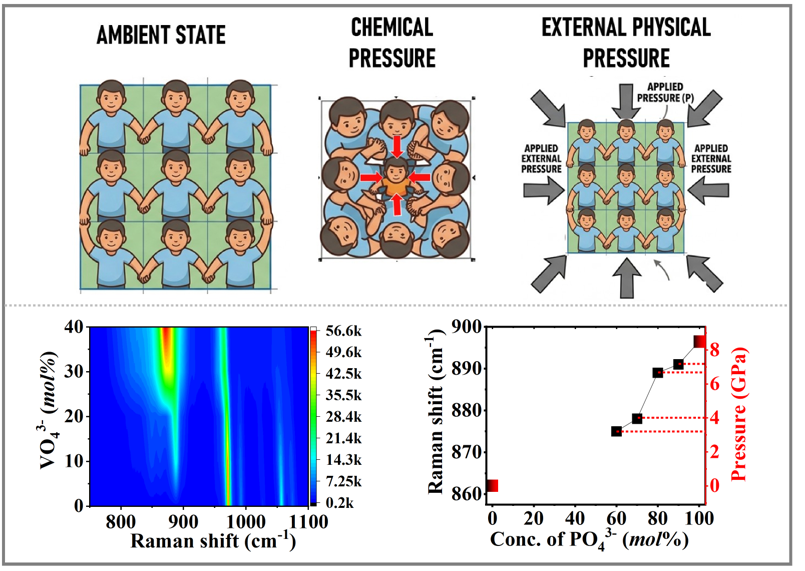
The key idea is that substituting existing ions with smaller ions of the same chemical nature or with units that form stronger bonds can act like internal clamps that pull the surrounding atoms inwards, effectively simulating the compression imposed by a high-pressure apparatus‑. In scientific terms, this internally generated lattice force arising from chemically induced strain is referred to as chemical pressure. A pictorial representation of the chemical and externally applied pressures is shown in Figure 1.
Why is being able to stabilize high-pressure crystal structures under normal laboratory conditions such an important breakthrough for materials science?
Developing ambient-pressure synthetic routes to phases previously accessible only under extreme pressures is very important, as it fundamentally expands the accessible materials genome, bringing high-pressure materials chemistry into mainstream solid-state synthesis. By eliminating the need for diamond anvils and multi-anvil techniques, this approach bridges the gap between fundamental discoveries and practical material synthesis.
Your research uses phosphate substitution to achieve this transformation. Could you explain, in simple terms, how this chemical modification changes the structure of the material?
Selecting an appropriate host lattice to implement our hypothesis was a critical first step. Drawing on our previous work on ABO4 compounds and insights from the literature, we focused on a class of materials that are well known for their polymorphism. Many rare-earth ABO4 compounds (A = rare earth; B = tetrahedral oxyanions such as PO43- or VO43-) can crystallize in multiple structures, most notably zircon and monazite structures. High-pressure studies have shown that PrVO4 undergoes an irreversible zircon-to-monazite transformation under an external pressure of 6 GPa, and importantly, PrVO4 lies close to the zircon-monazite phase boundary. This makes it an ideal model system to test our hypothesis: can externally applied pressure be mimicked through internally generated chemical pressure by substituting smaller PO43- tetrahedra for VO43- ?. In our PrBO4 (B = Cr, V, P) systems, the key “chemical piston” is the PO43- tetrahedron, which is significantly smaller in volume than VO43- or CrO43- in comparable coordination environments. This substitution imposes a negative chemical pressure that contracts the lattice and causes it to adopt the dense monazite structure rather than the more open zircon structure.
After extensive synthetic trials, we successfully stabilized single-phase PrV0.40P0.60O4 and PrCrO4 with monazite structures under ambient conditions. Our hypothesis of mimicking externally applied pressure through chemical pressure was validated by a systematic study of the hardening of the VO43- Raman modes with increasing PO43- substitution. A quantitative estimate of the induced chemical pressure was obtained based on certain assumptions. Although the resulting values should not be interpreted as exact equivalents of hydrostatic pressure, they provide a reasonable measure of its effect. This interpretation is further supported by the corresponding evolution of the lattice strain, which exhibits a consistent trend with the estimated chemical pressure (Figure 1).
Beyond creating a new crystal structure, your materials also exhibit interesting optical and oxygen-storage properties. Why are these properties important, and where could they be applied in the real world?
Beyond structural transformation, these materials exhibit intriguing optical and thermochemical properties arising from the unique electronic configuration of Cr5+ (3d1), its highly asymmetric crystal-field environment, and the inherited metastability of the Cr5+ oxidation state within the monazite lattice. In PrCr1-xPxO4, Cr5+ occupies a highly asymmetric C1 crystallographic site. The combined effects of the low-symmetry crystal field and intrinsic Jahn–Teller activity of the 3d1 configuration completely lift the degeneracy of the 2E and 2T states for an ideal tetrahedral (Td) environment, resulting in five non-degenerate d orbitals. This symmetry lowering also relaxes the Laporte selection rules, giving rise to intense visible-light absorption and a vibrant green color comparable to that of conventional chromium oxide pigments, despite containing substantially less chromium. The metastability of Cr5+, coupled with the lattice defect tolerance capacity of the monazite lattice, enables low-temperature, thermochemically reversible oxygen sorption and desorption. In this process, metastable Cr5+ can reversibly cycle between Cr5+ and Cr4+ as oxygen is absorbed and released at relatively low temperatures, which is relevant for catalytic converters, solid oxide fuel cells, and chemical looping schemes for clean energy. These findings highlight a new and relatively unexplored functional dimension of the Cr5+ oxidation state.
Do you believe this chemical pressure strategy can be extended to other classes of materials? What opportunities could this create for future discoveries?
After testing PrVO4 as a model system to validate our approach, we sought further confirmation of the strategy by extending it to the monazite polymorph of CeVO4. Moreover, Ce precedes Pr in the periodic table and exhibits only a minimal difference in ionic radius (Ce3+ vs. Pr3+), making it a suitable candidate for this investigation. We successfully stabilized the targeted phase monazite CeVO4, thereby supporting the effectiveness of our strategy. However, we believe that this approach requires further exploration, at least for systems in which high-pressure phases are separated by narrow thermodynamic stability boundaries, to achieve more robust and generalizable outcomes.
Looking ahead, how might this approach influence the development of next-generation materials for clean energy, electronics, environmental technologies, or other emerging applications?
The ability to “dial in” high-pressure structures using chemistry alone reshapes the approach to material discovery. Rather than viewing metastable phases as mere curiosities of limited accessibility, this strategy enables the deliberate design of synthetic routes that stabilize them in macroscopic quantities and allows for the evaluation of their real-world potential.