Scientific inventions in biosensing are important in enhancing early detection and monitoring of diseases. Dopamine is a neurotransmitter, which is an important biomolecule in the human body, and plays a vital role in the work of brain, nervous system, and cardiovascular system. It triggers feeling of satisfaction, motivation, cognition and mood. The abnormal dopamine levels are associated with severe neurological conditions, such as Parkinson, Alzheimer, Huntington, and Schizophrenia. Due to its clinical significance, the sensitive and accurate detection of dopamine is very important. Conventional methods of detecting dopamine involve electrochemical, fluorescence, chromatography, and colorimetry techniques. These methods may work well, but most of them need complicated instrumentation, more time to process, or more expensive laboratory equipment. Consequently, the necessity has increased to have easy, quick and extremely sensitive biosensors that are capable of detecting ultra traces of dopamine.
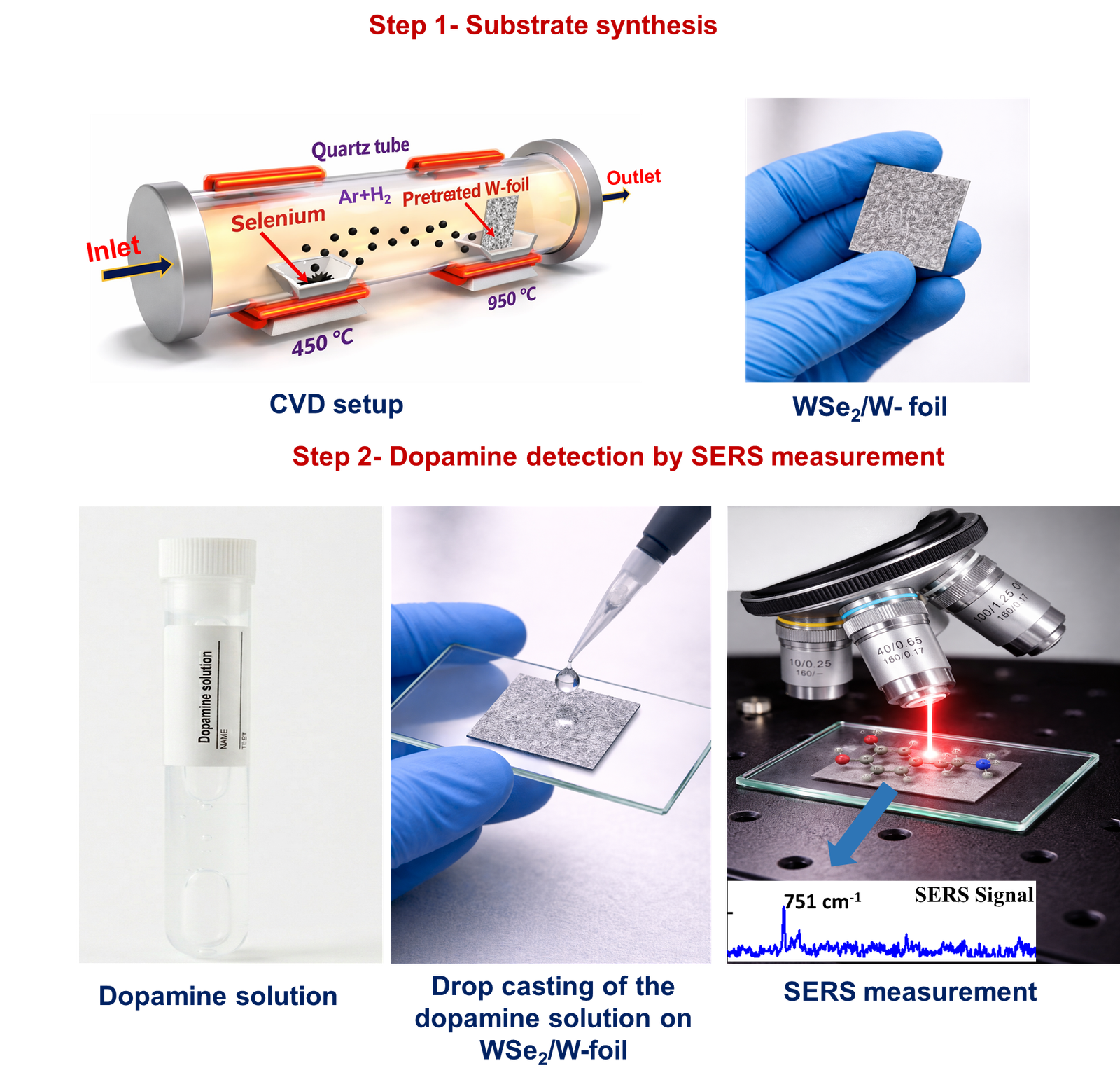
Our invention is a novel material-based biosensor, which can detect dopamine at very low concentrations using Surface-Enhanced Raman Scattering (SERS) technique. The SERS technique is based on interaction between substrate and analyte. Our sensor is based on a thin film of Tungsten Diselenide (WSe2) that is specially prepared on a tungsten foil substrate using Chemical Vapor Deposition (CVD) technique. The WSe2 grows as particulate nanostructures on tungsten foil, which provide good platform for dopamine to attach with its surface. The interaction of dopamine molecules with the surface of WSe2 produces powerful Raman signals, which allows more precise and reliable detection. One of the main specialties of the design is its high sensitivity. The biosensor can detect dopamine up to extremely low concentrations as low as 10-7 M (hundred nanomolar level). This sensitivity allows the measurement of small variations in dopamine levels, which is critical in the early diagnosis as well as monitoring of neurological disorders.
Our invention employs a comparatively simple process of fabrication of WSe2 based SERS biosensor, which is scalable and repeatable. The possible use of this biosensor is not limited to detection of dopamine only, but also can be used for detection of other biomolecules like vitamin B12, bilirubin etc. As it advances, it may find application in medical diagnostics, biosensing applications, pharmaceutical analysis, and neurological studies. This technology has the potential to revolutionize the next-generation biosensing platform using advanced nanomaterials and Raman spectroscopy that can be utilized in healthcare and biomedical research.