What inspired your team to work on multifunctional materials that combine energy storage and electrochromic properties?
In this era of global energy demand, the need for smart, energy-efficient and sustainable devices is crucial. Smart windows are used to effectively utilize the energy within the building and reduce overall energy consumption. The Smart windows, which work through electrochromism, consist of two electrodes, with one electrode containing an electrochromic layer and an electrolyte sandwiched between them. Generally, upon application of voltage, ion intercalation within the structure changes the device’s color. In any energy storage device, the energy storage mechanism primarily relies on charge intercalation/deintercalation. The materials, which are generally used as energy storage materials (such as carbon-based materials or some metal oxides), may not exhibit electrochromism and cannot be used in a smart window. However, if we can use one electrochromic material to make one smart window and utilise its energy storage properties during ion intercalation, it can serve both purposes simultaneously, without any extra energy cost. Additionally, the electrochromic property of a supercapacitor can serve as a real-time charge indicator, which is highly useful for smart displays and self-indicating energy devices. These were the inspiration to utilize a material’s multifunctionalities.
In simple terms, what does your material do, and how can it both store energy and change optical properties (like color or transparency)?
Our material is an oxygen-deficient bimetallic oxide. The material works as both an electrochromic and an energy-storage material.
A typical electrochromic device comprises two transparent conducting electrodes – one of which is coated with an electrochromic material, and the other is either a complementary electrochromic material or a bare electrode; and an ion-conducting electrolyte is sandwiched between the two electrodes. When a certain voltage is applied to the electrochromic electrode, the electrons move toward (or away, depending on the voltage bias) the electrode through the external circuit, and to balance the charge, the ions from the electrolyte intercalate into the structure (or de-intercalate, depending on the bias of the voltage). Through the intercalation of ions into the electrochromic material’s structure, the oxidation state of the metal changes, which leads to a change in the color or the optical state of the material. Through this ion intercalation, along with the color change, the material stores the charge, hence stores the energy. The ability to store charge is quantified by areal or specific capacitance. After reversing the applied voltage, the charges exit the structure and the material returns to its original optical state.
Your work focuses on a molybdenum–tungsten bimetallic oxide. What makes this combination unique compared to single-metal materials?
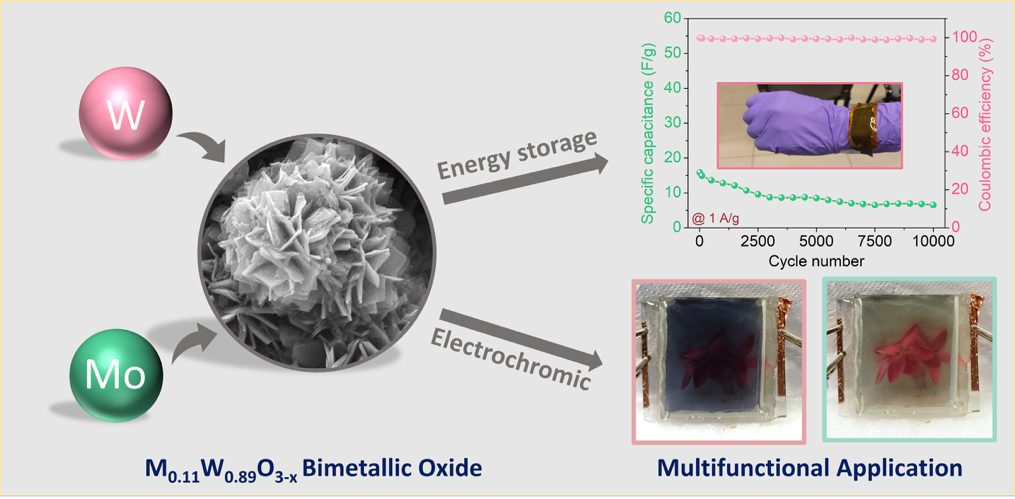
The material used in this work, oxygen–deficient molybdenum–tungsten bimetallic oxide, has outperformed individual metal oxides. Molybdenum oxide is well known for its strong redox activity and multiple oxidation states, but it exhibits poor electrochromic performance. On the other hand, tungsten oxide exhibits rich electrochromic performance with high optical modulation and high color purity, but shows limited energy storage performance. Therefore, combining these metals to form the metal oxide provides a high density of redox-active sites. Due to the presence of tungsten oxide, the bimetallic oxide can also exhibit electrochromic performance, with higher color contrast than a single metallic oxide, owing to enhanced ion intercalation. In addition, the material formed in this way exhibited a flower-like structure with a high surface area, a large interplanar spacing, and oxygen vacancies, which also contributed to high ion intercalation. Overall, the bimetallic oxide showed better electrochemical performance than the single metallic oxide.
How does your material improve performance in terms of energy storage and smart window applications?
The energy storage performance can be explained through the usual parameters – areal capacitance, specific capacitance, and cyclic stability. The material has exhibited a high areal capacitance of 975 mF cm−2 at a 5 mV s−1 scan rate, which is almost 1.5 times that of an individual tungsten oxide electrode and 3 times that of an individual molybdenum oxide electrode. It showed a high specific capacitance of 234 F g-1 at a current density of 5 A g-1, and remained stable for 1000 cycles at 10 A g-1. When integrated into a flexible device, it demonstrated 10,000 cycles of stability at a current density of 1 A g-1. The flexible device, consisting of a flexible electrode and a gel electrolyte, can operate similarly while bending to different radii and at both low and high temperatures.
As an electrochromic electrode, this material showed a good optical modulation with fast switching, with response and recovery times of 1.5 s and 3.5 s, respectively, and a high stability of 2000 cycles. While integrated as a device, it showed a high coloration efficiency of 146.65 cm2 C-1 at 700 nm.
Your study shows flexibility, stability, and fast response. Why are these features important for real-world applications?
For use in real-world applications, these features are highly demanding. For a wearable device or a smart window on a curved surface, flexibility is a crucial parameter, and any device should maintain its performance till a certain level of flexibility to support a wide range of applications.
Long-term reliability is also essential for any kind of electronic device. Whether it is in a smart window or an energy storage device, the consistent performance without degradation is what a customer wants for its practical use.
An electrochromic device can tune its color to the user’s requirements, and instant feedback is always expected, especially in smart display applications.
How do you see this technology being used in the future (for example, in buildings, wearable devices, or energy systems)?
This technology will definitely help build an energy-efficient building, where a user can simultaneously store charge through the window while modulating incoming electromagnetic radiation to reduce energy consumption. The material can also be used as a smart and wearable energy storage device, which can indicate different colors at different charge states. This will give the opportunity to build a compact system using a single material that can perform multiple tasks. This technology could enable smart, flexible, self-indicating energy systems, from buildings to wearables, where energy storage and functionality are seamlessly integrated into the material itself.