What motivated me to study greenhouse gas emissions in South Asia?
South Asia is home to nearly one-quarter of the world’s population and is undergoing rapid economic growth, urbanization, and industrial expansion. At the same time, it remains one of the world’s most climate-vulnerable regions, facing increasing risks from floods, cyclones, sea-level rise, heatwaves, glacier melting, and water stress. This contrast strongly motivated our research. While South Asian countries are contributing an increasing share of global greenhouse gas (GHG) emissions, millions of people across the region are also among the most vulnerable to climate-related disasters. Despite the urgency of this challenge, accessible long-term forecasting studies focused specifically on South Asia remain limited.
Our study aimed to provide a clear and data-driven picture of how regional emissions may evolve by 2030 and why timely policy action is becoming increasingly important for sustainable development and climate resilience.
How forecasting models help us understand future emission trends ?
To forecast future emissions, we used the ARIMA (Auto-Regressive Integrated Moving Average) model, a widely used statistical forecasting method designed to identify long-term patterns from historical data. Using greenhouse gas emissions data from 1975 to 2023, the model estimates future emission trajectories based on past trends and structural changes. In simple terms, ARIMA helps us understand how factors such as industrialization, economic growth, urbanization, and energy consumption may shape future emissions. By analyzing historical momentum, the model can project likely future pathways under existing development patterns.
This type of forecasting is especially valuable for regions like South Asia, where long-term environmental planning is essential for evidence-based policymaking, climate adaptation, and sustainable economic development.
Why emissions are continuing to rise across South Asia ?
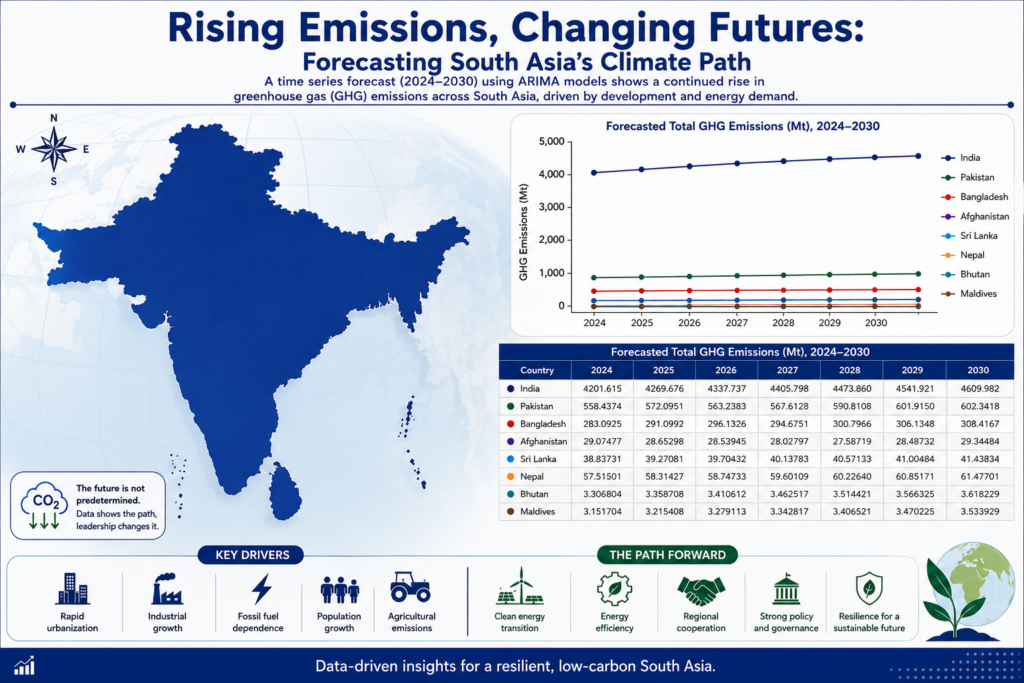
Our projections indicate a continued rise in greenhouse gas emissions across much of South Asia over the coming years. Several interconnected factors are driving this increase.
Rapid urbanization and industrial growth are expanding energy demand throughout the region. Many South Asian economies still depend heavily on fossil fuels such as coal, oil, and natural gas to support electricity generation, manufacturing, transportation, and infrastructure development. As economies grow and living standards improve, energy consumption also rises significantly. Population growth further intensifies pressure on energy systems and natural resources. In addition, agriculture remains an important contributor to emissions through methane and nitrous oxide released from livestock production, rice cultivation, and fertilizer use.
Although renewable energy adoption is gradually increasing across South Asia, current transitions are still not occurring fast enough to offset the region’s expanding energy and infrastructure demands.
India’s growing role in regional and global climate strategies
Our forecasts suggest that India could reach approximately 4,610 MtCO₂e by 2030, making it by far the largest emitter in South Asia. This finding highlights India’s central role in shaping both regional and global climate outcomes. As one of the world’s fastest-growing economies, India faces the complex challenge of balancing economic development with climate responsibility. The country’s decisions regarding energy transition, industrial policy, transportation systems, and renewable energy investment will significantly influence future emissions trajectories
across the region. At the same time, India also holds enormous potential to lead South Asia’s clean energy transition. Investments in renewable energy, green technology, sustainable infrastructure, and energy efficiency could position. India as a global example of low-carbon development among emerging economies.
Balancing low emissions with high climate vulnerability
One of the most important findings of our study is the contrast between emission levels and climate vulnerability within South Asia. Countries such as Bhutan and the Maldives contribute only a very small share of regional greenhouse gas emissions, yet they face some of the highest climate risks. The Maldives is extremely vulnerable to sea-level rise, while Bhutan’s fragile mountain ecosystems are highly sensitive to changing climatic conditions. This reflects a broader issue of climate justice: nations with the lowest emissions are often among the most vulnerable to climate impacts. As a result, policymakers across South Asia need differentiated strategies. Larger economies must prioritize emission reduction and clean energy transition, while smaller and more climate- sensitive countries require stronger adaptation support, including climate-resilient infrastructure, disaster preparedness, ecosystem protection, and improved access to international climate finance.
Regional cooperation will also be essential for addressing these shared environmental challenges effectively.
The path forward: balancing economic growth and climate responsibility
Our findings indicate that current emission trends are not inevitable outcomes but warning signals that can still inspire meaningful action. South Asian countries have an opportunity to pursue a more sustainable and climate-resilient future through a combination of strategic investments, policy reforms, and regional collaboration. Expanding renewable energy sources such as solar, wind, and other clean technologies can significantly reduce long-term dependence on fossil fuels while supporting economic growth. Improving energy efficiency across industries, transportation systems, and urban infrastructure can further lower emissions without compromising development objectives. At the regional level, stronger cooperation through technology sharing, clean-energy partnerships, and coordinated climate initiatives can accelerate progress and enhance collective resilience. Climate considerations should also be integrated into national development and infrastructure planning so that economic and environmental goals are addressed together rather than as separate agendas. In addition, smaller and highly climate-vulnerable countries require increased adaptation funding and targeted resilience-building measures to better cope with the impacts of climate change.
Ultimately, South Asia’s future will depend on its ability to redefine development in a way that balances economic progress with environmental sustainability. While the challenges are substantial, the opportunities are equally significant. Through evidence-based planning, coordinated policies, technological innovation, and strong regional partnerships, the region can chart a pathway toward a more resilient, low-carbon, and climate-conscious future that benefits both present and future generations.