What are emulsions, and why are they important in medicine and drug delivery?
Emulsions are the mixture of two immiscible liquid oil and water stabilised by emulsifying agent. The emulsifier adsorbs at oil-water interface and disperses the tiny droplets in the other phase. Common everyday examples of emulsion includes milk, cream, and lotions. Most of the pharmaceutical drugs are poorly water soluble as a result they pose problem in developing liquid medicinal products (e.g syrup, lotion). Also, the poor solubility makes it difficult for drugs to dissolve and absorb inside the body. The emulsion provides an advantage of solubilising the drug in oil which is dispersed in water phase. Thus, emulsions help to increase solubility and absorption of drug thereby improving its bioavailability.
In simple terms, what is the difference between microemulsions and nanoemulsions?
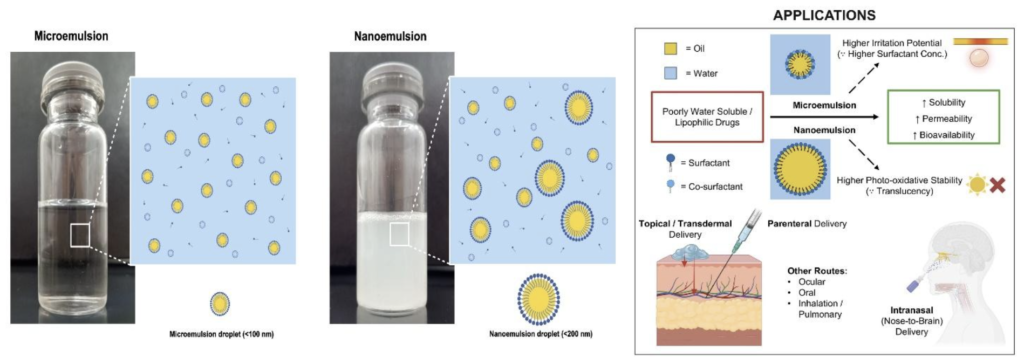
The conventional emulsion generally has the size ranges from about 0.1 to 100 µm, others with smaller size are microemulsion and nanoemulsion. Both microemulsion and nanoemulsion are the dispersion made of water, oil, and surfactant(s) but they differ mainly in stability and formation. Microemulsion is an isotropic and thermodynamically stable system with dispersed domain diameter varying approximately from 1 to 100 nm, usually 10 to 50 nm. Nanoemulsions are kinetically stable colloidal dispersions containing small fluid droplets (d < 200 nm). Thus, the prefix micro- and nano- is misnomer, practically, the microemulsions has smaller droplet size compared to nanoemulsion.
How do these tiny droplets help improve the effectiveness of medicines, especially those that are difficult to deliver in the body?
I would like to give an example of a commonly used traditional remedy for cough and cold which includes turmeric milk. The actives of turmeric are soluble in milk as they are lipophilic, so unlike water, it gets dissolved in milk and get absorbed easily providing relief against cough and cold. Similarly, poorly water-soluble medicines get dissolved in the oil phase of emulsion which helps in the absorption of medicines. Compared to the emulsions, microemulsion and nanoemulsions have smaller droplet size which enables greater permeation in the tissues. Thus, these tiny droplets help to increase solubility, permeation, bioavailability and stability of the medicines.
Your work highlights differences in stability and formation. Could you explain these concepts simply?
Ideally, mixing oil with water results in phase separation of these two, in order to make stable dispersion we add emulsifier. Emulsifier adsorbs at oil-water interface and tries to stabilise the system and keeps the droplets of oil dispersed in water. However, due to gibb’s free energy, the system tends to phase separate with time. The microemulsion uses high concentration of surfactant which helps to reduce interfacial tension between oil and water. They are formed low energy method like simple stirring and remains stable to long time. They also use cosurfactants to assist the surfactants in reducing the interfacial tension between oil and water. Nanoemulsions are prepared with low amount of surfactant (mostly without any cosurfactant) which as a result generally requires high energy (e.g sonication, high pressure homogenisation, microfludisation) to prepare nanoemulsion and they tend to separate in short or long time. Sometimes, nanoemulsions are prepared by low energy method which again requires high concentration of surfactant. Thus, microemulsions are long term stable system prepared by low energy method (e.g simple stirring) using high surfactant concentration and cosurfactants. Nanoemulsions are comparatively less stable system formed by both high and low energy methods using less concentration of surfactants and mostly without the use of cosurfactants.
What was the most surprising or interesting insight that emerged from your study?
Microemulsion and nanoemulsion has overlap in physicochemical and structural characteristics has led to great confusion about these two systems. The interchangeable use of the terms ‘microemulsion’ and ‘nanoemulsion’ is a serious error that is becoming increasingly common in the scientific literature, causing confusion and inaccurate reporting. So, we have shown three practical ways to distinguish them which are as follows:
(a) Long-term stability: The monitoring of size of droplet over time, if shows increase in droplet size it indicates a nanoemulsion system, whereas no change is consistent with microemulsion. (b)Reversibility of structural changes upon temperature variation: The observation of size of emulsion at room temperature and then increasing the temperature of (10 ◦C or higher) and subsequent return to the original temperature and measure the size again. The reversible recovery to the initial values of size indicates thermodynamic stability, characteristic of ME, whereas changes in size indicates the system is nanoemulsion. (c) Order of component mixing: By changing the order of mixing if there is no change in the properties of emulsion it is microemulsion. However, if the order of mixing affects the system it is nanoemulsion.
How can these systems be used in real-world healthcare, and what challenges remain before their wider application?
There are many marketed products on colloids used in healthcare and cosmetics. Few antimicrobial or antiviral drugs like cyclosporine A and Ritonavir are given as emulsions through oral route to increase the solubility and absorption of these drugs. There are also topical and parenteral products of painkiller emulgel and propofol anaesthesia injections. Thus, there is lot of application of these products in healthcare and many of them are available in clinical use.
However, the major challenge with these tiny droplet based systems lies in large-scale manufacturing as maintaining consistent droplet size, stability, and drug loading at industrial scale remains technically demanding and expensive. The emulsifiers and stabilisers used needs to be safe, non toxic and biocompatible. Thus, the selection of surfactant and its concentration plays a crucial role in the toxicity and health hazards to individual. Researchers are continuing to develop more stable, cost-effective, and patient-friendly formulations to make these advanced delivery systems more widely available in modern medicine.