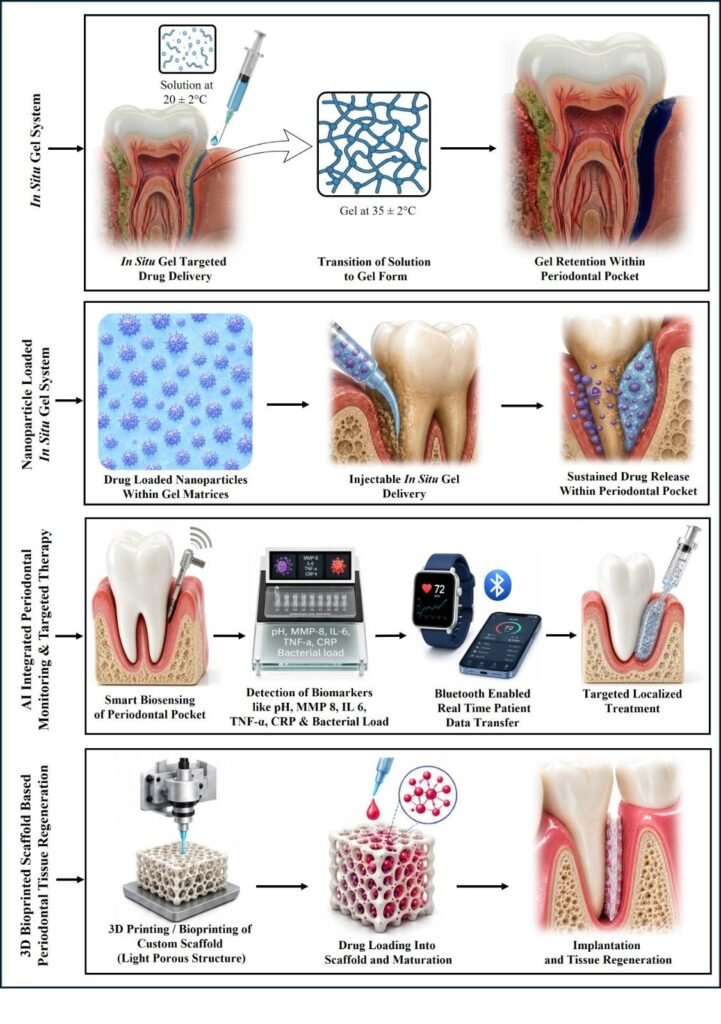
The increasing interest in advanced drug delivery systems for the management of periodontitis stems from the complex, chronic, and site-specific nature of the disease, which continues to pose significant challenges to conventional treatment strategies. Periodontitis is a biofilm-driven, host-mediated inflammatory disorder in which a dysbiotic microbial community initiates and sustains immune responses that progressively destroy tooth-supporting tissues. This destruction is not uniform but instead occurs within the periodontal pocket, a confined, irregular, and structurally complex niche that both limits drug access and protects pathogenic biofilms. Within this microenvironment, keystone pathogens such as Porphyromonas gingivalis and Streptococcus mutans contribute to the formation of a resilient biofilm matrix that restricts drug penetration and enhances antibiotic tolerance. Simultaneously, the host immune response promotes connective tissue destruction and alveolar bone loss through cytokine release, matrix metalloproteinase (MMP) activation, oxidative stress, and receptor activator of nuclear factor κB /osteoprotegerin imbalance. As these microbial and host factors continuously interact, they create a dynamic yet localized disease environment, thereby establishing a clear rationale for exploring more precise and responsive drug delivery systems.
This understanding of disease complexity naturally explains why conventional treatment strategies often fail to produce long-term clinical success. Systemic drug administration, although widely used, is inherently limited by insufficient drug retention at the periodontal site, leading to subtherapeutic concentrations. Conventional topical formulations have been developed to overcome these limitations; however, their effectiveness is often restricted by rapid diffusion and inadequate retention within the periodontal pocket. Continuous salivary washout and gingival crevicular fluid turnover contribute to rapid drug elimination and poor penetration into the biofilm structure. As a result, these systems are unable to maintain sustained therapeutic drug levels or effectively eradicate the organized biofilm, leading to incomplete disease management and recurrent infections. Therefore, the disparity between the localized, protected nature of periodontal disease and the short-lived action of conventional delivery systems has driven the need for more advanced, adaptive, and site-specific therapeutic approaches.Addressing this gap has led to the emergence of smart in situ gel systems, which fundamentally redefine how drugs are delivered within the periodontal environment. In contrast to conventional formulations, these systems exist as low-viscosity liquids that can be conveniently administered into the periodontal pocket with minimal invasiveness. Following administration, they undergo a stimuli responsive sol-to-gel transition induced by physiological conditions within the periodontal microenvironment, such as pH, temperature, ionic concentration, and enzymatic activity. This transformation produces a semi-solid matrix that closely adapts to the irregular architecture of the periodontal pocket, thereby ensuring localized and site-specific drug delivery. In addition, the gel matrix establishes intimate contact with the diseased tissues and acts as a localized drug reservoir, resulting in improved residence time and sustained retention. Consequently, these systems offer a considerable advantage over conventional formulations that lack such adaptive and prolonged delivery characteristics.
During active periodontitis, the periodontal microenvironment undergoes a shift toward a slightly alkaline pH, a condition that can be effectively utilized by pH-responsive polymers such as Carbopol. Under these conditions, ionization of polymeric carboxyl groups of the Carbopol induces swelling and network formation, leading to enhanced viscosity, mucoadhesion, and targeted drug retention. Simultaneously, the presence of divalent cations such as calcium and magnesium ions in gingival crevicular fluid enables ion-sensitive polymers like alginate and gellan gum to undergo rapid crosslinking through ionic bridging mechanisms, resulting in mechanically stable gels that resist washout. Building upon these mechanisms, thermosensitive polymers such as Poloxamer 407 introduce temperature-triggered gelation, allowing formulations to remain fluid during administration (20-25°C) while rapidly solidifying at physiological temperatures (37°C). Further enhancing this responsiveness, enzyme-sensitive systems, including peptide-crosslinked hydrogels, can utilize the elevated matrix metalloproteinase levels present within the periodontal pocket to dynamically modulate gel behavior and control drug release. Integration of these physiological triggers into multi-responsive systems enhances stability, prolongs retention, and enables precise site-specific drug delivery, thereby addressing the complex challenges of periodontal therapy
As these smart systems continue to evolve, recent advances in nanotechnology, artificial intelligence, and 3D printing are further expanding their capabilities and redefining their clinical potential. The incorporation of drug-loaded nanoparticles into gel matrices enhances drug stability and promotes deeper penetration into dense biofilms, thereby improving antimicrobial efficacy while enabling controlled, multi-phase drug release. Simultaneously, artificial intelligence and computational modelling are increasingly being utilized to predict polymer behaviour and optimize formulation parameters. These approaches also facilitate the customization of drug release kinetics according to patient-specific disease characteristics, introducing a new level of personalization into periodontal therapy. This integration is further strengthened by digital diagnostic tools, including intraoral sensors and wearable monitoring devices, which enable real-time monitoring of critical disease markers such as inflammatory cytokines, and periodontal pocket depth. The resulting data-driven insights support the development of adaptive, feedback-controlled drug delivery systems capable of dynamically responding to disease progression. Complementing these advancements, 3D printing and bioprinting technologies are enabling the fabrication of customized scaffolds with tunable porosity and controlled drug distribution. In addition to localized drug delivery, these systems possess regenerative capabilities, thereby extending their application toward periodontal tissue regeneration. Furthermore, hybrid strategies combining injectable gels with 3D-printed constructs provide an effective balance between minimally invasive administration and structural support, ultimately enhancing therapeutic outcomes.These technological advancements collectively translate into meaningful improvements in real-world dental care, where precision, efficacy, and patient comfort are critical considerations. Smart in situ gel systems are minimally invasive and easy to administer, reducing procedural complexity while enhancing patient acceptance. Their ability to maintain therapeutic drug concentrations at the site of infection over extended periods reduces dosing frequency and improves compliance, which is particularly important in managing chronic conditions such as periodontitis. At the same time, sustained and localized drug release enhances biofilm disruption, minimizes systemic exposure, and reduces the risk of adverse effects and antimicrobial resistance. By adapting to the periodontal microenvironment and integrating emerging technologies, these systems enable precise and personalized treatment strategies. Smart in situ gel systems represent a progressive shift from conventional, passive drug delivery approaches toward intelligent, adaptive therapeutic platforms. By integrating site-specific targeting, sustained retention, and responsiveness to physiological stimuli with advancements in nanomedicine and artificial intelligence, these systems are well suited to address the complex nature of periodontitis. As a result, they offer a cohesive and forward-looking strategy for improving treatment outcomes, advancing personalized care, and ultimately transforming the management of periodontal disease.