This article is currently maintained under temporary RFCSR publication support until 13 June 2026.
Rising global energy demand has made two problems impossible to ignore: the rapid decline of fossil fuel reserves and the environmental damage caused by burning them. This has intensified the search for cleaner, sustainable alternatives. Hydrogen is one of the most promising, producing only water in fuel cells. Yet its adoption is limited by challenges in safe storage and transport, and by the fact that most hydrogen is still produced from fossil fuels.
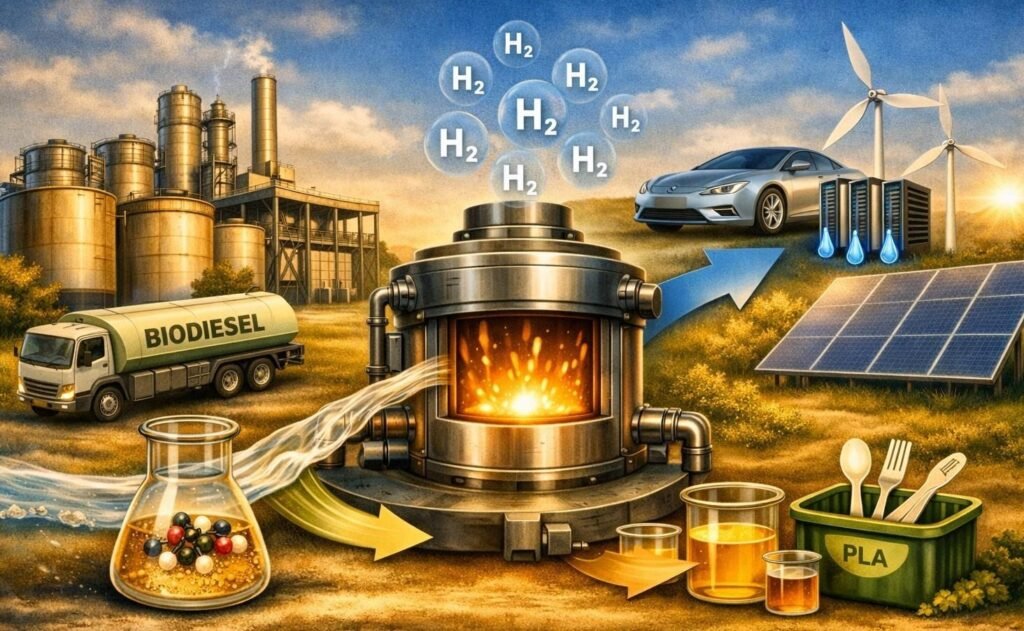
Meanwhile, the biodiesel industry generates large amounts of glycerol—about 1 kg for every 10 kg of biodiesel. This crude glycerol is cheap, non-toxic, easy to store, and widely available, making it an attractive renewable feedstock. Hydrogen can be produced from glycerol, but current methods require very high temperatures and often generate carbon monoxide and carbon dioxide, gases that both harm fuel cells and reduce hydrogen’s environmental benefits.
The invention described here offers a cleaner, safer, and far more efficient solution. It introduces a new catalytic process that converts glycerol into hydrogen and lactic acid at remarkably low temperatures—between 90 °C and 120 °C. This is achieved using a specially designed ruthenium–copper catalyst. Under basic conditions, glycerol undergoes a dehydrogenation reaction that releases hydrogen while simultaneously forming lactic acid, a valuable chemical widely used to produce biodegradable plastics such as polylactic acid (PLA). As a result, the process not only generates clean energy but also produces an eco-friendly industrial product.
What makes this invention particularly significant is its efficiency and practicality. While earlier catalytic systems required temperatures above 200 °C to produce hydrogen, the new catalyst operates effectively at around 110 °C and delivers a high hydrogen yield of 95–99%. This dramatic reduction in operating temperature lowers energy consumption, making the process more economical and environmentally friendly. Moreover, the catalyst can be easily recovered, and reused, and shows remarkable robustness and durability – an essential feature for industrial-scale applications.
The invention also addresses one of the biggest barriers to widespread hydrogen adoption: safe storage and transport. Instead of relying on heavy, high-pressure hydrogen cylinders, industries can transport glycerol, a stable liquid. Hydrogen can then be generated on-site whenever needed. This approach is safer, more cost-effective, and far more convenient.
In alignment with the global clean-energy initiatives such as Mission Innovation and India’s National Hydrogen Energy Mission, the team led by Prof. Sanjay K Singh has been working on the idea for producing CO2-free hydrogen from various carbon-based feedstocks recovered from biomass, biodiesel and even plastics. The key feature of the developed processes is the production of CO2-free hydrogen gas along with the high value products, such as formic acid, lactic acid, and transforming a low-value industrial byproduct into a clean, high-value energy source using a highly efficient catalyst. They have been granted several patents on hydrogen production. He is currently working on scaleup of the developed processes through his own startup Revive CleanTech Pvt. Ltd.
In summary, their processes offer a practical pathway toward greener hydrogen production, safer storage, and added economic value through lactic acid co-production, bringing us a step closer to a sustainable energy future.