This article is currently maintained under temporary RFCSR publication support until 13 June 2026.
The maintenance postharvest shelf life of fruits and vegetables throughout the supply chain is the biggest challenges around the world. Postharvest losses are accounted around 30-40% due to various factors including physical, mechanical, chemical and biologicals. The postharvest losses may be depending on the type and nature of the commodity; it occurs higher in highly perishable fruits and vegetables. The postharvest not only affected the economy but also contributed to the degradation of environmental due to emission of green house gases such as CO2 and other. According to the Food and Agriculture Organization (FAO) of the United Nation, the food losses including postharvest losses and wastage are mainly responsible for the emission of 4.4 giga tonnes of greenhouse gases in the environment and direly affected the food safety, food security, economic value and environmental conditions. The major cause of postharvest losses includes the poor temperatures, oxidation/respiration rate, mechanical damage, microbial contamination, poor packaging and higher water losses, which factors reduced the shelf life of produces. To overcome the postharvest losses, various technology such as cold chain transport and packaging can be used. However, the packaging is one of the important factors that protect the produced from external and internal factors. Various types of packaging i.e. plastics, synthetic polymers have been used to maintained quality characteristics and shelf life of produces. Despite, the advantages of the plastic and synthetic based packaging, the encounters the environmental degradation due to their synthetic nature, non-biodegradability, non-toxicity and lack of biocompatibility. However, edible coating made from the natural derived biopolymers such as polysaccharides, protein and lipid/wax are good alternatives to plastic and synthetic packaging for the postharvest shelf-life extension of fresh produce by retarded the weight loss, enzymatic browning, oxidation and quality loss throughout the supply chain and storage period. These biopolymers derived from natural resources such as plants and animals, are biodegradable, non-toxic, and safe for consumption. The edible packaging can be applied on the produces in form of liquid (coating) and solid wrapping materials (films) by various deposition methods. The various type of enhancer such as plasticizers, crosslinkers, emulsifiers, active agents such as plant extract and essential oil encapsulated in the edible coating and films to improve their mechanical, flexibility, thermal, functional and antimicrobial properties, which helps to maintain the integrity of the coating and film for a longer period on the produces. Howbeit, the several advantages of alone polysaccharide, protein and wax based coating, they are poor in water barrier, gas barrier, thermal stability and brittle in structure, resulted off flavour of produce and less effective in preservation.
To thwart alone biopolymer-based coating and films issues, the composite of these biopolymers is possessing excellent functional, mechanical, thermal, structural antimicrobial and UV/water & gas barrier properties due to molecular interaction and microphase separation between the biopolymer matrixes, which resulted in increasing surface area of matrix and showed higher functionality. The biopolymer based composite packaging (coating and films) can be developed in binary or ternary complex including polysaccharide – polysaccharide, polysaccharide – protein, protein – protein, polysaccharide-wax, protein-wax and combination of all these matrixes to achieving excellent protection efficiency of packaging from microbial spoilage, water loss and oxidation.
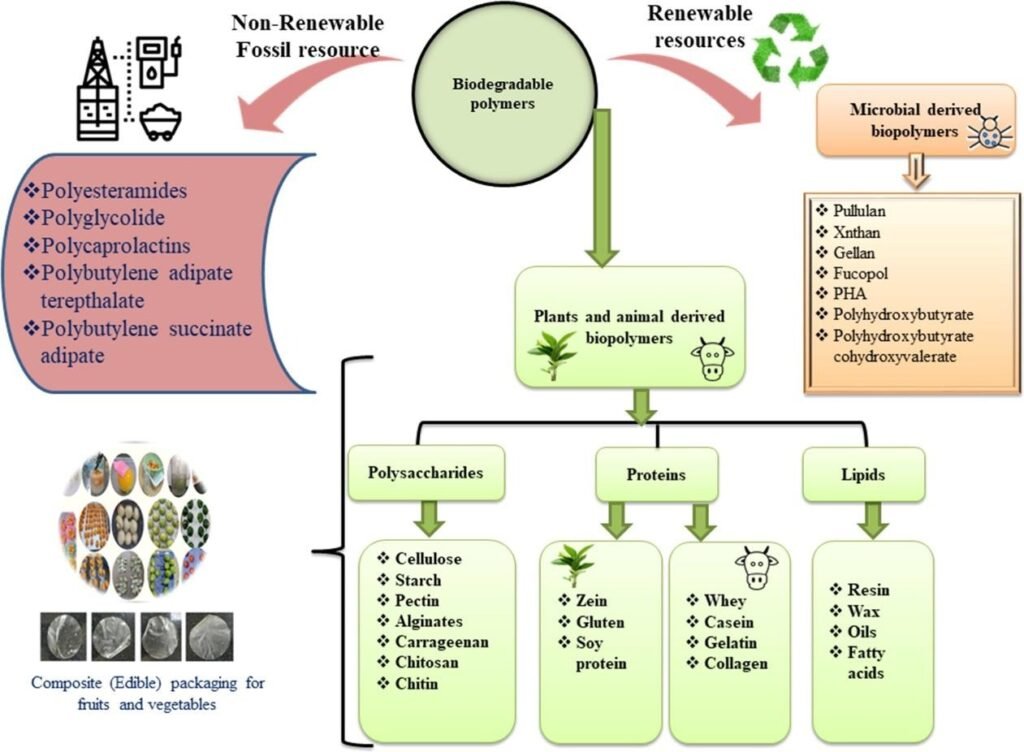
Different types of renewable and non-renewable biopolymers found in nature and their applications in the formation of composite packaging (coating/films) and deposition methods of composite coating on fruits & vegetables and applications of composite films as a wrapping material.
The application of composite coating and films significantly prolonging the shelf life of fruits and vegetables due to retarded the weight loss, microbial loads, TSS, acidity, TSS: TA ratio, oxidation, respiration, ethylene production, enzymatic browning with maintained color attributes, and consumer acceptability in comparison with alone biopolymer-based coating. This may be due to higher water and gas barrier properties (hydrophobic nature) of the composite packaging achieved due to molecular interaction between matrix and encapsulation of active and other texture enhancer such as plasticizers, active agents and nanomaterial etc. In addition, the agro waste can be also utilized to extract and isolates biopolymers for development of composite packaging for postharvest management.
The biopolymer based composite packaging is aligned with the sustainable development goal (2030) such as 2, 3, 12 and 13, which are stands for good health and wellbeing, economic growth, responsible consumption and production and climate action, respectively and helps in enhancing bio-circular economy due to valorization of agro waste to extraction of starch, protein and other valuable compounds for composite packaging application.
The composite packaging challenges such as interfacial tension, mechanical integrity, adhesion, solubility, durability, application uniformity, anaerobic respiration in fruits and vegetables, cracking/flaking, sensory impacts, allergenicity, cost of matrix, consumer acceptability, life cycle complexity and regulatory aspects limits their applications. The further study should be required to address the challenges of composite packaging formation and applications. The high-pressure methods such as ultrasonication, microfludization and ultrasound could be used to improving the structure and integrity of the composite formulations.