What inspired you to investigate how fruit flies respond to gut infections, and why is this an important model system?
Every year, millions of people suffer from foodborne illnesses caused by bacteria of the Enterobacteriaceae family, and most conventional treatments focus on killing the bacteria with antibiotics. We kept coming back to a different question: what if the host itself has smarter, built-in mechanisms to clear an infection? Drosophila melanogaster turned out to be the ideal model to study this. Despite being a simple organism, the fruit fly shares striking evolutionary conservation with humans (particularly in its innate immune cascades, signal transduction pathways and transcriptional regulators), so what we learn in the fly often translates to higher animals. It also has a relatively low-complexity microbiome and relies solely on innate immunity, which lets us study a coordinated, whole-organism response without the confounding layer of adaptive immunity. Much of this began as coffee-table discussions between Dr Marathe and Dr Tare, in the lab about how any gut, be it yours, mine, or a fly’s, actually fights a bacterial infection, and the project took shape when Shreya Verma joined with a background in fly husbandry and a keen interest in host–pathogen interactions.
For readers unfamiliar with the topic, how do fruit flies defend themselves against harmful bacteria that enter through food?
To combat bacteria, the fly relies entirely on its innate immune system. This provides fly a rapid non-specific defense against invading pathogens. Upon bacterial invasion, two immune pathways – IMD and Toll are activated which leads to the production of antimicrobial peptides. Additionally, flies also have immune cells like hemocytes which phagocytose the invading bacteria.
Your study found that fruit flies can actively expel pathogens from their gut. How does this process work in simple terms?
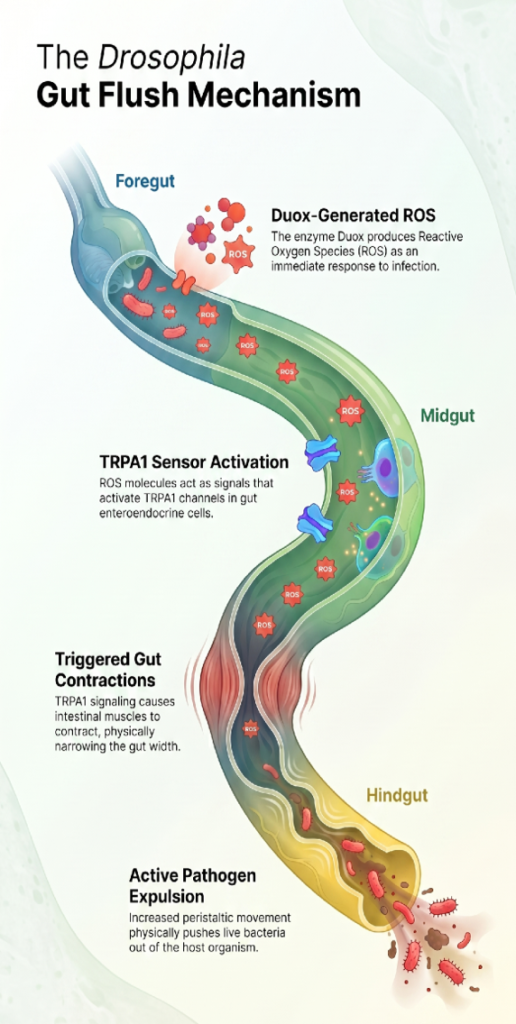
In simple terms, the fly physically pushes the bacteria out. When bacteria are ingested, a sensor channel called TRPA1, found in the enteroendocrine cells of the gut, becomes activated. Once switched on, TRPA1 triggers signals that make the intestinal muscles contract. Those rhythmic contractions are peristalsis, the same wave-like squeezing that normally moves food along the gut, and here they serve to flush the live bacteria out of the body. We could see signs of this as we recovered live bacteria being shed by the infected flies. So rather than only trying to kill the invaders chemically, the fly uses gut movement to expel them.
What role do reactive oxygen species (ROS) and the TRPA1 pathway play in controlling gut infections?
Within just 4 hours of ingesting the bacteria, the fly gut activated its initial line of defence and rapidly produced reactive oxygen species (ROS). These molecules are reactive and powerful enough to damage any macromolecule, including bacterial membranes. However, ROS, when left unchecked, begins destroying the fly’s own cells. The ROS levels dropped by 24 hours post-ingestion, suggesting a preventive mechanism in place. Then, at 48 hours post-ingestion, ROS levels surged again. The team traced the ROS production primarily to an enzyme called Duox (Dual Oxidase), which acted as the gut’s main ROS factory. Remarkably, all of this was happening solely in the gut, leaving the rest of the body at peace.
One interesting finding was that different bacterial species triggered different responses. What were the most surprising differences you observed?
The most striking thing was within just 48 hours of bacterial ingestion, the flies cleared nearly all bacterial species, although E. cloacae persisted briefly (at least 72 hours post ingestion) before being gradually pushed out of the body.
Additionally, S. Typhimurium and E. cloacae induced TRPA1, accompanied by their shedding. However, K. pneumoniae was the real mystery: ROS was high but TRPA1 was not induced, yet the flies still excreted it, pointing to a TRPA1-independent route as well. Despite all these differences, by 15 days post infection no bacteria could be recovered from any group, and very few flies died.
How could insights from fruit fly gut immunity help scientists better understand infection control and gut health in other animals, including humans?
Since TRPA1 and Duox have counterparts in the human gut, it’s possible that a similar mechanism operates in humans as well.
This raises Important concerns: what would happen to bacterial expulsion when gut contractions are reduced by antispasmodic drugs in certain diarrheal conditions? While these medications may alleviate discomfort, are we also hindering the host’s ability to effectively defend against the infection? Validating this mechanism in a mammalian model system could help address these questions.
Clinically, gut-motility disorders such as irritable bowel syndrome and bacterial gastroenteritis are linked to Intestinal contractions. Our work emphasis on the message that not all discomfort is a sign of weakness; sometimes those contractions mean the body is fighting back.
What are the next key questions your team hopes to explore about host–pathogen interactions and gut defence mechanisms?
Our future work aims to better understand these responses mechanistically and to map out the differential way fly activates and regulates these pathways against different pathogens. Beyond that, we are interested in whether these natural host defences can be repurposed to improve the way gastrointestinal infections are treated.