What inspired your team to develop a light-switchable artificial enzyme, and what scientific challenge were you aiming to address?
Our inspiration came from nature’s remarkable ability to regulate chemistry with precision. Nature has been regulating chemistry for billions of years. Photosynthesis is one of its most remarkable examples – plants, algae, and photosynthetic microorganisms capture light energy to drive chemical reactions that transform CO2 and water into glucose. Yet light does more than power photosynthesis. In living systems, it also helps regulate processes such as plant growth, development, flowering, and responses to environmental conditions.
Enzymes are central to this remarkable control. They accelerate chemical reactions with extraordinary speed and selectivity, while their activity can be regulated by environmental signals to ensure that chemistry occurs at the right time and place. Nature therefore demonstrates a powerful principle: Chemistry becomes more useful when it can be precisely controlled.
Inspired by these strategies, we asked: Can an organocatalytic system operate in water and be reversibly switched ON and OFF using light? Rather than trying to reproduce the enormous complexity of a natural enzyme, we followed a philosophy of “doing more with less.” Could relatively simple molecules organize themselves into a sophisticated functional system?
The answer lies in supramolecular chemistry the science of how molecules recognize one another and assemble through reversible, non-covalent interactions. When simple molecular building blocks work together, they can produce functions far beyond those of the individual molecules.
Your study combines light-responsive molecules, supramolecular assembly, and enzyme-mimetic catalysis. Could you explain how these components work together to switch the catalyst between its “ON” and “OFF” states?
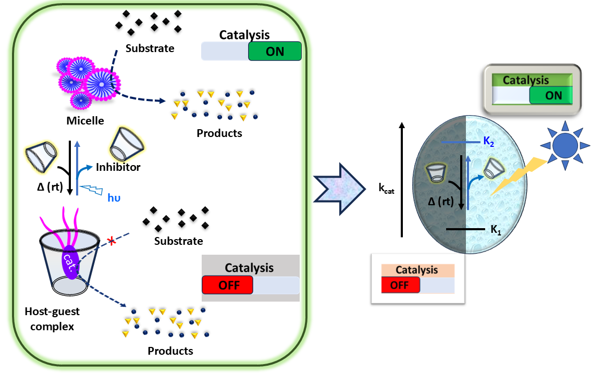
The system works through a coordinated sequence of molecular switching, self-assembly, and molecular recognition. Our design combines an imidazole unit, capable of participating in catalysis, with azobenzene, a well-established molecular photoswitch. The resulting molecule, Azo-Imd, brings catalytic activity and light responsiveness into a single molecular system.
Its most interesting behavior emerged in water. Rather than remaining as individual molecules, Azo-Imd spontaneously organized into vesicular nanostructures. When exposed to light, the azobenzene component underwent reversible trans-to-cis photoisomerization a change in molecular shape that triggered a larger structural transformation from vesicles to micelles. Thus, light did more than change one molecule. A tiny molecular movement was amplified through self-assembly to reorganize the entire catalytic environment.
But structural change alone was not enough. We wanted the catalyst itself to switch between OFF and ON states. The crucial ingredient was β-cyclodextrin (β-CD), a cyclic sugar molecule with a hydrophobic cavity that can selectively host suitable molecules. In the absence of light, β-CD preferentially captures the trans form of Azo-Imd. This effectively hides the catalytic imidazole group from the substrate, placing the catalyst in its OFF state.
Light changes Azo-Imd into its cis form. This shape no longer fits comfortably within the β-CD cavity, so the catalyst is released. It then self-assembles into catalytically active micelles, exposing the imidazole group and switching the system ON. The activated catalyst promotes ester hydrolysis in water. As the photoswitch gradually returns to its original form, the catalyst can again be captured by β-CD, restoring the OFF state.
The entire process can be viewed as a molecular smart home: Light is the remote control, β-CD is the smart lock, and supramolecular assembly creates the catalytic environment. The catalyst is already present—the signal simply controls access to its active site.
One of the most intriguing aspects of your work is the ability to control chemical reactions simply by using light. Why is light considered such a powerful tool for regulating catalytic processes compared with conventional chemical triggers?
Light is an especially powerful tool for programmable chemistry. Conventional triggers such as acids, bases, or additional chemical reagents can change the reaction environment and may generate unwanted by-products. Light can initiate molecular transformations without adding another chemical reagent.
It can also provide exceptional spatiotemporal control. In principle, a catalyst could be activated precisely when and where it is needed. This makes light-responsive catalysis attractive for developing more adaptive and potentially sustainable chemical processes.
Your artificial catalyst operates in water and mimics certain features of natural enzymes. How closely does this system resemble biological enzymes, and what advantages does it offer over traditional synthetic catalysts?
Our system is not intended to replace biological enzymes. Natural enzymes are extraordinarily sophisticated molecular machines refined through billions of years of evolution. Instead, our goal was to capture some of their most useful principles. The artificial catalyst operates in water, creates a localized catalytic environment through supramolecular organization, and displays Michaelis–Menten-type kinetics, a framework commonly used to describe enzyme-catalyzed reactions. Most importantly, its catalytic activity can be reversibly controlled by an external stimulus.
The lesson is that sophisticated function does not necessarily require a sophisticated molecule. Here, molecular recognition, self-assembly, and photoswitching work together to generate enzyme-like behavior.
What are the most promising real-world applications of light-switchable catalytic systems? Could they eventually contribute to greener chemical manufacturing, smart materials, or biomedical technologies?
The present work is fundamental research, but the concept points toward exciting possibilities. In green chemistry, catalysts that operate only when required could eventually help reduce unwanted reactions and chemical waste. In smart materials, similar systems could contribute to responsive coatings, polymers, hydrogels, and other materials whose chemical behavior can be programmed.
There may also be opportunities in biomedical technologies, including responsive therapeutic materials and controlled molecular systems. However, these remain future possibilities rather than demonstrated applications of the present catalyst.
Every breakthrough comes with challenges. What are the current limitations of this technology, and what improvements are needed before similar systems can be applied beyond the laboratory?
Important challenges remain. The current system has been demonstrated using a model reaction under controlled laboratory conditions. Future systems will need to work with a broader range of chemical transformations while offering greater efficiency, stability, and robustness. A particularly important goal is developing catalysts that respond effectively to visible light or sunlight, rather than ultraviolet irradiation. Researchers must also understand how these systems behave in complex chemical and biological environments. These challenges are not simply barriers they are opportunities to make programmable catalysis increasingly practical.
Looking ahead, how do you envision the future of programmable catalysis and artificial enzyme systems? What exciting developments should scientists and the public watch for in the coming years.
The broader significance of this work lies in its design philosophy. By combining simple molecular building blocks with supramolecular self-assembly, we can create chemical systems capable of responding dynamically to their surroundings. Future artificial enzymes may incorporate multiple molecular switches, respond to several environmental signals, perform more complex catalytic reactions, or become integrated into adaptive materials and reaction networks.
Nature teaches us that extraordinary functions can emerge when relatively simple components work together in precisely organized ways. Our light-switchable artificial enzyme offers a small but compelling demonstration of that principle. Light becomes the remote control. Supramolecular assembly becomes the molecular machinery. Chemistry becomes programmable capable of turning ON when needed and returning to OFF when the job is done.