What inspired you to explore rice seed-associated microbes as a source of new antifungal compounds?
Our laboratory has long been fascinated by the remarkable partnership between plants and their beneficial endophytic microbes. Rice seeds, in particular, carry inherited bacterial communities that have co-evolved with the plant over millions of years, making them a special and mostly unexplored microbial reservoir. We reasoned that such long-term evolutionary interactions might have equipped seed-associated endophytes with unique chemical weapons that have remained largely unexplored. We sought to find naturally existing microbial resources with strong antifungal qualities in light of the growing global concern over antifungal resistance and the effects of artificial fungicides on the environment. The notion that beneficial bacteria living in rice seeds could offer long-term, environmentally acceptable solutions for managing diseases while also deepening our knowledge of microbial biodiversity and plant-microbe interactions served as the impetus for our investigation.
Your team discovered a novel molecule called SM06. Can you take us through the journey from its discovery to identifying its antifungal properties?
The discovery of SM06 was initiated from our extreme interest on an exceptional bacterial strain associated with rice seeds that had several advantageous characteristics started the process of finding SM06. This bacterium may be used as a probiotic to treat hypercholesterolemia, as demonstrated by us in previous research using mice models. Simultaneously, the strain demonstrated potent plant growth-promoting capabilities that improved plant health and stress tolerance which indicates its use both as promising plant probiotic and a human probiotic strain.
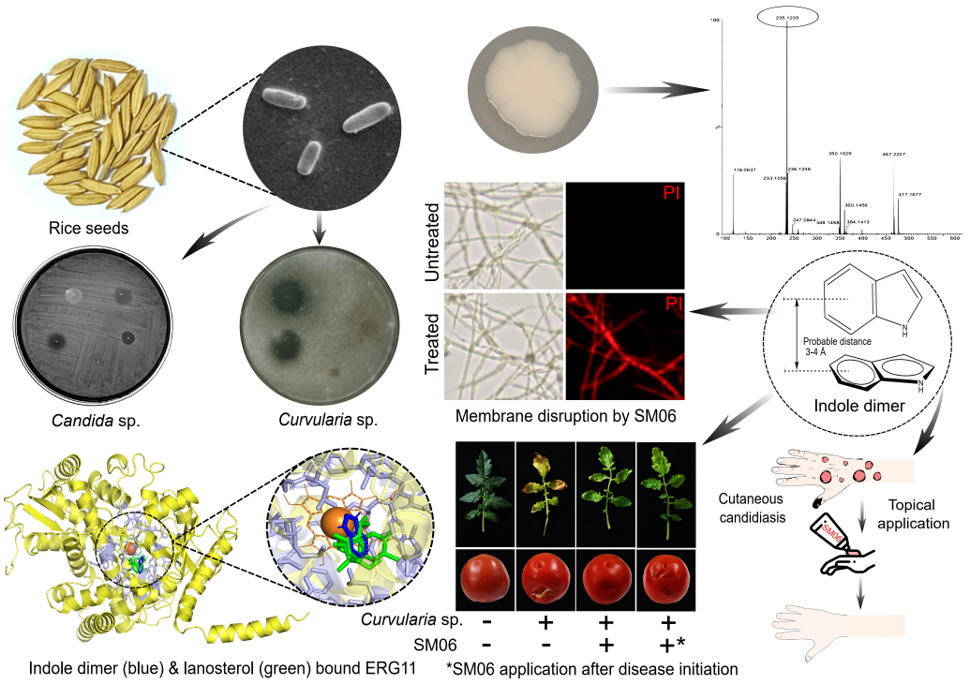
We first screened the strain against bacterial and fungal phytopathogens and found significant inhibitory effects against multiple tested fungal strains. The next challenge was identifying the active molecule responsible for this activity. Using chromatographic purification coupled with high-resolution mass spectrometry and advanced spectroscopic analyses, we isolated the metabolite SM06. Structural characterization revealed that it represented a new natural chemical (indole dimer) entity. We then rigorously validated its biological activity through laboratory assays against multiple economically and medically important fungal pathogens. Microscopic analyses, biochemical investigations, and molecular studies consistently demonstrated that SM06 possesses broad-spectrum antifungal activity. Additional research revealed that the chemical disrupts cellular integrity and fungal development. Importantly, we also showed that the bacterium naturally synthesizes SM06 inside rice plants, indicating that this metabolite is not merely produced under laboratory conditions but is likely involved in the natural defense system of the plant.
How does SM06 attack fungal pathogens, and what makes its mode of action different from many existing antifungal treatments?
Our mechanistic investigations revealed that SM06 targets one of the most critical components of fungal biology- ergosterol biosynthesis. Ergosterol functions as the principal sterol of fungal cell membranes and is essential for maintaining membrane integrity, nutrient transport, and cellular survival. By disrupting ergosterol production, SM06 destabilizes fungal membranes, leading to severe cellular damage and inhibition of fungal growth. Microscopic and biochemical analyses demonstrated that exposure to SM06 causes significant damage to the fungal spore as well as vegetative cells. In addition, SM06 induced excessive accumulation of reactive oxygen species (ROS) within fungal cells, resulting in oxidative stress that further compromises essential cellular functions.
What makes SM06 particularly interesting is that it is structurally distinct from currently available antifungal drugs. Although several clinical antifungals also interfere with ergosterol pathways, SM06 represents a completely new natural scaffold discovered from a beneficial plant-associated bacterium. Novel chemical scaffolds are especially valuable because they may overcome existing resistance mechanisms and provide new opportunities for developing next-generation antifungal therapeutics. Additionally, SM06 is derived from a naturally occurring bacterium associated with rice seeds, demonstrating the potential of plant microbiomes as sources of novel and ecologically sustainable antifungal treatments. SM06 is a good candidate for future uses in agriculture and perhaps other fields where fungal infections exert serious concerns for the civilization.
Fungal diseases and antifungal resistance are growing concerns worldwide. How could discoveries like SM06 contribute to more sustainable disease management in agriculture and beyond?
The increasing emergence of antifungal resistance poses serious challenges in agriculture, medicine, and food preservation. Modern agriculture often depends heavily on repeated fungicide applications, which increase production costs, create environmental concerns, and accelerate resistance development. Similarly, clinicians have relatively few therapeutic options when treating invasive fungal infections.
Natural microbial metabolites such as SM06 offer a promising alternative. As they originate from beneficial microorganisms that naturally coexist with plants, they provide an opportunity to develop environmentally sustainable disease-management strategies. Such compounds could potentially reduce reliance on synthetic fungicides while simultaneously extending the diversity of antifungal molecules available for medical research. It may spur the creation of next-generation antifungal therapies to treat resistant fungal infections in clinical settings. Although substantial work remains pending before clinical applications become feasible, discoveries like SM06 expand the pipeline of natural antifungal leads that may eventually contribute to safer crop protection, improved food security, and future therapeutic development.
One of the fascinating findings was that the beneficial bacterium can produce SM06 inside plants. Why is this discovery particularly important for future crop protection strategies?
Perhaps one of the most significant findings of our study was demonstrating that the rice seed endophyte produces SM06 within the living plant itself. This observation suggests that the bacterium functions as an internal biological factory, continuously generating protective molecules exactly where pathogens attempt to establish infection. Unlike conventional fungicides, which require repeated external applications, beneficial endophytes have the potential to establish long-term residence within plant tissues. If they consistently produce protective metabolites during colonization, they could provide continuous biological protection throughout plant development. This concept opens exciting possibilities for developing next-generation biological crop protection systems in which naturally occurring beneficial microbes strengthen plant immunity from within. Such approaches align well with sustainable agriculture by reducing chemical inputs while improving disease resilience.
Your study showed that SM06 is effective against both plant and human fungal pathogens while remaining biocompatible. What does this suggest about its broader potential applications?
The dual activity of SM06 against both agricultural and clinically relevant fungal pathogens is particularly encouraging. Many fungal species affecting crops share fundamental biological processes with fungi responsible for human disease. Therefore, compounds capable of targeting conserved fungal pathways may possess broad-spectrum applications. Also, preliminary biocompatibility studies indicated that SM06 exhibited minimal toxicity toward mammalian cells under the experimental conditions examined. While considerably more preclinical evaluation is necessary, these findings provide an encouraging foundation for future development. Dual agricultural-medical relevance of SM06 exemplifies the growing “One Health” concept, recognizing that the health of plants, animals, humans, and ecosystems is interconnected. Natural products capable of serving multiple sectors may become increasingly valuable as society seeks integrated solutions to combat antimicrobial resistance.
Looking ahead, what are the next steps in developing SM06, and how close are we to seeing such natural antifungal solutions used in real-world agriculture or healthcare?
Our published study establishes SM06 as a promising natural antifungal lead, but it also marks the beginning rather than the end of the scientific journey. We are now examining whether production can be enhanced through metabolic engineering. Additional studies will evaluate efficacy against larger collections of fungal pathogens, investigate resistance development, and assess safety towards normal flora upon application. We are also interested in understanding how endophytic bacteria establish stable colonization within plants and whether similar metabolites exist in other crop-associated microbiomes. Although commercialization requires substantial additional research, we believe discoveries like SM06 illustrate how exploring beneficial plant microbiomes can simultaneously advance sustainable agriculture, food security, and human health. By uncovering these hidden microbial partnerships, we may discover entirely new generations of environmentally friendly antifungal agents capable of addressing one of the most pressing global challenges of the twenty-first century.