What inspired you to explore new biomaterial-based approaches for chronic wound healing, especially combining bacteriophages and plant-derived extracts?
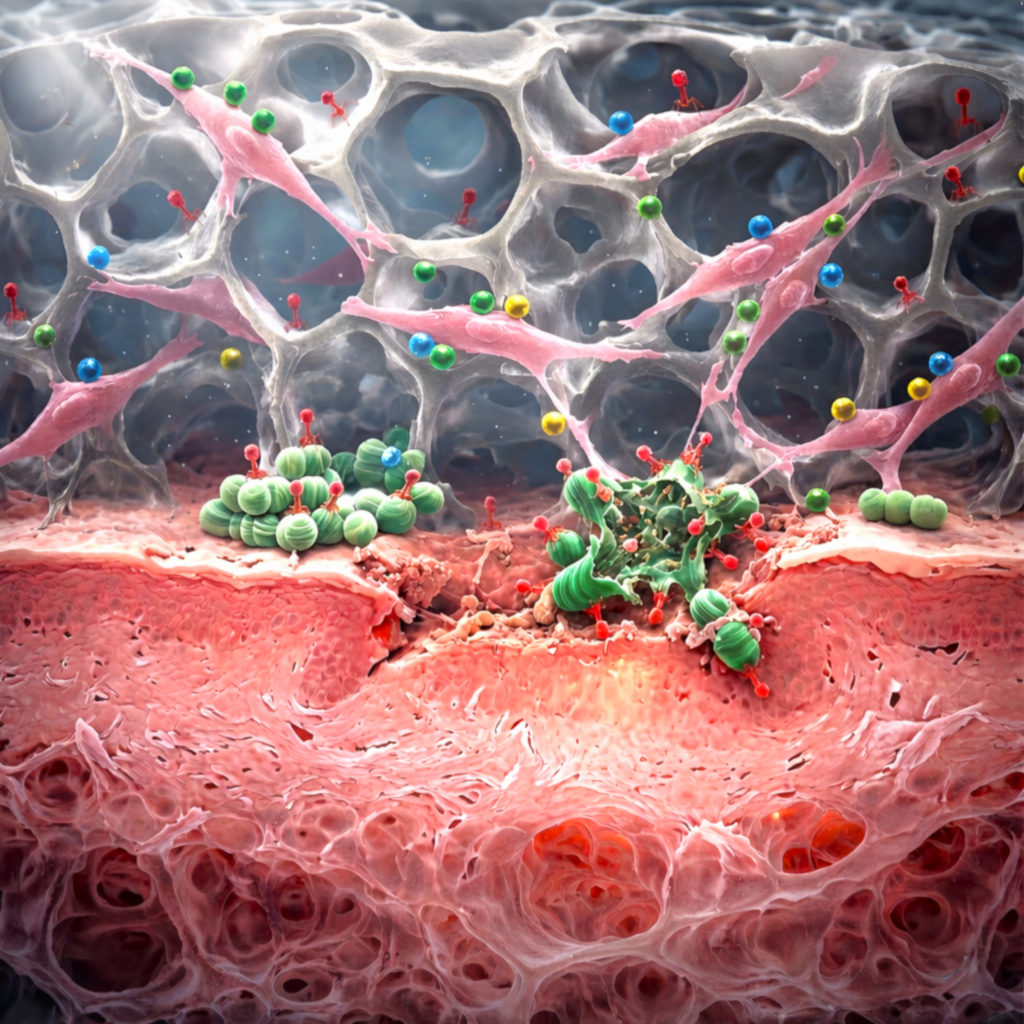
Chronic wounds can arise due to multiple conditions such as diabetic foot ulcers, bed sores, and burn wounds. Many times, such wounds are accompanied by microbial infections, causing further delays in the wound healing process. Such infections become more dangerous when the pathogenic microorganisms are multi-drug resistant (MDR) rendering conventional treatments ineffective. Therefore, it becomes highly imperative to not only address the complications arising due to such infections but also to accelerate the wound healing process. With this thought in mind, I wanted to look for a solution that can address both issues within a single platform. Hence, I came up with this idea of combining a biocompatible, highly porous and flexible biomaterial that can take the form of a wound dressing material, with bacteriophages that can act against the infections caused by drug-sensitive and multidrug-resistant pathogens as antimicrobial agents and plant-derived extracts (provided by ayurvedic doctors) aimed at enhancing the wound healing process. Herein, the biomaterial is expected to act as a substrate for the bacteriophages and plant-derived extracts while providing a moist wound environment through moisture retention at the wound site.
In simple terms, could you explain why chronic wounds are so difficult to treat and how antimicrobial resistance makes this problem even more serious?
Chronic wounds are non-healing wounds that do not heal within the timeframe of an acute wound healing response, i.e., from a few days to few weeks, depending on the severity of the wound. They may take months or years to heal and sometimes may not heal at all if left untreated. Usually, the chronic wounds are associated with an underlying condition such as diabetes leading to diabetic foot ulcers, lack of mobility leading to pressure ulcers/bedsores, or surgical complications. Such conditions may worsen with the occurrence of infections in the chronic wounds leading to further complications of persistent inflammation and tissue damage. So far, the antibiotics were a promising solution for the treatment of infections in the chronic wounds. However, with the advent of antimicrobial resistance, the issue of chronic wounds has become even more serious because antibiotics are no longer effective against such infections leading to uncontrolled microbial growth at the wound site that may cause dire consequences such as amputations.
How does your composite biomaterial work particularly the role of bacteriophages and phytoextracts in improving wound healing?
In our work, the porous and biocompatible composite biomaterial acts as the dressing material that forms the substrate for the incorporation of bacteriophages and phytoextracts. The bacteriophages are adsorbed onto the biomaterial surface and they are released from the biomaterial in a sustained manner so that the antimicrobial activity against the specific pathogen can be achieved for a longer duration. On the other hand, phytoextracts are expected to contribute to the anti-inflammatory and wound regenerative properties within the biomaterial to provide a slow and sustained release for enhanced and efficient wound healing.
During your research, what was the most surprising or important finding regarding healing efficiency or antimicrobial activity?
The research journey during this work was quite exciting where the most important finding was that the bacteriophages as antimicrobial components and phytoextracts as wound regenerative components retain their activity without interfering with one another and could function effectively together by providing a synergistic effect.
How can your research impact real-world healthcare, especially in developing more effective and affordable treatments for patients?
Our research opens up a new avenue for using affordable ayurvedic/herbal formulations as phytoextracts for enhancing chronic wound healing, and host-specific bacteriophages as antimicrobial agents against MDR pathogens, within a biomaterial system in the form of a composite biomaterial-based wound dressing. Considering that both the phytoextracts and bacteriophages are nature-derived sources, they are expected to form an affordable, sustainable and environment-friendly alternative to the currently available components used as wound care solutions.
In future, such solutions can impact the real-world healthcare by providing personalized treatments through the flexibility to incorporate bacteriophages depending on whether or not the wound is infected. Also, the bacteriophages can be incorporated in the form of a cocktail that can be further personalized by selecting the wound-specific bacteriophages for efficient and targeted antimicrobial action. Similarly, the choice of phytoextracts can be varied depending on the etiology of the wound, leading to more effective wound healing.
What are the next key challenges in this field, and what needs to be achieved before such biomaterials can be widely used in clinical practice?
Some of the challenges that still need to be addressed include efforts to enhance the duration of antimicrobial activity by finding ways to overcome the bacterial resistance through development of phage cocktails comprising multiple phage strains. Such cocktails can further be optimized based on the predominant pathogens of the chronic wound.
In case of phytoextracts, further research on optimizing the best formulation, i.e., in the form of powder or oil, and the dose composition for incorporation into the biomaterial, needs to be determined for anti-inflammatory activity that not only promotes wound healing but also supports the antimicrobial activity of bacteriophages.
With such advancements of our research, these composite biomaterials are expected to find broader applications in clinical practice, particularly in the form of advanced wound care products. However, the regulatory hurdles arising from the probable classification of the developed composite biomaterials as a new medical device are likely to pose challenges during clinical translation. Therefore, it is important to address the regulatory barriers through structured and robust regulatory reforms. The anticipated developments in the national regulatory guidelines may reduce the time lag between device development and commercialization.