What first led you to explore the connection between hypoxia, ER stress, and DNA repair in solid tumors?
Our interest began with a simple question: How do cancer cells survive under extreme stress? Earlier studies showed that proteins involved in DNA repair and cell recycling (autophagy) move to different parts of the cell when it is under stress, suggesting that these systems communicate with each other. In our previous research, we discovered that Beclin1, a protein best known for its role in autophagy, also helps repair damaged DNA by working with a DNA repair protein called MDC1. We found that Beclin1 supports DNA repair after damage caused by chemotherapy or radiotherapy. This revealed that the DNA repair system and autophagy work together to help cells decide whether to survive or die under stressful conditions. Solid tumors experience constant stress because they often lack oxygen and nutrients and contain high levels of harmful molecules. Cancer cells rely heavily on these stress-response systems such as DNA repair, autophagy, and the endoplasmic reticulum (ER) stress response to survive. Understanding how these systems interact may help us identify new ways to target cancer cells.
Can you explain in simple terms what happens to cancer cells when they face low-oxygen conditions inside tumors?
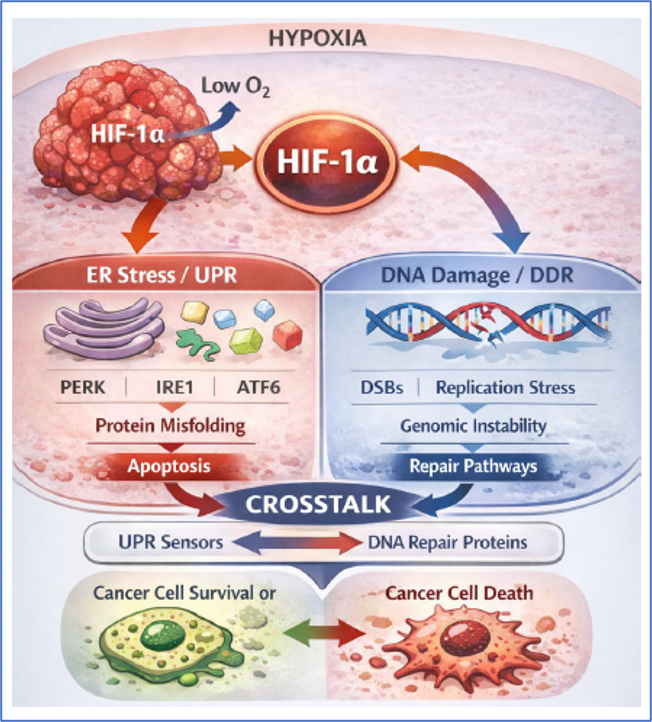
Low oxygen, or hypoxia, makes cancer cells more aggressive and harder to treat. Under these conditions, a protein called HIF-1α becomes active and switches on many genes that help cancer cells survive including, DNA repair, autophagy, and the ER stress response genes. HIF-1α also activates the changes that allow tumors to grow new blood vessels, spread to other parts of the body, and change the way they produce energy. Instead of relying on oxygen dependent sugar breakdown they switch to oxygen independent mechanism of energy generation, a process known as the Warburg effect. This produces lactic acid, making the area around the tumor more acidic. The acidic environment weakens the body’s immune response and makes it more difficult for medicines to enter the tumor. The chemotherapy drugs are pumped out of the cell before the drugs have a chance to work, making treatment less effective.
Your review discusses both ER stress and DNA repair pathways, why is their interaction so important in cancer biology?
ER stress and DNA repair are closely connected and decide cellular fate. Low oxygen causes proteins to fold incorrectly inside the endoplasmic reticulum, triggering the ER stress response. ER stress is accompanied by generation of reactive oxygen species which induce oxidative DNA damage including double stranded DNA breaks leading to activation of DNA repair response. Additionally, ER stress can directly suppress or activate DNA repair pathways. The DDR proteins can modulate the ER stress response and when the DDR is overwhelmed, it can sensitize a cell to ER stress-induced cell death. In this way, the two systems constantly communicate with each other. Cancer cells often experience continuous DNA damage and problems during DNA replication. By working together, the ER stress response and DNA repair pathways allow cancer cells to keep growing despite these challenges, making tumors more resistant to treatment.
What surprised you the most about how these stress pathways help tumors survive and become more aggressive?
One surprising finding is that the same stress-response systems that normally protect healthy cells can also help cancer cells survive. When these pathways remain active for long periods, they allow cancer cells to accumulate mutations, become genetically unstable, and develop into more aggressive forms. The ER stress response helps protect proteins from damage, while DNA repair systems fix damaged DNA and pause cell division until repairs are completed. Together, these pathways help cancer cells survive difficult conditions such as low oxygen, chemotherapy, and radiation. Unfortunately, this also makes tumors more diverse, more likely to spread, and more resistant to treatment.
Do you think understanding this cellular “survival system” could help improve cancer treatment in the future?
Yes. Although these stress-response systems help cancer cells survive, they may also provide an opportunity for new treatments. If therapies are developed that block both the ER stress response and DNA repair at the same time, cancer cells may no longer be able to cope with the damage caused by treatment. Without these protective systems, cancer cells would become much more likely to die. This suggests that combining drugs that target both pathways could improve treatment effectiveness and help overcome resistance to chemotherapy and radiotherapy.
What are the next steps, and what still needs to be discovered before this knowledge can be translated into better therapies?
Several challenges remain before these discoveries can be turned into effective treatments. First, these stress-response systems are also essential for healthy cells, so any new therapy must avoid causing excessive damage to normal tissues. Second, tumors constantly evolve and can become resistant by activating alternative survival pathways. In addition, different parts of the same tumor may respond differently to treatment because tumors contain a mixture of sensitive and resistant cells. Researchers also need to determine the best order and timing for combination treatments. Finding reliable biomarkers that identify patients whose tumors depend most on these stress pathways will help doctors choose the right patients for these therapies. Finally, new drug delivery technologies, such as nanoparticles and antibody-guided treatments, may help deliver these medicines more precisely to tumors while reducing side effects. These advances could make future therapies both safer and more effective.