From an extraordinary journey inside the female reproductive tract to tiny engineered channels, scientists are exploring whether the principles of natural sperm selection can be recreated on a chip.
Imagine a race where millions of runners participate; the track changes along the way, narrow passageways act as gates, some sections are almost syrup-like, and reaching the finish line first doesn’t necessarily mean you are the best runner. In many ways, this describes the journey of a sperm cell.
A human sperm is only about 50–60 micrometres long, yet it must navigate a reproductive tract millions of times larger than itself. Along the way, it encounters changing fluids, confined spaces, fluid flow, temperature differences and chemical signals. Millions of sperm may begin the journey, but only a small fraction reach the vicinity of the egg. More importantly, the sperm that arrives is not necessarily simply the fastest. Motility matters, but so do shape, structural integrity and overall cellular health. Nature, therefore, performs a remarkable process of selection long before fertilization occurs. The race is not simply about speed; it is about competence.
“Natural sperm selection is not simply a race for speed; it is a complex journey that favours functional competence.”
When Nature Becomes the Blueprint
Infertility turns this biological puzzle into an important global health challenge. The World Health Organization estimates that about one in six couples of reproductive age experience infertility during their lifetime. The causes can involve the male partner, the female partner, both, or remain unexplained. In men, problems with sperm number, movement and shape are common contributors, while female infertility may involve the ovaries, uterus, fallopian tubes or reproductive hormones.
Assisted reproductive technologies have created new possibilities for people facing infertility. In intrauterine insemination (IUI), prepared sperm are introduced directly into the uterus, bringing the selected sperm closer to the site of fertilization. In in vitro fertilization (IVF), eggs and sperm are brought together in the laboratory, whereas in intracytoplasmic sperm injection (ICSI), an embryologist selects an individual sperm and injects it directly into a mature egg. As the treatment becomes more technically selective, from IUI to IVF and particularly ICSI, the quality of the sperm available for selection becomes increasingly important.
Fertility centers commonly use swim-up, in which motile sperm migrate into fresh culture medium, and density-gradient centrifugation, in which sperm are separated according to their physical properties using centrifugation. Both are established and useful methods. However, these methods involve sample handling and, particularly with centrifugation, mechanical forces that can place additional stress on sperm. Processing can contribute to cellular and oxidative stress and may affect delicate structures, including sperm DNA. More fundamentally, conventional methods cannot reproduce the changing flow, confined spaces, fluid properties and chemical signals that sperm encounter inside the female reproductive tract. This difference between how nature selects sperm and how we select them in the laboratory has become an important motivation for microfluidic research.
Microfluidics is a branch of science and engineering concerned with controlling very small volumes of fluids, often inside channels comparable in size to individual cells. At this scale, researchers can control fluid movement, confinement, surfaces and gradients around living cells. For sperm, this creates an opportunity to build a miniature environment that reproduces selected features of their natural journey.
From Understanding Sperm Behaviour to Engineering Selection
Recent research indicates that sperm actively respond to their physical environment. Our research has followed this idea from understanding sperm behaviour to using that knowledge for selection. We first examined sperm motion in environments designed to resemble aspects of the female reproductive tract. This work showed how sperm can adapt their flagellar waveform, the pattern of movement produced by the tail, to maintain propulsion as surrounding fluid conditions change.
We then investigated rheotaxis, the tendency of sperm to orient and swim against fluid flow, as an important long-distance navigation mechanism. We observed that many sperm preferentially adopted rheotactic behaviour and tended to migrate along channel boundaries. This suggested that a natural navigation behaviour could also guide sperm inside a microfluidic environment.
These observations led to the development of our Microfluidic-Assisted Sperm Sorter (MASS). The device uses engineered microchannels to exploit sperm responses to fluid flow and nearby boundaries, aiming to provide a controlled route for obtaining sperm suitable for downstream IVF and ICSI applications. The important point is not simply that the device is small. The physics inside it is deliberately designed around sperm biology. This is the essence of biomimetic engineering: rather than forcing biology to fit the machine, we ask the machine to learn from biology.
Why Has Translation Been Slow?
Despite rapid progress, relatively few microfluidic sperm-selection technologies have moved from laboratory research into routine fertility practice. The challenge is not simply to separate sperm efficiently. A clinically useful system must work reliably with real patient samples, accommodate differences in sperm quality, provide reproducible results and fit naturally into an embryology laboratory workflow.
Patient samples can vary enormously. Some contain millions of highly motile sperm, while others contain very few. In severe male infertility, sperm may need to be recovered from testicular tissue. In non-obstructive azoospermia, where sperm production is severely impaired and sperm may be absent from the semen, viable sperm can be exceptionally rare.
A device designed around an “average” sample may therefore struggle precisely where the clinical need is greatest. Future systems will need to accommodate differences in sperm number, movement and sample type rather than applying a single strategy to every patient.
Artificial intelligence could provide another important layer. Finding a rare sperm can be like searching for a moving needle in a microscopic haystack. AI can rapidly analyse images, identify potential sperm and track their movement. Combining automated imaging with microfluidic handling could reduce prolonged manual searching and help identify sperm that might otherwise be difficult to find.
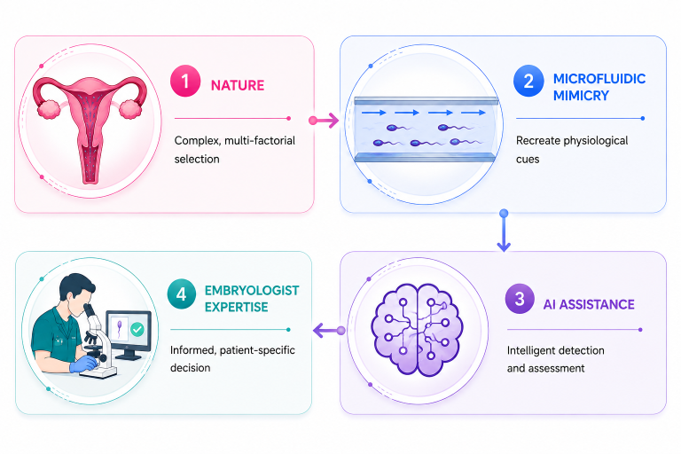
The goal, however, should not be to replace embryologists. A more realistic future is a partnership: microfluidics provides the physical environment, AI provides rapid analysis, and the embryologist provides clinical judgement. Microfluidics can shape where sperm go. AI can help identify which sperm deserve attention.
From Sperm Separation to Precision Selection
For decades, sperm preparation has largely asked: How can we obtain enough motile sperm?
The next generation may ask a harder question: How can we identify sperm with greater biological competence while preserving their function?
Motility matters, but so do morphology, DNA integrity, cellular energy systems and other aspects of sperm health. Microfluidic selection is showing promise in improving several laboratory measures of sperm quality, although the connection between these improvements and successful reproductive outcomes is still being established.
The future may therefore not belong to one universal sperm sorter. It may belong to adaptive systems. A highly motile semen sample may require one approach, while a sample with very few sperm, elevated DNA damage or testicular sperm may require another.
Nature has already been doing something remarkably similar for millions of years. The female reproductive tract uses fluid flow, geometry, changing fluid properties, temperature and chemical signals to progressively narrow a huge sperm population to a small group of candidates. The challenge for engineers is to understand these processes well enough to reproduce the parts that matter.
The opportunity for microfluidics is therefore not to compete with nature, but to learn from it. By recreating selected features of the reproductive environment and eventually combining them with real-time imaging and artificial intelligence, future systems could move sperm preparation beyond simple enrichment toward more intelligent and biologically informed selection. The future of infertility treatment may not be a machine that chooses the “perfect” sperm. It may be a system that helps embryologists make a better-informed choice. And that is where a tiny microfluidic chip may have a surprisingly large role to play.