Marine Aerosols and the Climate Connection
Aerosols, the tiny solid particles or liquid droplets suspended in air, affect the Earth’s climate in various ways and span a diverse size range from a few nanometers to several micrometers. About a quarter of the solar radiation reaching the Earth’s atmosphere is reflected by aerosol, exerting a direct effect on the Earth’s radiation field and thus affecting its surface temperature. Beside this direct effect, aerosols also exert an indirect effect on climate by modifying cloud albedo through the formation of cloud condensation nuclei (CCN). Beside their climatic effects, aerosols and particulate matter also exert adverse effects on human health. According to the United Nations report, air pollution is the second highest cause of mortality around the world causing millions of deaths every year. Given the immense importance of aerosols on environment and human health, it is imperative to ask what are their sources and how are they formed. As the oceans cover two-thirds of the Earth’s surface, chemistry in marine boundary layer (MBL) plays a pivotal role in shaping the climate, particularly in remote regions where continental influence is minimal. Sulfur species such as Dimethyl sulfide (DMS) emitted from oceanic phytoplankton is known to be the primary source of CCN in MBL. The second-generation oxidation products derived from marine emission can modify the clouds and droplets properties either by participating in new particle formation or by undergoing direct partitioning from gas to aerosol phase. Recently, a new atmospheric emission methane sulfonamide (MSAM) was detected during Air Quality and Climate Change in the Arabian Basin (AQABA) campaign in the Somalia upwelling region of the Arabian Sea, the fifth largest upwelling region in the world. Data collected during the campaign strongly indicated a source linked to phytoplankton blooms. MSAM is a multifunctional molecule having both sulfur and nitrogen atoms-that are traditionally linked to aerosol formation. The physical and chemical processes undergone by the molecule near its emission source determine how far the molecule can be transported and how its local chemistry can influence marine sulfur cycling, and its downstream climate effects. Hence, knowledge of the processes that can remove MSAM from the atmosphere is important for the evaluation of its effects on the climate. Although the field measurements indicated that both DMS and MSAM have similar atmospheric lifetime, the reaction of MSAM with OH radical i.e. ‘the detergent of the atmosphere,’ was found to be much slower than that of DMS. Various studies also found the reactivity of MSAM toward other major atmospheric oxidants to be rather limited. Considering the slow reaction of MSAM with the major oxidants, previous studies concluded that the dry deposition to the ocean surface is the dominant and effectively-only significant removal pathway.
“As the oceans cover two-thirds of the Earth’s surface, chemistry in marine boundary layer (MBL) plays a pivotal role in shaping the climate”
A New Pathway for Removing MSAM from the Atmosphere
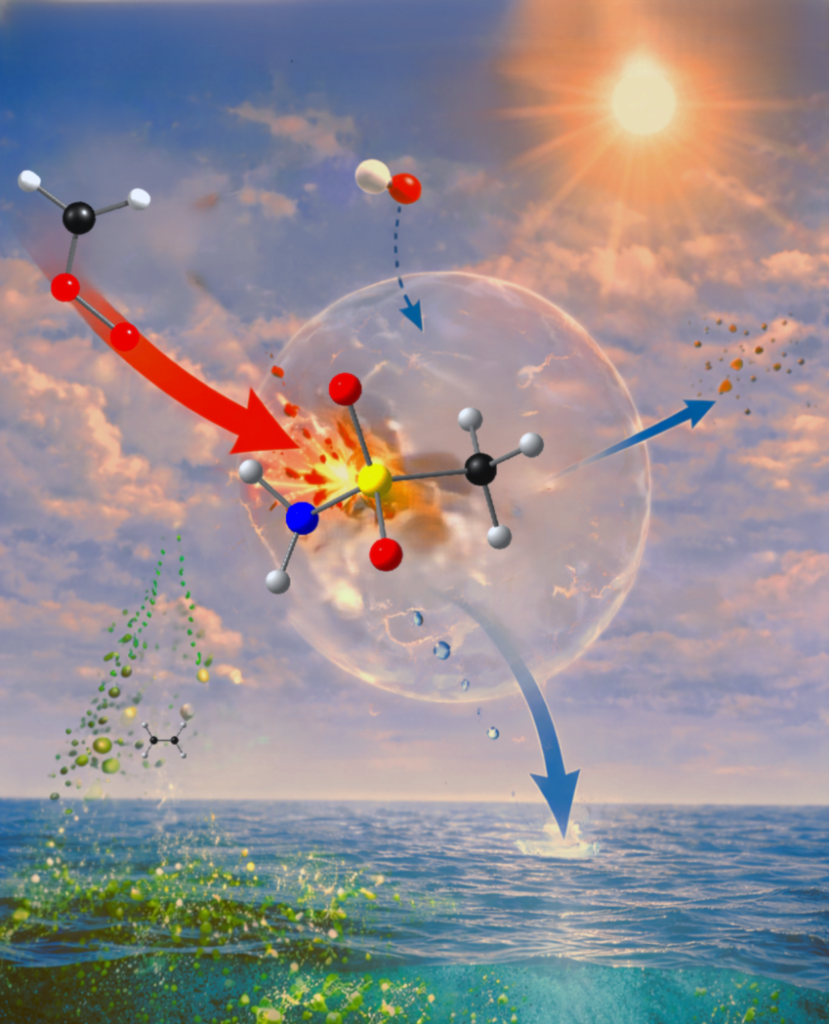
Challenging this notion, we recently published (Syed Ibrahim J., Surabhi Gupta, Goutam Chowdhury, and Mausumi Goswami, Environmental Science & Technology, 2026) the findings of a new chemical reaction pathway that can remove MSAM from the atmosphere at rates comparable to its dry deposition process. We argued that before accepting dry deposition as the sole significant sink for MSAM, it is necessary to assess its reaction inventory against oxidants that had not yet been considered. Interestingly, alkenes, are emitted in substantial quantities from biologically productive marine regions such as the Arabian Sea. Alkenes, when they come into contact with atmospheric ozone (in a process known as ‘ozonolysis’), can produce highly reactive species called ‘Criegee intermediates’ (CI). We hypothesized that CIs should be present in marine environments and could constitute an important sink for MSAM that had not previously been examined.
How Criegee Intermediates React with MSAM
With the help of Density Functional Theory (DFT) calculations, we showed that the reaction of CIs with MSAM generated, with substantial rate, a unique class of hydroperoxides. The hydroperoxides once formed are unlikely to revert to reactants under atmospheric conditions. Especially, the smallest CI fomaldehyde oxide (CH2OO) and anti-CH3CHOO (generated from the ozonolysis of cis-/trans- 2-butene) react with MSAM at rates fast enough to surpass the reaction with OH radical. Other highly substituted CIs reacted at slower rates, but even their reactions were found to be competitive with the OH removal pathway. Notably, our studies indicated that the removal rate of MSAM by CIs increased at colder tropospheric temperatures; at 200 K, the ratio of rate constants for CI versus OH reactions approached ∼100 specifically for anti-methacrolein oxide (anti-MACRO; produced via the ozonolysis of isoprene), corresponding to a lifetime roughly ten times shorter than that from the OH reaction alone. Overall, accounting for the inventory of CIs considered in our study, reactions with CIs with MSAM can surpass the OH-radical reaction rate for several CIs across the tropospheric temperature range. Particularly for the CIs such as CH2OO and anti-CH3CHOO, the reaction can rival the dry deposition rate. In addition, the reaction of MSAM with certain CIs can be as fast as OH + DMS under atmospheric conditions.
What This Chemistry Could Mean for Marine Aerosols
We also estimated the relative branching ratios of the products and found that the product distribution varied with the nature and substituents on CI backbone. While the reactions of MSAM with CIs such as CH2OO, syn-CH3CHOO, (CH3)2COO, and syn-methyl vinyl ketone oxide (syn-MVKO) were found to proceed exclusively via a single mechanism, the reactions with anti-CH3CHOO and anti-MACRO proceeded via two distinct pathways forming different functionalized hydroperoxides. Detailed mechanistic study indicated that under atmospheric conditions, the generated hydroperoxides are resistant to internal dissociation. Importantly, these functionalized hydroperoxides, which retain both the nitrogen and sulfur of the parent MSAM molecule would potentially be low volatile with decent solubility in aqueous medium. Thus, the hydroperoxide products generated in the reaction of MSAM and CIs can partition into the condensed phase. Such aqueous-phase partitioning will affect the properties of particulate matter and aerosols, in a manner comparable to other sulfur-containing hydroperoxides, such as hydroperoxymethyl thioformate, that are already known to affect cloud uptake and the marine sulfur-di-oxide budget. However, we do realize that any conclusion regarding the ultimate fate of these hydroperoxides remains conjectural at this stage and will require further investigation. Taken together, the findings establish that Criegee intermediate chemistry is a previously unrecognized major atmospheric sink for MSAM. Our studies indicate that in marine regions with high biological activity, chemical processes such as the reactions with CIs can become an important removal route for MSAM and dry deposition alone will not govern its atmospheric removal rate. Given that the simplest CI formaldehyde oxide (CH2OO) is generated from the ozonolysis of essentially all biogenic alkenes, including isoprene, we concluded that CI-mediated removal of MSAM is likely to be particularly significant in biologically active marine regions such as the Somalia upwelling zone, where it may result in an atmospheric lifetime for MSAM close to that of DMS. More broadly, the study opens a new line of inquiry into sulfur-nitrogen cycling in the marine environment, and establishes the need for further experimental work that may provide important insight into aerosol formation process in the biologically active region of the Earth’s ocean.