
When we think about the impact of climate change on agriculture, our minds often turn to parched soils and empty reservoirs. However, beneath the visible wilt of a stressed crop, a complex molecular struggle unfolds. Unlike animals, plants cannot escape to cooler environments. Rooted firmly in the soil, they must survive wherever they grow, relying exclusively on their internal defence systems.
But what actually happens inside a plant during extreme heat?
The answer lies deep within the cell. Heat affects one of life’s most fundamental building blocks, proteins. These microscopic molecules perform nearly every task inside a plant, from capturing sunlight to producing energy and regulating growth. For proteins to function, they must maintain a precise three-dimensional shape. High temperatures disturb this delicate structure, causing proteins to unfold and stick together into harmful aggregates. If this damage spreads unchecked, cells lose their ability to function, and the plant may not survive.
Fortunately, plants have evolved an extraordinary molecular quality-control system that constantly monitors, repairs, and protects proteins during stressful conditions. Understanding this hidden rescue machinery has been the focus of our laboratory for many years.
“Plants survive heat not because their proteins never fail, but because they possess an extraordinary molecular rescue system that repairs damage before it becomes irreversible.”
The cell’s molecular rescue team
Fortunately, plant cells are equipped with a sophisticated protein quality-control system that continuously monitors and repairs damaged proteins. At the heart of this system are molecular chaperones, specialized proteins that help other proteins maintain or regain their correct shape.
Among these, the HSP70 (Heat Shock Protein 70) family serves as one of the cell’s primary repair systems. Hsp70 recognizes proteins that have begun to unfold, prevents them from forming irreversible clumps, and gives them another opportunity to fold correctly.
However, HSP70 cannot accomplish this task alone. It relies on a group of helper proteins known as J-domain proteins (JDPs). These proteins act as coordinators, identifying where damage has occurred and guiding HSP70 to the proteins that need immediate attention. Plants possess an unusually large and diverse collection of JDPs, reflecting the wide variety of environmental stresses they encounter throughout their lives.
Over the past several years, our laboratory has been interested in understanding how individual JDPs contribute to the protection of plants from environmental stress. Although many members of this family have been identified, the specific functions of most remain largely unexplored.
A new piece of the puzzle: AtDJB3
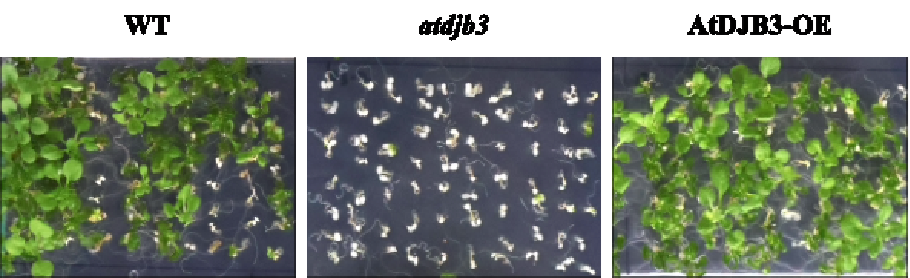
Our recent work focused on one such protein, AtDJB3, in the model plant Arabidopsis thaliana. We found that AtDJB3 responds remarkably quickly when plants are exposed to high temperatures. As heat stress begins, AtDJB3 accumulates rapidly and relocates to areas within the cell where damaged proteins gather. Our earlier work showed that AtDJB3 helps clear these protein aggregates, enabling damaged proteins to recover their normal function.This behaviour suggested that AtDJB3 is actively involved in the plant’s response to heat rather than simply being produced as a consequence of stress. To understand its importance, we examined plants in which AtDJB3 was absent. Under normal conditions, these plants grew just like healthy plants. However, when exposed to prolonged heat stress, they showed a dramatic reduction in their ability to recover. In contrast, plants producing higher levels of AtDJB3 survived heat stress much more successfully. Our work further revealed that AtDJB3 functions together with HSC70-1, one of the major members of the HSP70 family involved in protecting plant cells during heat stress. AtDJB3 helps ensure that HSC70-1 reaches damaged proteins efficiently, allowing the cell to restore protein quality before irreversible damage occurs.
But is repairing damaged proteins only part of the story?
Heat survival also depends on the rapid activation of hundreds of protective genes. These genes produce additional molecular chaperones and other stress-response proteins that prepare the plant to cope with prolonged high temperatures. Our research showed that AtDJB3 is also essential for activating many of these protective genes. In plants lacking AtDJB3, this genetic response was significantly weakened, leaving the plants less capable of surviving extended heat stress. Together, these findings reveal that AtDJB3 performs two closely connected functions. It helps maintain protein quality by supporting the HSP70 chaperone system, while also enabling the plant to activate its broader heat-response programme.
“Heat tolerance is not controlled by a single gene or protein. It emerges from a carefully coordinated network that repairs cellular damage while preparing the plant for continued stress.”
From basic discovery to climate-resilient crops
Our work on AtDJB3 was carried out in Arabidopsis thaliana, a small flowering plant widely used as a model in plant biology. Although it is not a crop, many of the cellular mechanisms that protect Arabidopsis from heat are remarkably similar to those found in important food crops such as rice, wheat, maize, and tomato. This means that understanding how AtDJB3 helps maintain protein quality and activate the heat response provides valuable clues for improving crop resilience. As tools such as genome editing, molecular breeding, and precision biotechnology continue to advance, discoveries like these could help scientists strengthen the plant’s own natural defence systems. The goal is not to create plants that tolerate higher temperatures, but crops that continue to grow, flower, and produce stable yields even under increasingly unpredictable climates. Perhaps the most important lesson is that solutions to future agricultural challenges often begin with fundamental research. By understanding how individual proteins cooperate inside a single plant cell, we build the knowledge needed to develop the climate-resilient crops of tomorrow.
Conclusion
Rising global temperatures are placing increasing pressure on plants, making it more important than ever to understand how they naturally cope with heat stress. Our work shows that AtDJB3, one out of more than a hundred JDPs found in Arabidopsis, can play a surprisingly important role by helping cells both repair damaged proteins and activate protective responses during heat stress. By uncovering the molecular machinery that protects plant cells, we move one step closer to understanding the remarkable resilience of plants and to finding new ways to safeguard agriculture in a changing climate.
“Every discovery about how plants respond to heat brings us closer to developing crops better equipped for a changing climate.”