While monuments crumble and written histories fade, human DNA preserves stories that stretch to millennia. India, home to nearly 1.48 billion people has one of the richest archives of migration, adaptation, and social life in its genomes. Thar is the world’s most densely populated hot deserts, where extreme heat, aridity, intense UV radiation and scarce vegetation test the limits of survival. It is home to communities whose traditions in pottery, weaving, embroidery, leatherwork, metalworking, woodcraft, pastoralism, and trade have endured for centuries- occupations that are cultural identities as much as livelihoods, passed down through generations. About 85% of the Thar lies within India, across Rajasthan, Gujarat, Punjab, and Haryana, with the rest extending into Pakistan’s Sindh and Cholistan regions. Far from isolated, it has for millennia been one of South Asia’s great migration corridors, sitting at the eastern edge of the ancient Indus Valley Civilisation. Archaeology has long shown the Indus Valley’s connections with North-West India, Central Asia, and beyond.
“Lactase persistence as gene culture co-evolution among Thar pastoralists”
What we already knew
Despite a geographical and documented history, the genetic diversity of the Thar’s own inhabitants has remained surprisingly understudied. This gap sits inside a story that population genomics in India has been piecing together for over decades. A comprehensive study from the early 2000s from the Indian Genome Variation Consortium (IGVc) had provided the first comprehensive genetic landscape encompassing diverse populations of India at a national scale. Further substantiated by the recent large-scale Genome India initiative. Building on IGV, we have traced migration histories across the subcontinent, identified disease-risk variants specific to Indian populations, characterised adaptations to high-altitude living, studied populations shaped by long exposure to malaria, examined how non-native groups admixed into India over time, and uncovered founder mutations behind rare genetic disorders in India’s endogamous communities. Ancient DNA studies elsewhere reconstructed the timeline, Ancestral North Indian and Ancestral South Indian ancestry framework, the arrival of Steppe pastoralist and Iranian-related ancestries, and genomic evidence from sites connected to the Indus Civilisation. However, these had not looked closely at the desert – an extreme environment is a place where natural selection would be most evident and in these genomes one is likely to find stories of such struggles, this is the gap the present study set out to fill. Under the initiative project of Thar DESIGNS at IIT Jodhpur where a group of investigators set out to understand Desert Ecosystem Innovations Guided by Nature and Selection in the microbes, plants, animals, humans and ecosystem as a whole.
We analysed genome-wide SNP data from 176 individuals across eight traditional occupational communities in the Thar — seven artisan groups and one pastoral community in conjunction with genome-wide data available from global populations as well as ancient DNA. With the question of who are the people of the Thar? When did their ancestors arrive, and how far have they travelled both in ancient times and in the recent past? How is that history written into their genomes today? And how has culture shaped their survival in this landscape? Answering these is also a first step towards a pressing question: what happens to people adapted to an extreme/ancestral environment when they are displaced into a very different one, a concern that matters to all transitioning populations worldwide.
What the genome reveal
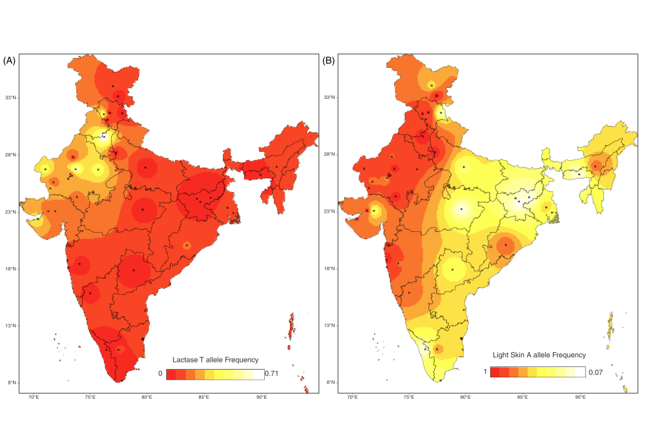
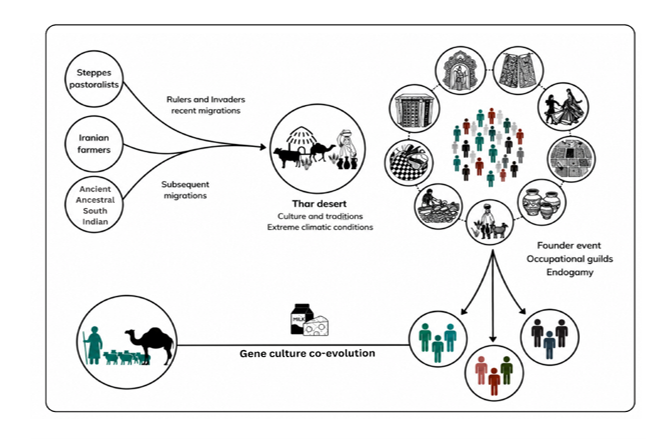
Despite close geographic proximity, artisan and pastoral communities such as potters, metalworkers, leatherworkers, woodworkers, weavers, Persian gold-embossers, embroidery artisans, and pastoralists form distinct genetic clusters rather than one uniform population, the study found heterogeneity each carrying its own demographic history. Their genomes carry South Asian ancestry alongside varying West Eurasian-related contributions, forming part of a broader north-south genetic cline. Pastoralists and groups such as woodcarvers and gold-embossers cluster closer to West Eurasian lineages, while potters and performers align more with southern clines. Present-day communities also show genetic continuity with the ancient Indus Periphery populations, echoing archaeological evidence that crafts such as pottery, wood art, gold embossing, tye and dye, weaving-embroidery, leatherworking, and animal husbandry trace back to the Indus (Harappan) civilisation. These genomes also have varying signatures of later migration, including Neolithic Iranian-related and Eurasian Steppe-related ancestries. Genetic modelling suggests West Eurasian-related admixture at approximately 60-80 generations ago, with more recent founder events around 500-600 years ago, coinciding with medieval trade expansion and documented migrations, including of Persian-descended and tie-dye artisans. Some Thar communities showed stronger founder effects, along with elevated runs of homozygosity and identity by descent. These patterns suggest that the communities have remained relatively small and genetically isolated and shared ancestry within the communities over the generations. Role of Ancestry as well as adoption of cultural practices appears to have left detectable imprints in a few populations. The clearest example is seen in MCM6/LCT region, which is known for lactase persistence – ability to digest lactose into adulthood. with the strongest signal among pastoral groups due to dairy dependency and cultural centrality of livestock appears as gene-culture co-evolution. The desert also receives some of the highest sunlight exposure in South Asia, which might suggest selection toward genes associated with darker pigmentation as seen in other deserts. Instead, the Thar population retains the lighter skin pigmentation gene associated with SLC24A5, a relic of European ancestry highlighting possibilities in different routes to UV adaptations. This emphasizes the need for contextualising ancestry and culture for understanding phenotypic and genotypic variations in geographically dispersed populations.
What we don’t yet know
This study is a first step, not a final answer- Extreme-environment populations remain underrepresented in the reference panels much of human genomics relies on, and ancient DNA study is limited and challenging in South Asia’s climate, leaving many gaps. Small, endogamous communities are statistically demanding to study and carry real ethical sensitivity, given how closely genetic findings can map onto occupation and community identity. A genetic signature of selection or founder risk is only a starting point: connecting it to actual disease burden requires functional and clinical follow-up studies. The open question is the one that motivated this work is what happens, biologically and medically, when populations adapted over centuries to a specific environment move away from it? As rapid urbanisation, changing diets, and the erosion of traditional lifestyles reshape health across the globe, this question is a live concern for displaced and transitioning populations everywhere. The throughline across our work is that India’s genetic diversity cannot be understood through geography or ancestry alone. The Thar communities not only carry imprints of ancestral migrations but having settled in an extreme environment show distinct gene-culture coevolution and founder signatures shaped as much by occupation and marriage practice as by landscape. This has relevance for rare disease risk, and ascribing community-specific disease risks when natives transition to new environments with ancestral genomes – a classic example of Genome-Environment mismatch. Insights from these studies are important for setting baselines for precision medicine for stratified and more effective public health interventions. We are at present integrating these insights, with multi-omics in Thar populations that are transitioning from rural-to-urban environment for improved public health solutions for resident as well as non-resident communities.