
It is astonishing to see how sound and magnetism, two apparently unrelated phenomena, could interact in a significant way. One belongs to the world of vibrations and waves in matter, while the other governs the invisible forces behind magnets and electronic devices. Yet, when these two meet at the nanoscale, they give rise to a fascinating field known as magnetoacoustics, where vibrations can control magnetism and vice versa. This interplay is not just scientifically intriguing; it is opening doors to next-generation technologies in communication, sensing, and even quantum computing.
“When sound and magnetism meet at the nanoscale, they create a new language of energy where vibrations can control magnetism and unlock powerful technologies.”
The Language of Waves: Magnons and Phonons: To understand this interaction, we must first introduce two key players:
a) Magnons: These are collective excitations of spins in a magnetic material, essentially waves of magnetization.
b) Phonons: These represent vibrations of atoms in a lattice, what we perceive macroscopically as sound or mechanical waves.
In magnetostrictive materials, i.e. materials that change shape under magnetic fields or change magnetization under strain, these two excitations can couple. This interaction is called magnon–phonon coupling, and it forms the foundation of magnetoacoustics. When a vibrating wave (phonon) travels through such a material, it produces strain. This strain alters the magnetic state, generating spin waves (magnons). Conversely, magnetization dynamics can generate mechanical vibrations. This two-way interaction is the essence of magnetoelasticity.
When Coupling Becomes Strong: A New Hybrid World: In recent work by Anjan Barman and collaborators, an extraordinary phenomenon was observed: when magnons and phonons interact strongly, they no longer behave as separate entities. Instead, they hybridize to form a new quasi-particle known as a magnon-polaron. In a two-dimensional array of nanomagnets placed on a piezoelectric substrate, surface acoustic waves (SAWs) were used to excite vibrations. These vibrations interacted with spin waves in the nanomagnets. When their frequencies and wavevectors matched, a condition called phase matching, a strong coupling emerged, leading to nearly complete energy transfer between modes. Even more remarkably, the study demonstrated tripartite coupling, where two magnon modes interact via an intermediate phonon mode (SAW). This resulted in the formation of a binary magnon-polaron, showcasing how rich and tunable these hybrid systems can be. This is not just a scientific curiosity. Strong coupling regimes allow coherent energy exchange (quantum transduction), a critical requirement for quantum technologies.
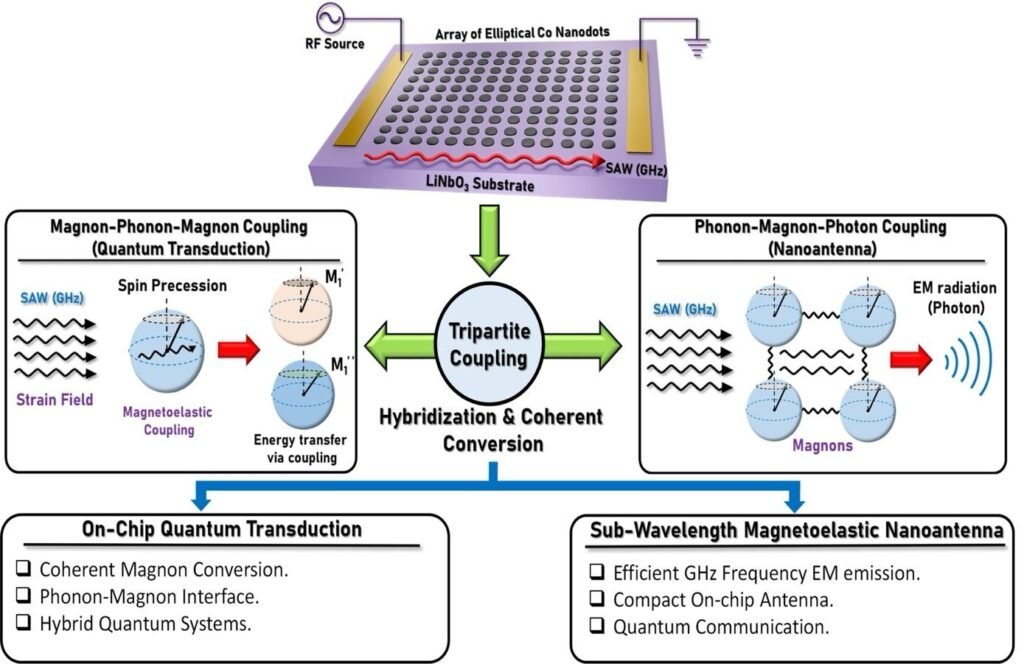
From Vibrations to Wireless Signals: Nanoantennas: What happens if this interaction can be extended further? Can vibrations and magnetism generate electromagnetic waves? The answer is yes, and this leads to one of the most exciting applications: magnetoelastic nanoantennas. In another groundbreaking study, Barman and co-workers demonstrated that phonons (acoustic waves) can excite magnons, which in turn emit photons, real electromagnetic radiation. This creates a chain of interaction: Phonons → Magnons → Photons
This tripartite phonon-magnon-photon coupling enables the creation of extremely small antennas, much smaller than the wavelength of the emitted radiation, yet with surprisingly high efficiency. Traditional antennas become inefficient when miniaturized, but these magnetoelastic nanoantennas overcome that limitation. Experiments showed that such antennas can operate in the GHz frequency range with efficiencies exceeding classical limits by orders of magnitude. Imagine wireless communication devices that are not only smaller but also more energy-efficient. This could possibly revolutionize everything from IoT devices to biomedical implants.
Implications for Quantum Technologies: The ability to coherently couple magnons and phonons, and even photons, has significant implications for quantum information science. Quantum computing relies on coherent control of quantum states. Hybrid systems like magnon-phonon platforms offer unique advantages:
i) Long coherence times (phonons are less prone to loss).
ii) Tunability via magnetic fields.
iii) Interfacing different quantum systems (spin, mechanical, electromagnetic).
Magnons can act as intermediaries between microwave photons and other quantum excitations, making them ideal for quantum transducers, devices that convert signals between different quantum platforms. The strong coupling observed in magnetoelastic systems provides a pathway for transferring quantum information between different carriers, a key requirement for scalable quantum networks.
“From tiny nanoantennas to quantum communication, magnetoacoustics shows how combining waves and magnetism can transform the future of devices.”
A Broader Perspective: Engineering Hybrid Matter: What makes magnetoacoustics particularly exciting is its versatility. By precise engineering of nanostructures, such as arrays of nanomagnets on piezoelectric substrates, we can design systems where: frequencies are tunable via magnetic fields, coupling strength can be controlled geometrically and directional properties (anisotropy) can be exploited. These systems behave like artificial crystals, where waves interact in controlled and predictable ways. They allow us to explore new physical regimes and develop devices that were previously unimaginable. Looking ahead, the convergence of magnetism and vibration is more than an interdisciplinary curiosity, it represents a new paradigm in controlling energy and information at the nanoscale. From hybrid quasi-particles like magnon-polarons to ultra-efficient nanoantennas and quantum transducers, magnetoelastic systems are redefining how we think about communication and computation. As research progresses, we may soon see practical devices where sound waves control magnetic memory, or where tiny antennas powered by vibrations enable seamless wireless connectivity in the smallest of devices. In the end, when magnetism and vibration work together, they do not merely coexist. They create entirely new possibilities.