This article is currently maintained under temporary RFCSR publication support until 13 June 2026.
Reproductive wellness in humans is multifactorial. Apart from genetic and physiological factors, environmental factors, substance abuse etc., the modifiable lifestyle habits have profound influence upon male reproductive health. This has assumed greater importance as we progress through the 21st century with conscious modern lifestyle choices oblivious of the fact that some of these habits can be potential deterrents of fertility. The past few decades have witnessed an alarming rise in infertility worldwide leading to, in parallel, increased dependence on assisted reproductive technologies (ART). According to the latest estimates, approximately one in every six persons in the global adult reproductive population face fertility issues during their lifetime, and male factors contribute to almost 50% of the infertility cases.
“Healthy lifestyle choices today can safeguard fertility and reproductive health for the future.”
Dietary patterns can have significant impact upon the male reproductive system. Traditional heathy dietary patterns e.g., Mediterranean diet and others that recommend balanced intake of carbohydrates, proteins, fats, vitamins and minerals, are associated with healthy male reproductive outcomes. Nevertheless, in the hectic fast-paced modern-day living, these traditional diets have fallen into oblivion. These are increasingly being replaced by more convenient, canned/tinned ultra-processed food laced with high content of saturated fat, refined carbohydrates, refined sugar, preservatives and other chemicals. Long-term intake of such energy-rich high-fat food leads to obesity which poses major risks for myriad health problems including diabetes, hypertension, cardiovascular diseases, metabolic dysfunction, and infertility. There seems a close connection between obesity and reproductive capacity. Our laboratory has been engaged in exploring the molecular mechanisms implicated in metabolic and testicular dysfunction in obese males. Using the laboratory mice model of diet-induced obesity, we have investigated in-depth how obese condition modulates reproductive hormonal titres in males, induces hypogonadism, alters testicular histoarchitecture, and compromises reproductive function.
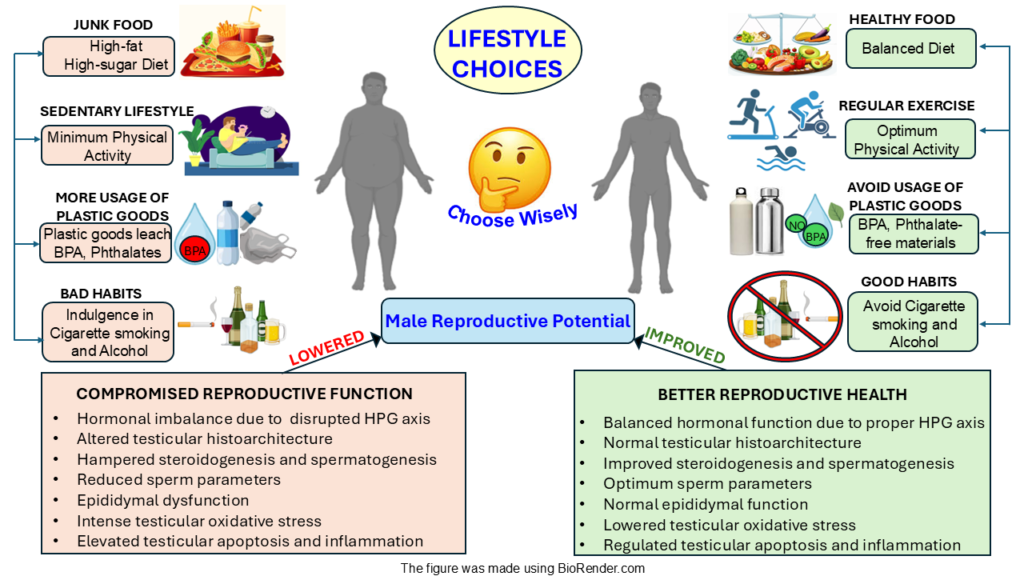
In condition of obesity, the prime hormonal hypothalamic-pituitary-gonadal axis is disturbed leading to lower testosterone levels. This is accompanied by drastic changes in testicular tissue structure with marked disorganization of seminiferous tubules, inter-tubular vacuolization, loss of cellularity, and partial to complete tubular atrophy. This ultimately manifests in the forms of oligospermia (lower sperm count), asthenospermia (low sperm motility due to which sperm fail to swim or show effective movements), teratospermia (sperm with morphological anomalies in head, mid-piece and/or tail), and in extreme cases, azoospermia (lack of sperm altogether). Such sperm pathologies in obesity-induced male infertility arise from hormone-mediated effects as well as non-hormonal mechanisms. These are mainly accounted by the prevalence of intense oxidative stress, inflammation, excessive testicular apoptosis and high rate of sperm DNA fragmentation. Testis being poor in antioxidant defences and rich in highly unsaturated fatty acids in germ cell membranes, is vulnerable to oxidative damage. With the alarming rise in obesity among adolescents and young adults, the deterioration in sperm quality could have significant consequences in the coming years. It becomes pertinent to generate public awareness, especially among the adolescents and young population, not only about healthy nutritional choices but also about the ill-effects of wrong dietary habits. Other than high fat diet, infertility can also be induced by several environmental chemicals. Prominent among these are bisphenol A, plasticizers such as phthalate esters, pesticides, heavy metals etc. These ubiquitous environmental chemicals can serve as potent endocrine disruptors playing havoc with the hormonal milieu. Modern-day lifestyle is excessively dependent on a host of manufacturing items, consumer products, personal day care items, pharmaceutical tubings and coatings, dental sealants, paints etc. with rampant usage of such endocrine disrupting chemicals. Our laboratory has particularly, studied the adverse fertility outcomes of long-term exposure to low levels of diethyl phthalate ester. There should be conscious effort to reduce usage of such compounds in our daily life. Moreover, excessive indulgence in alcohol and smoking can elicit serious fertility issues yet these remain as fully preventable factors.
Apart from diet and environmental chemicals, physical activity plays an important role in protecting male reproductive health. Sedentary men have greater chances of having defective sperm than men who remain physically active. While an active lifestyle would alleviate fat deposition and insulin resistance, the actual consequences of exercise upon testicular function have been inconsistent. Moreover, the effects have been two-sided. While moderate-intensity exercise had beneficial effects upon erectile dysfunction, intense exercise had negative outcomes. Exercise in excess, be it either vigorously intense or for prolonged durations, rather can cause poor fertility. This clearly implied that the intensity of exercise is a critical determinant. We envisaged a complex interplay between diet and physical activity in the context of male reproduction. In order to address the existing knowledge gaps in this field, our laboratory established mice models of diet-induced obesity with/without moderate-intensity exercise intervention. The molecular mechanisms were examined using relevant markers in the testicular germ cells and spermatozoa. It was interesting to note that the recovery of reproductive function in exercise-trained obese mice was remarkable when compared to their sedentary obese male counterparts. Taken together, the data revealed significant ameliorative effect of moderate-intensity exercise in obesity.
“Balanced nutrition, regular exercise, and reduced exposure to toxins are key to preserving male reproductive wellness.”
In the recent times, nationwide campaigns have been launched in India to promote public awareness about the importance of physical activity. The Government of India initiative ‘Khelo India programme’ aims to boost excellence in sports and encourage mass participation. The ‘Fit India Movement’ has been running successfully with the core objective of encouraging citizens to make sports, exercise and physical activity an essential part of daily life. The immense health benefits from the ancient practices of Yoga have been accepted worldwide. The concepts and practices as various asanas of Yoga have been rooted in Indian spiritual and cultural heritage. In addition to physical movements, Yoga involves focused breathing exercises – pranayama, and regular meditative practices which bring in mental peace and emotional stability, thereby assuring holistic well-being. By mitigating stress, restoring hormonal balance and improving sperm parameters, Yoga can exert significant beneficial effects in the male reproductive system. Together with psychological wellness, this could pave way for better reproductive health.
Thus, lifestyle habits can influence male reproductive potential to a significant extent. Increased public awareness about healthy dietary patterns, negative effects of smoking and alcohol consumption, avoiding indiscriminate usage of plasticizers and other environmental toxins, and regular sports activities, moderate-intensity exercises and yoga practices will definitely improve overall health and, in particular, the reproductive health of populations. Government policies and initiatives in this regard would create proper sports ecosystem and emphasize upon holistic wellness. Self-discipline and self-motivation in individuals which will drive appropriate lifestyle choices is the need of the hour.
Acknowledgement
We are grateful to the Science and Engineering Research Board (SERB), Govt. of India for funding this work.