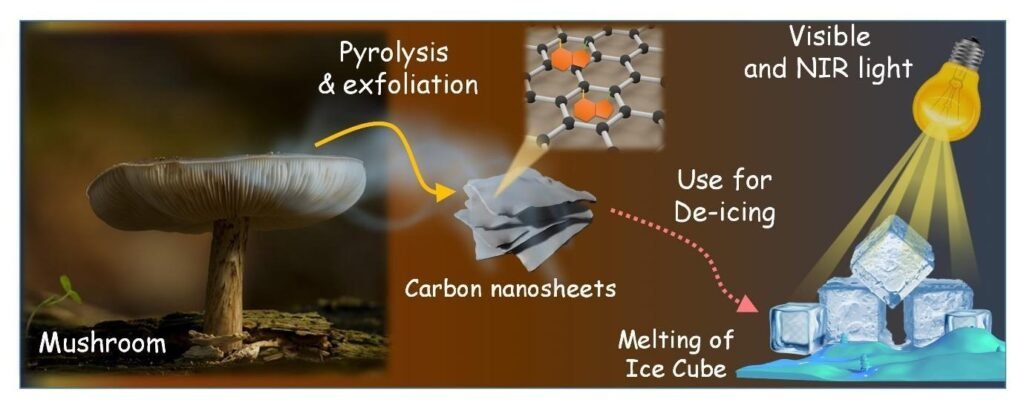
Ice formation is a widespread challenge that affects multiple sectors, such as transportation, energy and infrastructure. When ice builds up on aircraft wings, it disrupts aerodynamics and increases fuel consumption. For cars, it causes a major problem in even unlocking the doors, as well as raising the risk of accidents by making the wheels slippery. In renewable energy systems such as wind turbines, icing can significantly reduce efficiency and lead to costly maintenance. Traditional de-icing methods, such as mechanical scraping, chemical treatments (like salts and glycols), and electrical heating, have been frequently used. However, these methods have drawbacks such as the consumption of large amounts of energy, damage to surfaces over time, and the introduction of pollutants into the environment. Hence, in our recent research, we demonstrated a method to efficiently solve this problem by using a material that is derived from natural sources and does not need any external energy to clear the frozen layers on different systems. Mushroom-derived carbon nanosheets offer the advantage of sustainability to tackle a persistent real-world problem, which is ice accumulation.
“Sometimes the smartest materials found in nature; these mushroom-derived carbon nanosheets turn ordinary light into a clean and energy-free solution for melting ice.”
The strategy lies in the remarkable photothermal property of these Mushroom-derived carbon nanosheets. These materials absorb light, either from the sun or artificial sources and convert it into heat. This localised heating can melt ice directly at the surface, reducing the need for external energy inputs. Even more effective is the combination of photothermal behaviour with super-hydrophobicity as demonstrated in our research. Superhydrophobic surfaces repel water, preventing droplets from sticking and freezing easily. When paired with photothermal heating, such surfaces can both delay ice formation and quickly melt any ice that does form.
However, many existing photothermal materials rely on expensive or environmentally harmful synthesis processes. This is where our research becomes significant. The study introduces an innovative approach, that is, using wild mushrooms as a starting material to create carbon nanosheets. We specifically used a mushroom species rich in psilocybin, a naturally occurring compound containing nitrogen and phosphorus elements that are highly beneficial for tuning material properties. The synthesis process begins by drying and heating the mushroom biomass at moderate temperatures (around 300 °C). This step is known as pyrolysis which breaks down the organic compounds and produces a carbon-rich material called biochar. This biochar is then chemically treated and exfoliated into ultra-thin, sheet-like structures which are referred to as carbon nanosheets. These nanosheets are only a few atomic layers thick, with a large surface area and unique electronic properties. This synthesis process is green, renewable and it does not include any toxic reagents. The overall cost is also low making it suitable for large-scale applications.
The mushroom-derived carbon nanosheets exhibit several features such as,
- Heteroatom Doping: The presence of nitrogen, phosphorus, and oxygen atoms within the carbon structure enhances light absorption and thermal response.
- Graphitic Structure: The nanosheets contain partially ordered carbon domains that facilitate efficient energy transfer.
- Broadband Absorption: They absorb light across a wide range of wavelengths, including visible and near-infrared regions.
Together, these properties make the material highly effective at converting light into heat which is a major requirement for photothermal applications.
To demonstrate practical applications, we embedded these nanosheets into a flexible polymer matrix, creating thin films. These films can be coated onto surfaces that are prone to icing. When exposed to light, the films heat up rapidly. The experiments showed measurable temperature increases under both visible and infrared light, with stronger heating at higher light intensities. The unique factor in the obtained results is how the material interacts with different environments. For example, when tiny droplets of water or organic solvents were placed on the surface, the temperature rise varied depending on the liquid. Water showed strong heating under visible light, while certain solvents performed better under infrared light. This adaptability suggests that the material can be tuned for specific applications such as for outdoor solar-driven systems or controlled industrial environments. The findings show the carbon nanosheet ability to melt ice efficiently using light alone. Under illumination, the nanosheet-based films generate localized heat that directly melts ice on their surface.
This eliminates the need for electrical heating systems, Chemical de-icers, Mechanical removal and so on. Such a system could be particularly valuable in remote or energy-limited regions, such as high-altitude wind farms or rural areas.
Beyond de-icing, our research also highlights a broader shift in material science from the lab synthesised harmful materials to bio-derived materials. By using natural resources like mushrooms, we can reduce dependence on fossil-based or toxic precursors. This proves advantageous for environmental protection, careful usage of energy and usage of renewable sources. Moreover, the approach demonstrates how waste or low-value biomass can be transformed into high-performance materials, adding economic value while reducing the effect on the environment.
Hence. for students and young researchers, this work offers a compelling example of interdisciplinary innovation. It brings together the fields of Physics to understand the optical and thermal properties of the materials, chemistry to synthesize the materials, Device engineering, and also environmental science to understand the effect of these materials on the environment. It also shows how fundamental scientific principles such as light absorption, electron transitions, and heat transfer can be applied to solve real-world problems.
From a policymaking perspective, technologies like this align with global goals for sustainability and clean energy. Governments and industries are increasingly seeking alternative options to reduce the dependency on energy-intensive and polluting technologies. Hence, by using bio-derived photothermal materials we could reduce the maintenance costs in infrastructure, improve safety in transportation systems and support renewable energy efficiency.
“By transforming biological waste into high-performance nanomaterials, we can tackle real-world challenges like de-icing with sustainability at the core.”
This work demonstrates how an everyday biological material like mushroom can be transformed into a high-performance nanomaterial with real-world impact. By combining green synthesis with advanced functionality, the research offers a promising pathway toward safer, more sustainable de-icing technologies. The key takeaway from this research would be that the solutions to complex technological challenges can sometimes be usually found in the nature around us.