Blood transfusions save millions of lives every year, yet ensuring the right blood match can still be challenging. What inspired your team to develop a new nanotechnology-based approach for RhD blood typing, and what clinical problem were you hoping to solve?
Indeed, blood transfusion saves millions of lives if an accurate group of blood is provided. While most people are familiar with the ABO blood groups, the RhD blood group is equally important. An incorrect RhD match can trigger an immune response in patients, complicating future transfusions.
Our motivation was to explore whether we could utilize nanotechnology for a simple and efficient way to detect the RhD gene. The plan was simple: designing a Gold-oligo nanonet assembly to detect the RhD gene directly without fluorescence and PCR amplification.
Although this technology is in a proof-of-concept stage, we have tried to build the foundation for a faster and more accurate platform for specific blood typing. We are working in the direction of modifying the design to adapt to more suitable point-of-care diagnostics.
Many readers may not be familiar with RhD blood typing. Could you explain why accurately identifying RhD blood groups is so important, particularly for patients who require repeated blood transfusions?
Yes, in terms of blood grouping, ABO is much more common, but RhD is just as important as the other for safe blood transfusion. If a RhD-negative patient receives RhD-positive blood, the recipient will recognize the donor RBCs as a foreign entity and will start producing antibodies against them. This process, known as alloimmunization, will create serious concern for future transfusions and pregnancies. The problem is not restricted to RhD alone but extends to other minor Rh system antigens such as C, c, E, and e. This process is highly important for patients with thalassemia, sickle cell disease, and bone marrow failure syndromes, where blood transfusion is almost a regular necessity throughout life.
That is why precise RhD typing is very crucial. With the long-term goal of making molecular blood typing more dependable and accessible, our research attempts to help achieve this goal by creating a straightforward nanotechnology-based technique for identifying the entire gamut of Rh genotypes with better specificity.
Your study introduces a unique “gold NanoNet” platform. In simple terms, how does this technology work, and what makes it different from conventional blood typing methods?
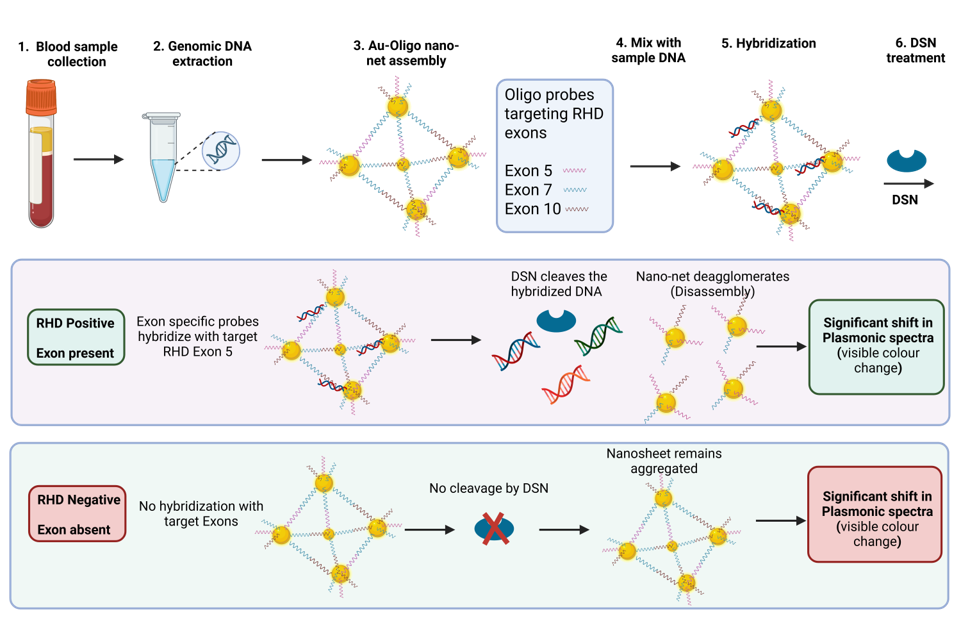
Imagine our “Gold NanoNet” as a small fishing net composed of gold nanoparticles (AuNPs) as the beads and complementary oligonucleotides as the thread to connect the beads. We have introduced this supramolecular AuNP-oligonucleotide nanonet as a new plasmonic diagnostic tool for genotyping the RhD blood group. We aimed to detect the RhD gene directly from genomic DNA instead of using conventional serological typing. Our main goal was to create a simple, PCR-free plasmonic biosensor that can differentiate between RhD-positive and RhD-negative individuals by targeting the RHD gene. This approach reduces reliance on complex molecular labs. The differences in AuNPs assembly in the presence of the target RhD DNA form the basis of the biosensor. In the course of DNA addition, RhD DNA hybridizes with complementary oligonucleotides if the patient is RhD positive. Duplex-specific nuclease (DSN) recognizes and cleaves the DNA, resulting in de-aggregation of the nanonet and a significant change in optical properties. Conversely, when DNA from RhD-negative patients is present, there is no complementary hybridization with the “Gold-NanoNet” assembly, and hence no change in aggregation and optical properties.
Conventional blood typing involves protein detection on the surface of RBCs, while molecular detection techniques, such as PCR, necessitate complex laboratory equipment, include a large number of steps, prolonged sample-to-result time and skilled personnel, which we mostly tried to minimize in our technology.
Gold nanoparticles are at the heart of your sensing platform. What makes these tiny particles particularly suitable for detecting specific genetic markers such as the RHD gene?
Scientists are fascinated by gold due to its distinct chemical properties. Its remarkable nanoscale behaviour makes it extremely useful in medical diagnostics. The major scientific reason for using gold in our study is its strong localized surface plasmon resonance. Let me explain it in a very general way. Light interacting with tiny gold nanoparticles differs greatly from that of bulk gold. These particles are great signal producers because even slight alterations in their arrangement/ self-organization can result in observable changes in their optical characteristics.
Along with this, the chemical stability, ease to modify with DNA molecules, and high biocompatibility are the reasons that attracted us towards gold and led us to build the sensing platform out of it.
What do you consider the most significant finding of your study, and how could this research contribute to making blood transfusions safer in the future?
Our study’s most important discovery is that we showed how to use a programmable network of gold nanoparticles to identify the RhD genotype in an entirely new method. We demonstrated that a nanostructured material could identify a specific genetic sequence and translate that chemical event into a straightforward optical signal, rather than relying solely on traditional blood typing techniques. This gives molecular blood group diagnostics a new avenue.
Although the results are promising, your platform is currently a proof-of-concept. What are the major challenges that need to be overcome before this technology can become part of routine clinical practice?
Although this paper is currently at the proof-of-concept stage, it is still far from being a clinically deployable molecular diagnostic platform. The limited sample size is a problem in this case. However, we understand the room for improvement in this particular work, and a group of students from our lab is working towards it. Designing a multi-oligonucleotide panel covering common D variants, including the DEL phenotype, will make the platform globally applicable. The same technology will also be used to target four other Rh antigens: C, c, E, and e. This will facilitate extended blood grouping based on genotype for patients who require transfusions. Furthermore, we are working on a point-of-care electrochemical diagnostic platform to perform a direct whole blood assay, which the current nanonet platform lacks.
Looking ahead, could the same programmable gold nanoparticle strategy be adapted to detect other genetic markers or diseases, and how do you envision this technology shaping the future of molecular diagnostics?
Absolutely. The greatest strength of our nanoplatform is that it is programmable. In principle, the same sensing strategy can be adapted to recognize different genetic markers of blood typing, infectious disease, or even cancer-causing genetic biomarkers. In the future, I see this technology developing into portable, point-of-care diagnostic tools that are inexpensive, user-friendly, and able to concurrently identify several genetic markers from a single sample.