This article is currently maintained under temporary RFCSR publication support until 13 June 2026.
What inspired you to explore metal halide perovskites, particularly their stability challenges in water, and how did this research direction evolve over time?
My research has been primarily driven by the need to develop cost-effective, high-performance electrocatalytic materials for electrochemical energy applications such as fuel cells and water electrolyzers. Traditionally, the most efficient catalysts in these systems rely on noble metals like platinum (Pt), iridium (Ir), and ruthenium (Ru), which significantly increase the overall cost of energy devices. This economic limitation motivated me to explore alternative material platforms that could deliver comparable performance at a lower cost. Metal halide perovskites emerged as a compelling candidate due to their simple crystal structure, ease of synthesis, and scalability. Their tunable composition and electronic properties make them particularly attractive for energy-related applications. However, a major bottleneck quickly became evident: their intrinsic instability in aqueous environments, which limits their direct use in water-based electrocatalysis. This challenge shaped the evolution of my research. I began focusing on strategies to enhance the water stability of these materials while preserving their catalytic activity. One approach involved modifying the surface chemistry, such as tuning the A-site cation to introduce hydrophobic character by incorporating long-chain organic molecules. Increasing conjugation within the structure also helped improve stability. More recently, protective coating strategies have gained prominence, where thin layers are applied to control water accessibility while maintaining the structural integrity of the perovskite. This research direction evolved from the broader goal of replacing expensive noble-metal catalysts to the specific challenge of stabilizing promising yet vulnerable materials, ultimately advancing their practical applicability in sustainable energy technologies.
In simple terms, could you explain what metal halide perovskites are and why their instability in water is such a critical issue for real-world applications?
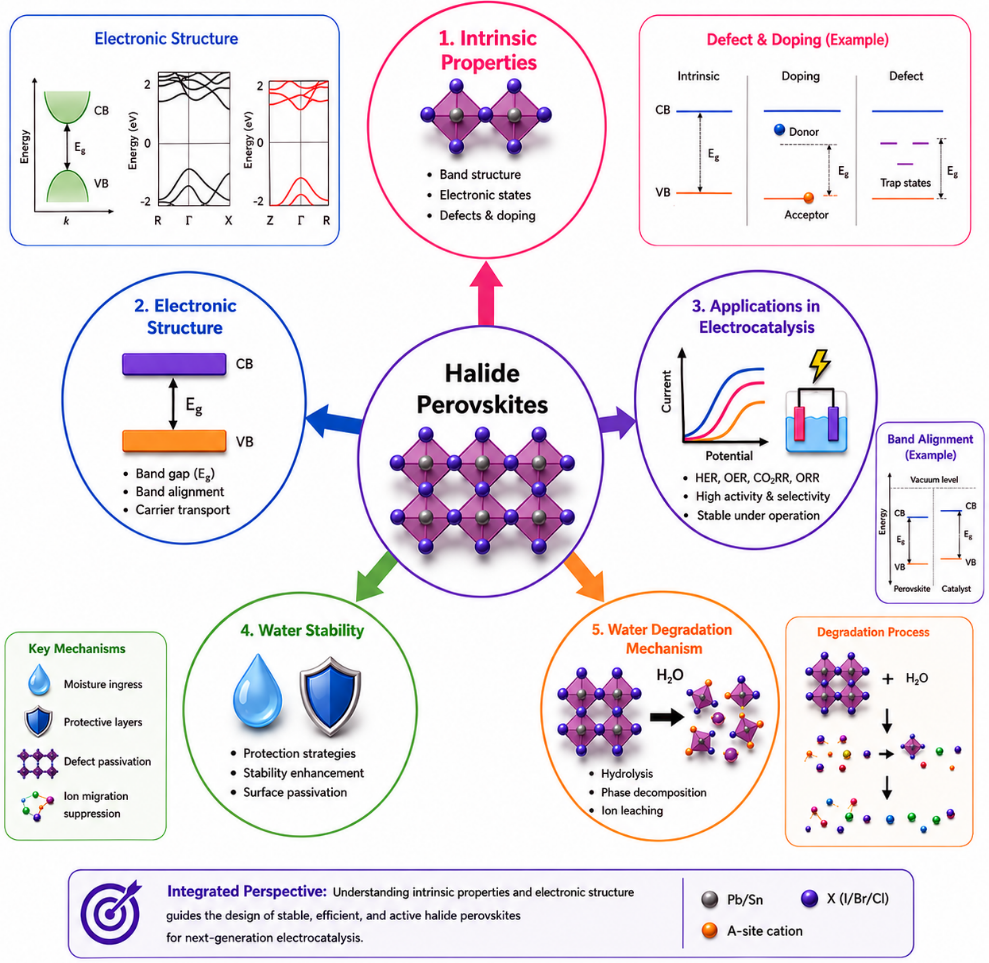
Metal halide perovskites (MHPs) are crystalline materials with an ABX₃ structure, where A is a large cation, B is a metal (e.g., lead or tin), and X is a halide (Cl, Br, or I). They form a 3D metal-halide framework with A-site ions in the cavities. MHPs are widely studied for their strong light absorption, efficient charge transport, tunable energy levels, and low-cost synthesis, making them promising for solar cells, LEDs, and electrocatalysis. However, their poor stability in water is a major limitation. Due to their soft, ionic structure, MHPs readily interact with water, leading to hydration, structural changes, and eventual decomposition into simpler compounds or even complete dissolution. This instability is especially problematic for aqueous energy technologies like fuel cells and electrolyzers, where rapid degradation limits their long-term practical use.
How do the electronic structure and material design of these perovskites influence their performance in energy-related applications like electrocatalysis?
The electronic structure of metal halide perovskites (MHPs) is central to their electrocatalytic performance, as it governs charge transport, surface reactivity, and overall catalytic efficiency. Their valence and conduction bands, primarily derived from metal (B-site) and halide (X-site) orbital interactions, enable efficient light absorption, charge generation, and separation, which are critical for driving reactions such as hydrogen evolution (HER), oxygen evolution (OER), and CO₂ reduction. The alignment of these band edges with the reaction potential determines how effectively electrons can be transferred to reactants. A key advantage of MHPs is the high tunability of their electronic structure. By modifying composition (e.g., substituting different metals or halides), introducing dopants, or engineering defects, researchers can precisely adjust the band gap, Fermi level, and adsorption energies of reaction intermediates. This control is crucial for optimizing catalytic pathways and minimizing energy barriers. In particular, defect states such as halide vacancies can act as active sites, enhancing catalytic activity by promoting charge localization and increasing the density of reactive centers. Structural dimensionality further influences electronic behavior. Lower-dimensional MHPs (0D, 1D, 2D) generally exhibit stronger quantum confinement, leading to larger band gaps and improved environmental stability, though often at the cost of reduced charge mobility. In contrast, 3D MHPs offer better charge delocalization, higher conductivity, and faster electron transfer, which are beneficial for catalytic turnover. Therefore, an effective design strategy requires balancing stability and electronic performance by carefully controlling composition, defects, and structure.
During your research, what was the most surprising or challenging finding regarding degradation mechanisms or stability in aqueous environments?
One of the most challenging yet surprising findings of this research is the complex and poorly understood degradation mechanism of metal halide perovskites (MHPs) in aqueous environments. While their instability in water is well known, the exact pathways, intermediate phases, and energy barriers, especially under realistic electrocatalytic conditions, remain unclear. The study reveals that degradation is not a single-step process but a dynamic, multi-stage transformation involving hydration, phase transitions, decomposition, and eventual dissolution. For instance, materials like MAPbI₃ initially form hydrated intermediate phases before gradually breaking down into PbI₂ and organic components, highlighting a stepwise structural evolution from 3D to lower-dimensional phases. A major challenge lies in the intrinsically “soft” ionic crystal structure of MHPs, which allows water molecules to easily penetrate the lattice, disrupt ionic interactions, and trigger phase changes. Additionally, degradation strongly depends on the electrolyte environment: acidic conditions lead to hydrolysis and irreversible breakdown, while alkaline conditions accelerate phase transformations. This environment-dependent behavior complicates the design of universally stable materials. Overall, the key challenge is understanding and controlling this multi-step degradation process, while the most striking insight is the critical role of intermediate hydrated phases and structural transformations in governing stability.
How can your research contribute to future technologies in clean energy, such as hydrogen production, CO₂ reduction, or energy storage?
My research advances clean energy technologies by developing efficient, low-cost metal halide perovskite (MHP)-based electrocatalysts for hydrogen production, CO₂ reduction, and energy storage. Their tunable electronic structure, high charge mobility, and favorable surface properties make them promising for key reactions like HER, OER, and CO₂RR. By engineering composition, dimensionality, and defects, the work optimizes charge-transport and adsorption energies, enabling catalytic performance comparable to that of noble metals at lower cost. A major focus is improving water stability by studying degradation mechanisms and applying strategies such as compositional tuning, surface passivation, and encapsulation. Additionally, controlled synthesis enhances surface area, active sites, and charge-transfer kinetics. Overall, this research bridges fundamental design and practical application, enabling the development of stable, efficient, and scalable catalysts for sustainable energy systems.
What are the next big questions in this field, and what still needs to be understood before these materials can be widely used in practical applications?
The manuscript highlights that, despite rapid progress, several fundamental challenges must be resolved before metal halide perovskites (MHPs) can be widely used in practical energy applications. A key open question is how the electronic structure and interactions among the A-, B-, and X-site components govern catalytic activity under real electrochemical conditions. Although their tunable band structure is advantageous, a deeper understanding is needed to precisely control charge transfer, adsorption energies, and reaction pathways for processes such as HER, OER, and CO₂ reduction. Another major issue is the incomplete understanding of degradation in aqueous environments, where the exact pathways, intermediate states, and energy barriers, especially across different pH conditions, remain unclear, limiting the rational design of stable materials. A further challenge is achieving durability comparable to conventional electrocatalysts. Existing stabilization strategies, including encapsulation, ligand passivation, and compositional engineering, often introduce trade-offs, such as reduced activity, hindered charge transport, and long-term coating instability. Additionally, the roles of structural dimensionality, defects, and interfaces in determining both stability and catalytic performance remain poorly understood. For example, lower-dimensional perovskites offer better stability but poorer conductivity, while 3D structures exhibit the opposite trend. Moving toward practical deployment requires a clear understanding of structure-property-stability relationships, along with scalable synthesis methods and long-term operational durability under realistic conditions.