What inspired you to explore low-grade lignite coal as a starting material for carbon quantum dots?
The inspiration arose from two important realities. First, Nigeria possesses significant lignite coal reserves, particularly in Enugu State, that have remained largely untapped since the country’s transition from coal to petroleum-based energy. Second, there is a growing global demand for sustainable, affordable, and environmentally friendly nanomaterials.
Rather than viewing lignite coal solely as a fuel or an environmental burden, we saw an opportunity to transform it into a high-value technological resource. Our goal was to demonstrate that a locally available and underutilized material could be converted into advanced nanomaterials with significant industrial and scientific value. This approach aligns with modern principles of resource recovery, sustainability, and the circular economy.
In simple terms, what are carbon quantum dots, and why are they attracting so much attention?
Carbon quantum dots are extremely small carbon-based nanoparticles, typically less than 10 nanometres in size. To put this into perspective, thousands of these particles could fit across the width of a human hair.
What makes them special is that matter behaves differently at such small dimensions. When particles become sufficiently small, they exhibit quantum confinement effects, which alter how electrons move within the material. As a result, carbon quantum dots can absorb and emit light, conduct electrical charge, and interact with chemicals in unique ways.
These properties have attracted worldwide attention because CQDs can potentially be used in medical imaging, drug delivery, environmental monitoring, water purification, photocatalysis, solar energy harvesting, light-emitting devices, sensors, and advanced electronic technologies. Unlike some conventional quantum dots that contain toxic heavy metals, carbon quantum dots are generally considered more environmentally friendly and biocompatible.
What makes lignite coal a particularly suitable and sustainable precursor?
Lignite coal offers several advantages that make it uniquely suited for CQD production.
First, it contains a high concentration of carbon, which forms the backbone of carbon quantum dots. More importantly, lignite naturally contains elements such as nitrogen, sulfur, silicon, aluminium, calcium, iron, magnesium, and oxygen. During synthesis, many of these elements become incorporated into the quantum dots as dopants, enhancing their functionality without requiring expensive additional chemicals.
The relatively low carbonization level of lignite also makes it highly reactive. Its abundance of oxygen-containing functional groups and volatile matter facilitates the breakdown of the coal structure into nanoscale carbon domains during synthesis.
From a sustainability perspective, lignite is abundant, inexpensive, and readily available. Using it as a nanomaterial precursor transforms a low-value resource into a high-value technological product while reducing dependence on costly synthetic feedstocks.
What was the most surprising or exciting finding from your study?
Several discoveries were particularly exciting.
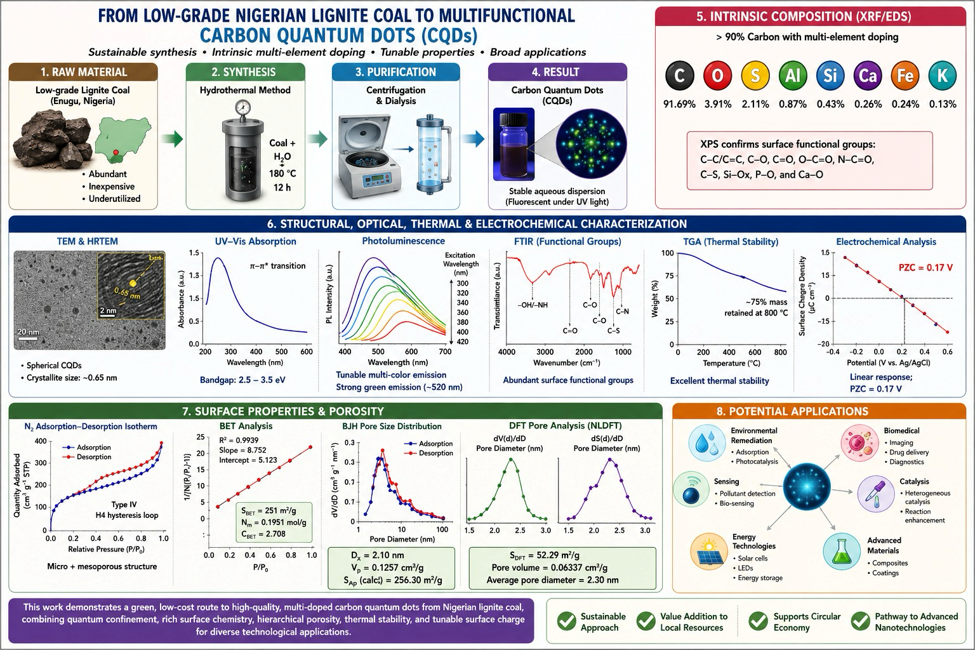
First, the synthesized CQDs contained over 90% carbon while simultaneously incorporating naturally occurring dopants such as nitrogen, sulfur, silicon, and aluminium. This intrinsic multi-element doping significantly enhanced their functionality.
Second, we observed strong quantum confinement effects. The CQDs possessed an extremely small crystallite size of approximately 0.65 nanometres, resulting in tunable optical properties and bandgap energies between approximately 2.5 and 3.5 electron volts. These values are highly desirable for optoelectronic applications.
Another exciting result was their fluorescence behaviour. The CQDs emitted different colours depending on the excitation wavelength, producing stable and tunable photoluminescence with strong green emission. Such behaviour is highly valuable for imaging and sensing technologies.
We also discovered a hierarchical pore structure consisting of both micropores and mesopores, combined with a moderate surface area and abundant surface functional groups. These characteristics make the material attractive for adsorption, catalysis, and environmental remediation.
Finally, the CQDs exhibited remarkable thermal stability, retaining approximately 75% of their mass at temperatures as high to 800°C. This suggests potential suitability for applications requiring robust performance under demanding conditions.
How could these coal-derived carbon quantum dots be used in real-world applications?
The potential applications are extensive.
In environmental remediation, the CQDs can adsorb contaminants and enhance photocatalytic degradation of pollutants such as dyes, heavy metals, and organic compounds. Their porous structure, surface functional groups, and dopant-rich composition make them particularly effective for water treatment technologies.
In sensing applications, their fluorescence changes can be used to detect pollutants, metal ions, food contaminants, and biological molecules with high sensitivity.
In biomedical fields, the CQDs show promise as fluorescent imaging probes because they emit bright, tunable light. Their surface charge characteristics and biocompatibility may also support future applications in targeted drug delivery and diagnostics.
For energy technologies, the CQDs possess optical bandgaps suitable for solar energy conversion, light-emitting devices, photocatalysis, and other optoelectronic applications. Their ability to absorb and transfer energy efficiently makes them attractive candidates for next-generation renewable energy systems.
The combination of quantum confinement, intrinsic doping, hierarchical porosity, and tunable surface charge creates a multifunctional platform capable of serving numerous technological sectors.
What are the next major challenges and opportunities in this field?
One of the major challenges is scaling up production while maintaining precise control over particle size, surface chemistry, and optical properties. Laboratory synthesis is relatively straightforward, but industrial-scale manufacturing requires consistency and quality assurance.
Another challenge involves optimizing the materials for specific applications. Different uses require different combinations of fluorescence, conductivity, porosity, and surface functionality.
Further studies are also needed to evaluate long-term environmental safety, biological interactions, and commercial viability.
The opportunities, however, are enormous. Growing global interest in sustainable nanotechnology creates a pathway for transforming underutilized natural resources into advanced materials. For countries such as Nigeria, this research demonstrates how local resources can contribute to high-value manufacturing, environmental technologies, renewable energy systems, and scientific innovation. Our findings show that low-grade lignite coal is far more than a fossil fuel resource. It can serve as a naturally pre-engineered nanomaterial precursor that simultaneously provides carbon, dopants, surface functional groups, hierarchical porosity, and electronic tuning. By converting an underutilized resource into multifunctional carbon quantum dots, we have demonstrated a pathway toward sustainable nanotechnology that benefits both science and society.