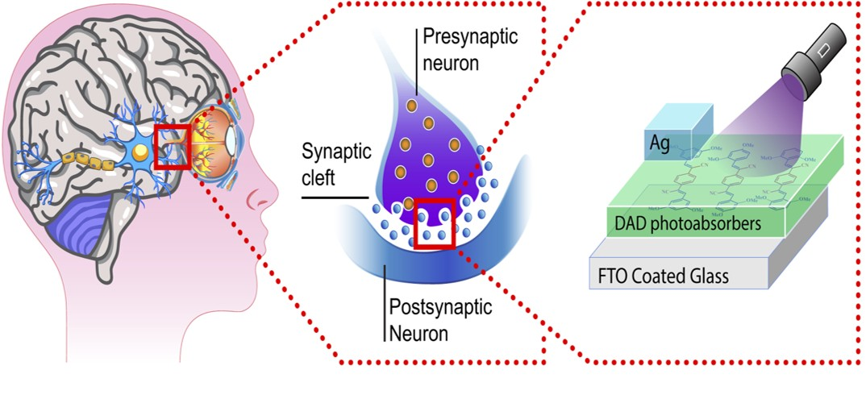
Can non-living materials “remember”? Not like a human brain, but perhaps in a way that could transform future technology. Today’s computers largely keep memory and processing separate, constantly shuttling data between different components, a process that consumes both time and energy. Our brain operates very differently: its neurons and synapses can sense, store information, learn from experience, and process new signals together, using remarkably little energy. Inspired by nature, scientists are developing neuromorphic electronics, a new generation of smart electronic materials and devices designed to mimic the basic functions of biological neural systems. By using materials that can adapt their physical state in response to past activity, these devices can potentially provide a unified framework for storing and processing information. The result could be faster, more adaptive and energy-efficient hardware, bringing computing a step closer to the remarkable efficiency of biological systems.
Our research interest lies at an emerging intersection of organic molecular materials, optoelectronics and neuromorphic electronics, with a central question: Can we design a molecule whose electronic response behaves like a synapse? The answer is increasingly yes. Organic molecules are particularly attractive because their electronic, optical and structural properties can be modified through molecular design. Unlike conventional inorganic semiconductors, where properties are often strongly constrained by composition and crystal structure, organic materials offer an enormous chemical design space. Their donor and acceptor groups, molecular conjugation, symmetry, packing, intermolecular interactions and even the precise position of a functional group can be deliberately manipulated. This molecular freedom is important because an artificial synapse does not merely need to conduct electricity. It must possess a controllable history. The response to a second stimulus should depend on what happened during the first; repeated stimulation should strengthen or modify the response; and information may need to persist after the stimulus has disappeared. Organic semiconductors can exhibit such behaviour through photoinduced charge generation, charge trapping and detrapping, molecular charge transfer, and structural disorder. These mechanisms can generate phenomena analogous to paired-pulse facilitation, short- and long-term plasticity, excitatory postsynaptic currents and spike-number-dependent learning.
From electronic devices to artificial synapses
The development of artificial synapses has advanced rapidly using metal oxides, two-dimensional materials, perovskites and other emerging semiconductors, demonstrating impressive memory and synaptic plasticity. Organic materials offer a complementary advantage: they can often be synthesized by simple chemistry, solution-processed, fabricated under mild conditions and chemically tailored, making them attractive for flexible, low-cost and large-area neuromorphic electronics. An especially exciting development is optoelectronic synapses. Biological vision does not simply record light intensity; the brain interprets its temporal and spatial patterns. Similarly, an artificial photosynapse can use light as both an input signal and a trigger for memory. This behaviour can arise from photoinduced charge trapping, photoactive electrets and defect-related processes. The key advance is that the material itself can perform part of the information processing, rather than merely transmitting signals to an external processor.
The molecule matters and so does its geometry
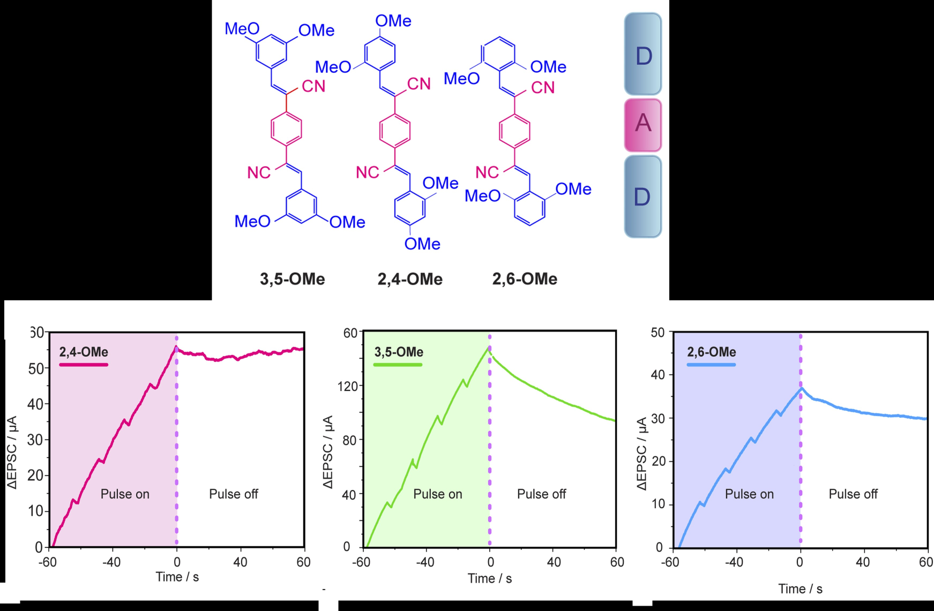
Our recent collaborative work shows how molecular engineering can be a powerful strategy for neuromorphic materials. We studied a family of donor–acceptor–donor (DAD) organic luminophores with nearly identical chemical compositions but different positions of methoxy donor groups. This provided a clean test of how molecular arrangement alone can influence electronic and synaptic behaviour. The differences were substantial. The regioisomers showed distinct molecular conformations, crystal packing, optical properties, charge-transfer characteristics and memory responses. The 2,6-isomer became strongly twisted due to steric crowding, while the 2,4- and 3,5-isomers remained more planar, enabling stronger electronic communication. Their different packing and intermolecular interactions further influenced charge transport and trapping. This highlights a key principle of organic electronics: molecular structure goes beyond chemical composition. Molecules with the same elemental composition can behave very differently because their three-dimensional arrangement determines how electrons move, where they are trapped and how molecules interact. The device results reinforced this structure-property relationship. The 3,5-isomer achieved a photoresponsivity of 41.25 A W⁻¹ and detectivity of 4.57 × 10¹¹ Jones, while also showing persistent photocurrent after illumination was removed. The 2,4-isomer exhibited particularly strong synaptic behaviour: repeated light pulses produced enhanced postsynaptic currents, with a PPF index of ~196% under a 10-second UV pulse followed by a 2-second interval. At the microscopic level, these memory effects arise from charge generation, molecular charge transfer and charge trapping within the crystalline environment. The 2,4-isomer, which has the largest calculated void space (~24.4% of the unit-cell volume), may provide favourable sites for charge trapping, while stronger intermolecular interactions can help stabilize the stored charge. Thus, the macroscopic phenomenon of “memory” can emerge directly from molecular packing and nanoscale charge dynamics.
From mimicry to molecular computing
The most exciting possibility is that neuromorphic functionality can be encoded directly into molecular architecture. Instead of optimizing a material only after synthesis, we could design molecules for a desired computing function from the outset. This marks a conceptual shift from materials for electronics to molecules for computation. However, the field remains far from mature. Demonstrating PPF or long-term potentiation in a laboratory device is not enough to build practical neuromorphic systems. Key challenges include understanding and controlling charge traps, achieving reproducible molecular packing over large areas, improving environmental and operational stability, lowering operating voltages, broadening optical response and integrating individual synapses into dense arrays. A fundamental challenge is balancing charge mobility and memory. Fast electronics favour efficient charge transport, while memory requires controlled trapping and delayed release. Too few traps give weak memory; too many immobilize carriers and slow the device. The goal is therefore to engineer the appropriate distribution of electronic states and relaxation times. Ultimately, the field must move beyond isolated demonstrations toward reproducible multilevel states, low-energy operation, long endurance, device uniformity and integration with sensing and computing architectures. Organic materials offer exceptional chemical tunability; the challenge is to translate that molecular freedom into predictable, reliable device behaviour.
From materials for electronics to molecules for computation
The current state of the field can be captured in one idea: the molecule itself can become part of the computational architecture. Learning-like behaviour in organic electronics can emerge from the interplay of molecular conjugation, donor-acceptor charge transfer, crystal packing, intermolecular interactions, defects, voids and carrier trapping, without requiring complex circuits. Our recent study shows that even regioisomerism, the position of a functional group within an otherwise similar molecule, can tune optoelectronic synaptic behaviour. This points to an exciting future in which neuromorphic materials are designed not simply to imitate a transistor or synapse, but to sense, remember and process information intrinsically. Organic molecules are particularly promising because chemistry offers extraordinary control over molecular structure. Establishing reliable links between molecular architecture, charge dynamics and learning behaviour could increasingly blur the boundaries between chemistry, materials science and computing. The ultimate goal is not merely to build machines that look like brains, but to create materials that embody some of the brain’s fundamental principles: adaptation, memory and information processing so that matter itself becomes an active participant in computation.