Turning Biomass Waste into Valuable Resources
The increasing generation of agricultural and food-processing waste has created a major environmental challenge, but it also represents an important opportunity for developing sustainable technologies. Fruit peels, seeds, shells, and other plant residues are commonly discarded despite containing valuable carbonaceous materials and diverse bioactive compounds. The research field of biomass waste valorization aims to transform these underutilized resources into high-value products through chemical, thermal, biological, and materials-engineering approaches. This field is particularly important because it connects waste management with resource recovery, clean energy, sustainable food preservation, and the circular bioeconomy. Fruit residues such as orange and pomegranate peels contain cellulose, hemicellulose, lignin, pectin, polyphenols, flavonoids, essential oils, and other functional constituents, making them versatile feedstocks for producing activated carbon, energy-storage materials, natural preservatives, nutraceutical ingredients, and other value-added products. The central concept is to move beyond conventional waste disposal and instead extract maximum value from biomass while minimizing environmental impact.
“Waste is not the end of a resource—it is the beginning of a new opportunity for human innovation.”
From Fruit Waste to Energy and Food Applications
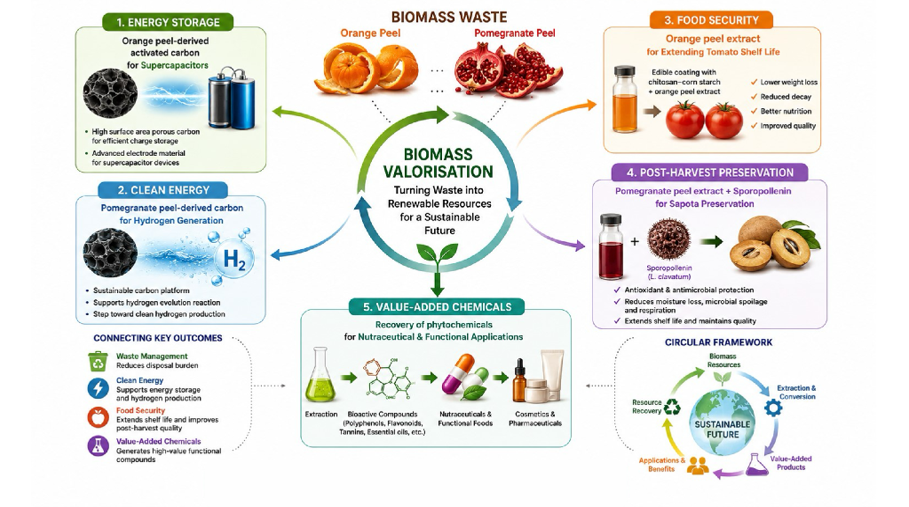
One of the important advances in this field is the development of biomass-derived activated carbon as a functional material for energy and environmental applications. Through controlled carbonization and activation, biomass can be transformed into porous carbon with suitable surface functionality, making it useful for supercapacitors, batteries, adsorption, catalysis, sensors, and environmental remediation. Our research has demonstrated the potential of orange peel as a precursor for activated carbon and its integration with iron phosphate through an in situ hydrothermal process to develop an electrode material for supercapacitor applications. The porous carbon provides an accessible framework for electrolyte interaction and charge transport, while iron phosphate contributes additional electrochemical activity. The resulting composite was further utilized in a prototype symmetric solid-state supercapacitor, demonstrating how a discarded fruit-processing residue can be converted into a functional material for energy-storage technology.
The application of biomass-derived carbon is also being extended towards hydrogen generation, an important area in the transition towards cleaner energy systems. Pomegranate peel-derived activated carbon provides a renewable carbon platform with suitable surface characteristics for hydrogen-evolution processes. Our work explored the use of pomegranate peel-derived activated carbon prepared under acidic activation conditions, where the functionalized carbon surface and reaction environment contributed to hydrogen generation. These developments demonstrate that biomass-derived materials can participate in both energy storage and energy conversion, broadening the role of agricultural waste beyond conventional low-value utilization. Although improvements in catalytic efficiency, stability, reaction optimization, and scalability remain necessary, biomass-derived carbon represents a promising platform for future clean-energy technologies.
Another important advance is the development of natural and active food-packaging systems using bioactive compounds recovered from fruit residues. Orange peel extract contains compounds such as limonene, linalool, phenolics, and flavonoids that provide antioxidant and antimicrobial functionality. In our study, orange peel extract was incorporated into a chitosan–corn starch edible coating for tomatoes. The extract complemented the physical barrier provided by the coating, helping to reduce oxidative deterioration and microbial spoilage, while the semipermeable coating reduced moisture loss and helped regulate respiration. Consequently, coated tomatoes demonstrated lower weight loss and decay and better retention of nutritional and sensory characteristics during storage. This work demonstrates that a fruit-processing residue can be converted into a functional ingredient for extending the post-harvest shelf life of fresh produce.
The same principle has been explored for sapota preservation through the combination of pomegranate peel extract and Lycopodium clavatum-derived sporopollenin. Pomegranate peel provides antioxidant and antimicrobial compounds, while sporopollenin can act as a natural carrier and protective matrix for bioactive molecules. When incorporated with chitosan and corn starch, the resulting coating provides a multifunctional preservation system capable of addressing moisture loss, microbial deterioration, respiration, and ripening. These developments demonstrate the increasing importance of combining naturally derived polymers, biomass-derived bioactive compounds, and functional biological materials to develop sustainable post-harvest technologies.
A further advancement is the recovery of high-value phytochemicals and nutraceutical compounds from biomass waste. Fruit peels are rich sources of polyphenols, flavonoids, tannins, essential oils, pigments, and other functional molecules. Instead of losing these compounds through disposal, appropriate extraction and purification strategies can recover them for potential applications in functional foods, nutraceuticals, food packaging, pharmaceutical formulations, cosmetics, and other value-added products. Molecularly imprinted materials provide an additional opportunity for selective recognition and recovery of specific target molecules (Quercetin, 4-Hydroxybenzoic acid etc. in the peels), potentially improving the efficiency of extraction, separation, and detection processes. Such developments are moving biomass utilization towards a biorefinery model in which different components of a single waste stream can be converted into multiple useful products.
Towards a Zero-Waste Biorefinery Approach
This multidisciplinary approach also supports the concept of zero-waste production. Rather than assigning a single application to an entire biomass residue, different fractions can be directed towards their most appropriate uses. Bioactive compounds can be extracted for food, nutraceutical, or preservation applications, while the remaining carbon-rich fraction can be converted into activated carbon for energy or environmental applications. Suitable residual fractions may also be explored for animal feed, composting, bioenergy, or other resource-recovery pathways, subject to appropriate safety and technical evaluation. Such sequential utilization increases the value obtained from the original biomass and reduces the quantity ultimately entering the waste stream.
Challenges in Scaling Biomass Technologies
Despite significant progress, several challenges continue to limit the large-scale implementation of biomass-derived technologies. The first is the inherent variability of biomass. Its chemical composition depends on plant species, geographical origin, cultivation conditions, maturity, and processing history. This variability can influence the properties of activated carbon and the concentration and activity of extracted bioactive compounds. Standardized feedstock characterization and reproducible processing are therefore essential.
A second challenge is the scale-up of laboratory processes. Materials that demonstrate excellent performance under controlled laboratory conditions may not necessarily be economically or environmentally viable at industrial scale. Activation processes may require significant energy or chemical inputs, while bioactive-compound extraction can involve solvents and multiple purification steps. Future research should therefore place greater emphasis on green extraction methods, energy-efficient processing, solvent recovery, techno-economic assessment, and life-cycle analysis.
For energy applications, further improvements are required in electrode performance, long-term cycling stability, device-level energy density, manufacturing consistency, and scalability. For food-preservation systems, regulatory safety, coating uniformity, sensory acceptance, storage stability, and real-world supply-chain performance require further investigation. In the field of bioactive extraction, the identification, purification, stability, bioavailability, and safety of recovered compounds remain important areas for further research. Addressing these knowledge gaps will be essential for translating promising laboratory findings into practical technologies.
Connecting Waste, Energy and Food through a Circular Bioeconomy
The most important message from the current state of biomass research is that biomass waste should no longer be viewed simply as a disposal problem; it should be considered a renewable resource and a potential source for multiple value-added products. Our research illustrates this transition through distinct applications: orange peel-derived activated carbon for energy storage, pomegranate peel-derived carbon for hydrogen-generation studies, orange peel extract for extending tomato shelf life, pomegranate peel extract and sporopollenin for sapota preservation, and recovery of phytochemicals for nutraceutical and functional applications. These examples demonstrate how biomass valorization can connect waste management, clean energy, food security, and value-added chemical production within a circular framework.
The Future of Biomass Valorization
The future of the field should therefore move from simple biomass conversion towards integrated biomass-refinery and zero-waste strategies, in which each component of the feedstock is directed towards its highest-value application. Success will depend not only on developing materials with excellent laboratory performance but also on demonstrating reproducibility, safety, economic feasibility, environmental benefits, and scalability. The key scientific challenge is consequently to transform biomass waste into products that are not only technically effective but also genuinely sustainable throughout their life cycle. This shift, from treating waste as an end product to using it as a starting material for innovation, represents the central opportunity for biomass research in the emerging circular bioeconomy framework.