Microplastics have become a growing environmental concern worldwide. What inspired your team to investigate their presence in the Golden Mahseer, and why is this species important for monitoring freshwater ecosystem health?
Microplastics – plastic particles smaller than 5 mm – have become one of the most pervasive pollutants in aquatic ecosystems, and they persist, travel long distances, and bioaccumulate through food webs. Yet most evidence comes from marine and estuarine fish, while Himalayan freshwater systems remain poorly studied. We were struck by how little was known about these mountain waters, which are vital freshwater resources and home to many endemic and endangered species. The Golden Mahseer (Tor putitora) is a culturally and economically important fish of these rivers and lakes, and it is widely regarded as a reliable bioindicator of environmental contamination. By examining where microplastics accumulate inside its body, we could obtain an early, sensitive signal of ecosystem health. Our study is among the first organ-level assessments of microplastic contamination in Himalayan freshwater fish.
Your study found microplastics in the gills, gut, and even the muscle of the fish. What does this tell us about the extent of plastic pollution in Himalayan freshwater ecosystems?
We detected microplastics in every tissue we examined – gills, gastrointestinal tract, and even muscle – in fish from all three sites. This tells us that plastic pollution has already reached deep into Himalayan freshwater ecosystems, which are often assumed to be pristine because of their low industrial activity. The presence of particles in muscle is especially telling, because it shows that microplastics do not simply pass through the gut; some move into body tissues. Compared with other systems, the contamination we found was moderate – other researchers reported 4 to 10 particles per fish on the Tibetan Plateau and up to 12 in the Indus basin – but it is ecologically significant. It confirms that even remote mountain catchments are not insulated from plastic pollution, most likely because particles arrive through atmospheric deposition and are transported across the wider catchment.
One of your key findings is that the gastrointestinal tract contained the highest levels of microplastics. Why do these particles accumulate mainly in the gut, and what does this reveal about how fish are exposed to plastic pollution?
The gastrointestinal tract clearly carried the heaviest burden – on average 5.53 plus or minus 4.26 microplastics per individual, compared with 3.50 plus or minus 2.58 in the gills and just 0.08 plus or minus 0.02 in muscle – and these organ differences were statistically significant. This pattern points to ingestion as the main route of exposure. Microplastics suspended in the water column are swallowed during feeding or taken in accidentally with food particles. The Golden Mahseer is a benthic feeder that forages close to the sediment, exactly where microplastics tend to settle and accumulate, so it readily consumes particles along with prey and detritus. Similar gut-dominated patterns have been reported in other freshwater fishes such as common carp and snow trout. The higher counts in gills also indicate a respiratory pathway, meaning fish are exposed both through what they breathe and what they eat.
Most of the microplastics you identified were small fibers, many of them black or blue in color. Where do these particles most likely come from, and what human activities are contributing to their presence in rivers and lakes?
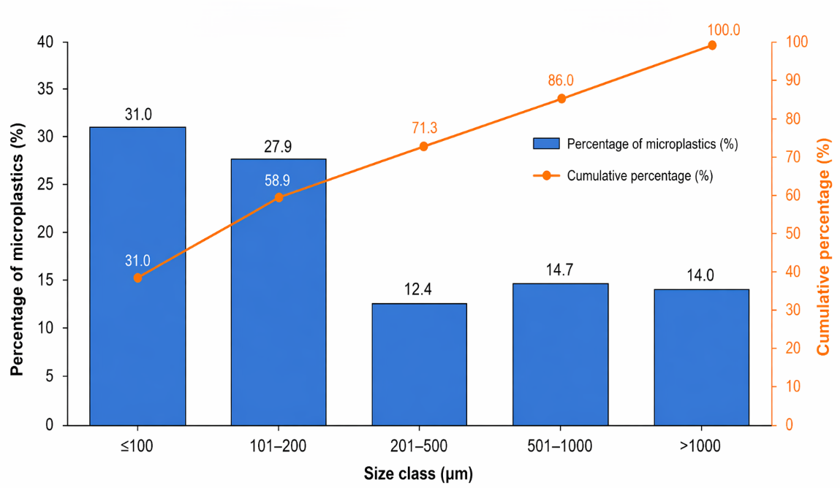
Fibers were by far the most common shape (49.6%), ahead of fragments (27.9%) and pellets (22.5%), and more than 74% of all particles were black or brown and blue or violet. Most were small – about 71% were 500 micrometres or less. This combination is a fingerprint of everyday human activity rather than heavy industry. Dark fibers of this kind typically come from weathered synthetic textiles and laundry wastewater, from domestic sewage, from tire-wear debris carried in road and urban runoff, and from fishing gear such as nets and lines. Comparable fiber-rich, dark-coloured profiles have been reported in the Yangtze and Brahmaputra river systems, where domestic wastewater and urban runoff were identified as major sources. It is important to stress, however, that because we used visual and morphological identification rather than FTIR or Raman spectroscopy, these source links remain informed inferences rather than confirmed polymer identifications.
Although only small amounts of microplastics were detected in the edible muscle, should consumers be concerned? What do we currently know, and what remains uncertain about the implications for food safety and human health?
Consumers should be thoughtful rather than alarmed. We found only trace amounts in edible muscle (0.08 plus or minus 0.02 particles per fish), but the fact that any particles reach muscle matters, because the Golden Mahseer is widely eaten by local communities. Laboratory and field studies suggest that very small microplastics – below about 500 micrometres – can cross epithelial barriers, move into tissues, and trigger oxidative stress and inflammation in aquatic organisms, which raises legitimate questions about transfer up the food chain to people. What remains genuinely uncertain is the human health picture: our study did not measure toxicological effects or actual dietary risk, and visual identification can overestimate counts by including natural fibers. So the honest message is that microplastics are present in the food chain and deserve attention, but the real implications for food safety cannot yet be quantified and require dedicated toxicological and exposure research.
Your study highlights differences in microplastic contamination among the three sampling sites. What do these variations tell us about the influence of tourism, urbanization, and local human activities on freshwater pollution?
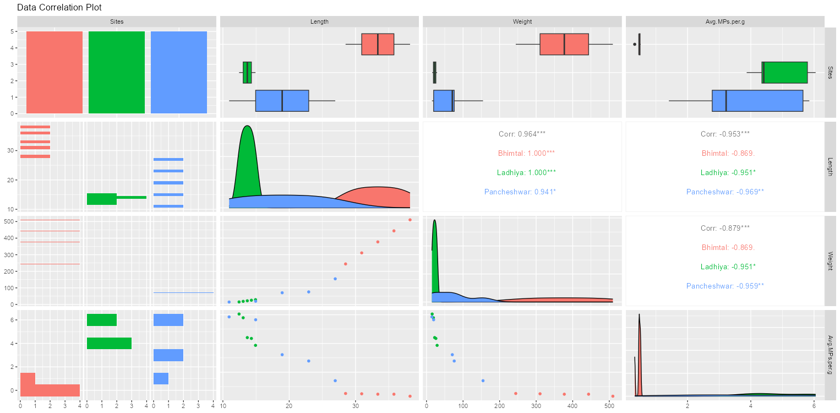
The three sites told very different stories. The Ladhiya River carried the highest overall load (4.89 plus or minus 2.26 particles per fish), followed by Pancheshwar (3.77 plus or minus 2.06), while Bhimtal Lake was strikingly lower (0.45 plus or minus 0.16). The elevated contamination at Ladhiya reflects concentrated human pressure – tourism, urban runoff, and effluent discharges – entering a relatively confined river stretch. Pancheshwar, at the confluence of the Kali and Saryu rivers, showed lower counts most likely because higher flow and dilution reduce particle retention, consistent with reports that faster mountain rivers retain fewer microplastics. In other words, contamination tracks local human activity and hydrology rather than being uniform across the landscape. This variation is a useful message for managers: pollution hotspots form where tourism and urbanization concentrate, so targeted, site-specific interventions are likely to be more effective than blanket measures.
Looking ahead, what actions should researchers, policymakers, and the public take to reduce microplastic pollution and better protect freshwater ecosystems and the species that depend on them?
Reducing microplastic pollution will require coordinated action. Researchers should move beyond counting particles to confirming polymer types with FTIR or Raman spectroscopy, analyse water and sediment alongside fish to trace sources, and study toxicological effects such as oxidative stress, histopathology, and metabolic disruption. Policymakers should prioritise improved wastewater treatment, better solid-waste and plastic regulation in Himalayan catchments, and effective management of tourism, which our data link to local contamination. Sustained, standardized monitoring is essential so that trends can be tracked over time. The public also has a direct role – reducing single-use plastics, disposing of waste responsibly, and limiting the shedding of synthetic fibers from clothing. Because vulnerable species like the Golden Mahseer act as sentinels of ecosystem health, protecting them and their habitats ultimately safeguards the freshwater resources and communities that depend on these rivers and lakes.