A central, unresolved paradigm in modern pharmacology is achieving the localization of therapeutic agents with high spatial and temporal precision at targeted disease sites. Conventional small-molecule drugs and biologics often suffer from rapid systemic clearance, off-target toxicity, and an inability to maintain therapeutic concentrations within localized, pathological microenvironments. To address these limitations, researchers have increasingly turned to synthetic chemistry, nanoscience, and non-covalent supramolecular design to construct systems capable of recognizing, responding to, and modulating specific biochemical niches.
Among these strategies, peptide-based supramolecular materials have emerged as exceptionally versatile candidates. By leveraging multivalent, dynamic, and reversible non-covalent interactions, chemically programmable peptide assemblies offer elegant solutions to structural and functional challenges in complex disease pathways spanning neurodegenerative disorders, oncology, and multidrug-resistant infectious diseases.
Globally, over 55 million people live with dementia, alongside a massive burden from cancer and antimicrobial-resistant ESKAPE pathogens. In neurodegeneration, particularly Alzheimer’s disease (AD), conventional drug development has faced notorious attrition rates due to the biological complexity of central nervous system (CNS) disease pathways. Historically, the amyloid cascade hypothesis positioned the deposition of mature, $\beta$-sheet-rich fibrillar species of amyloid-b (Ab) as the primary therapeutic checkpoint. However, contemporary clinical and mechanistic insights strongly indicate that transient, soluble prefibrillar/oligomeric species of (Ab-42) generated via enzymatic cleavage of amyloid precursor proteins (APPs) by b– and g-secretases under physiological conditions are the true primary drivers of synaptic disruption and neurotoxicity. Despite the shift toward targeting transient Ab-42 oligomers, major challenges remain in designing therapies that can navigate their dynamic structural heterogeneity without static binding pockets while achieving precise spatiotemporal delivery. A truly transformative strategy must move beyond simple aggregation inhibition to provide dual action simultaneously halting toxic oligomerization and actively destabilizing existing mature fibrils through smart, non-covalent sequestration.
To tackle the structural and mechanical complexity of toxic protein species, recent years have witnessed a renaissance in molecular and supramolecular strategies. Prof. Stupp and coworkers (J. Am. Chem. Soc. 2025, 147, 17710-17724) demonstrated the copolymerization of a trehalose-conjugated amphiphilic glycopeptide (TPA) with Ab-42 monomers/oligomers, arresting aggregation by altering the self-assembly landscape. Prof. Raskatov and colleagues (J. Am. Chem. Soc. 2024, 146, 2634-2645) introduced an Aa isoform chaperone system that co-assembles with Ab-42 to selectively interrupt toxic oligomer formation. Prof. Knowles, Prof. Kassiou, and coworkers designed Perphenazine–Macrocycle conjugates (ACS Chem. Neurosci 2023, 14, 87-98) that modulate the pathological aggregation pathway by sequestering Ab-42 monomers and converting them into non-toxic amorphous aggregates. Prof. D.S. Eisenberg and coworkers (Nature 2025, 644, 1020-1027) pioneered the concept of stereochemically mismatched peptide sequences that exert severe mechanical torque on the protein fibril lattice, successfully dismantling mature Tau fibrils. Prof. Takuzo Aida and colleagues (Nat. Commun. 2022, 13, 5424) introduced a multivalent salt-bridging molecular glue, demonstrating how non-covalent logic can reconstitute dynamic proteins like microtubules into higher-order capsule structures.
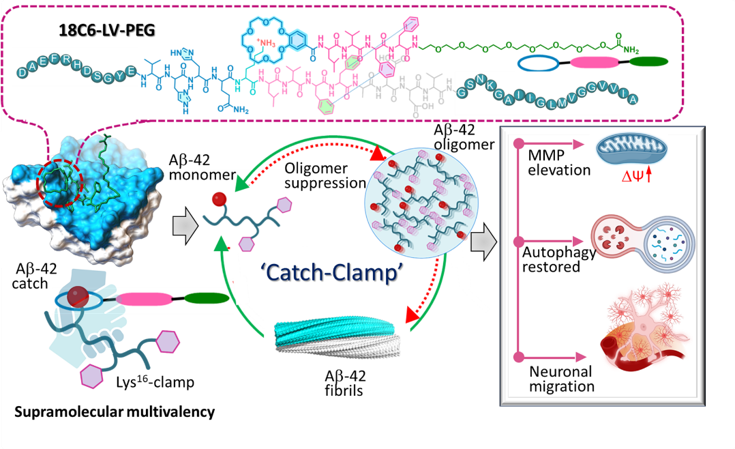
While contemporary literature offers pioneering tactics for either oligomerization inhibition or structural reconstitution, a chemically programmable supramolecular strategy backed by comprehensive mechanistic validation for simultaneous oligomerization inhibition and mature fibril destabilization has remained elusive. Recognizing that the central core domain (17-21LVFFA) and C-terminal residues (33-42Ab-42) govern hydrophobic self-assembly, while the adjacent Lys16 residue plays a pivotal role in proteotoxicity during oligomerization, our group engineered a targeted supramolecular conjugate (18C6-LV-PEG) comprised of 18-Crown-6, a short peptide LVFF and PEG chain (J. Am. Chem. Soc. 2026, 148, 27260-27281).
This conjugate, 18C6-LV-PEG catches Ab-42 via specific hydrophobic interactions of LVFF, clamps Lys16, and halting Ab-42 oligomerization. PEG chain imparts biocompatibility, extends circulation half-life in vivo, and aids translational feasibility of this construct. By pairing sequence-specific hydrophobic recognition (LVFF) with site-directed macrocyclic clamping of Lys16, the system not only prevents the formation of toxic oligomeric species, modulates ROS, restores impaired autophagy and ameliorates cognitive deficits but also actively destabilizes established mature Ab-42 aggregates.
Beyond Alzheimer’s therapeutics, our research group leverages localized, spatiotemporally controlled peptide self-assembly pathways to tackle other urgent healthcare challenges. Utilizing the diphenylalanine (Phe-Phe) motif, we designed host–guest supramolecular adducts, and coacervates vesicles responsive to ALP and ALP mediated host-guest disassembly/rupture of coacervates vesicles lead apoptosis through ‘Phe-Phe’ fibrillization and therapeutic release respectively (Sarkar et al., Adv. Healthcare Mater. 2024, 14, 2403243 and Sarkar et al., Adv. Mater. 2026, 38, e73804). Our group also deployed gelatinase-responsive peptide self-sorting pathways followed by localized self-assembly to selectively combat resistant ESKAPE pathogens (Bose et al., J. Am. Chem. Soc. 2025, 147, 37398–37413).
Looking forward, the treatment of complex pathologies like Alzheimer’s disease will increasingly rely on smart, bio-orthogonal supramolecular materials rather than traditional single-target pharmacology. We anticipate the key avenues that will shape the next generation of advanced therapeutics include¾supramolecular traps, molecular glues and stimuli-responsive dissipative peptide self-assembly. By bridging synthetic chemistry with biological architecture, the continued exploration of chemically programmable supramolecular platforms holds immense promise for developing non-invasive nanomedicines, tissue regeneration frameworks, and localized therapies capable of reversing disease progression at its fundamental molecular root.