There has been an exponential increase in the biomanufacturing processes utilizing microbes or yeast as they are known to be cost-effective, have versatile capability and provide high yields. The ongoing advancements in the biomanufacturing industry are growing along with the challenges of detecting products and processes in real time. An industrial microbial culture is comprised of growth media, cells, and variety of metabolites. An accurate identification of commercially relevant metabolites in a growing complex culture is one of the critical process parameters. The traditional approaches, such as chemical-based assays, high-performance liquid chromatography (HPLC) and mass spectrometry provide valuable information and are highly sensitive but these are known to be time-consuming, involve invasive and extensive sample preparation steps. To achieve consistent quality, yield, and reproducibility, a precise, quantitative, real-time monitoring approach is essential. Among the growing interest of the scientific community in identifying alternate solutions, methods based on the principles of Raman spectroscopy have emerged as a cornerstone process monitoring tool in the biomanufacturing industry.
“Raman spectroscopy offers a quasi-real time alternate to monitor the lactic acid build-up in the microbial culture.”
Raman Spectroscopy is based on the principles of inelastic scattering and can serve as a robust analytical tool to provide analyte-specific information with minimal sample preparation. The potential to acquire Raman signals from complex biological matrices in a non-invasive, reagent-free manner enables its application for quasi real time monitoring. Notably, Raman signals are minimally affected by water, thereby enabling effective monitoring of metabolites, biomass, and other variables in aqueous environments. Leveraging Raman spectroscopy as a real-time monitoring tool for continuous process control will be a significant transition in the biomanufacturing industry. The amalgamation of spectroscopic measurements with chemometric tools can help to transform the high dimensional data into quantitative (e.g. metabolite concentration) as well as qualitative (e.g. sampling time-point) values. As the biomanufacturing moves towards Biopharma 4.0, Raman based methods combined with advanced chemometric or data analysis tools will help in translating from a passive measurement method to an autonomous process control method.
Our laboratory at the Biosciences and Bioengineering (BSBE) Department, Indian Institute of Technology (IIT) Dharwad works at the intersection of various scientific disciplines ranging from physics, biology and machine learning. The primary focus of our research group is to develop optical sensors for dynamic monitoring and mapping of commercially relevant metabolites at the laboratory and batch scale fermenters. Using Raman spectroscopy as a tool for investigations we focus on identifying lacunae in existing endpoint metabolomics measurements and offer real-time, sustainable frameworks that can be applied for biomanufacturing of biofuels, biochemicals, and other relevant microbial biopolymers.
In our recent work published in Talanta (Phaneeswar et al., 307, 129934 (2026)), we reported Raman spectroscopic identification of protonated and deprotonated lactic acid in the microbial culture supernatant with enhanced limit of detection. Lactic acid is an industrially relevant metabolite derived from microbes; it serves diverse industries, including pharmaceuticals, cosmetics, and food, and is also a monomer used to produce the biobased polymer polylactic acid.
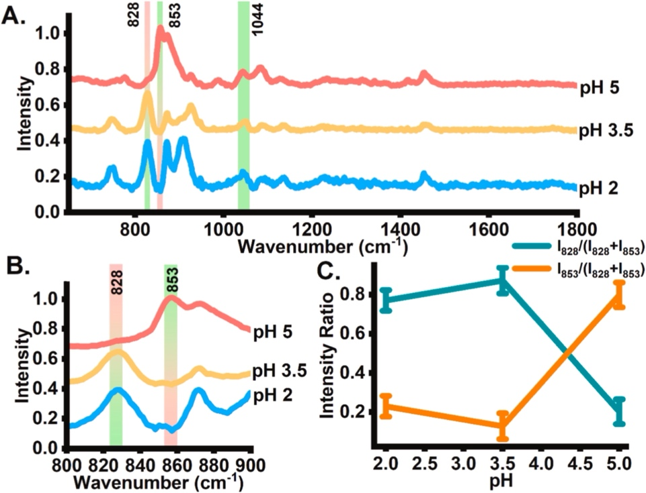
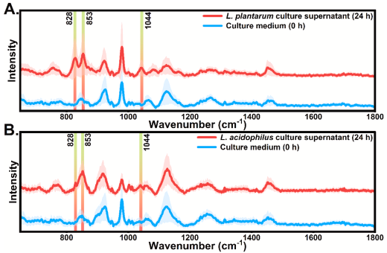
This study began with a simple yet intriguing question: “Can we determine the characteristic signal of lactic acid in the complex culture media in a label-free manner and with minimal sample preparation?” We used Lactobacillus plantarum and Lactobacillus acidophilus, well-known lactic acid bacteria (LAB) and recorded Raman spectrum at 0 and 24 h from the liquid culture supernatant without any enzymatic derivatization. As can be seen in Figure 1A, at 0 h negligible signals were observed at 828 cm− 1, 853 cm− 1 and 1044 cm− 1 in the average Raman spectra from the supernatant. In contrast the supernatant of 24 h have prominent bands at these positions suggesting presence of lactic acid. Interestingly, the 24h spectrum from L acidophilus had a small peak at 828 cm-1, which led us to dive further in understanding the protonation state of lactic acid in both cultures, Figure 1B. It was found that the loss of H+ ion from the lactic acid molecule leads to the shift of the Raman signal from 828 cm-1 to 853 cm-1 (conversion of lactic acid to lactate). The driving factor for this proton shift was the pH value at 24 h for both cultures. This was found to be around 3.24 ± 0.1 for L. plantarum and4.35 ± 0.5 for L. acidophilus. Due to this difference the prominent form of lactic acid was in lactate form in L. acidophilus. This observation was further validated with adding pure lactic acid in buffer solutions at varying pH. Spectra collected from these solutions revealed versatility of this method in identifying both protonated and deprotonated form of lactic acid, Figure 2. This observation is extremely important as most commercial kits available on the market detect only lactate and lack the ability to monitor a growing culture medium. Altogether, this highlights the potential of Raman spectroscopy for real-time, reagent-free monitoring and future integration with in-line bioprocess monitoring systems. Another interesting finding was that that Raman spectroscopy based detection achieved a sub-millimolar concentration limit of detection (~0.6 mM = ~0.05 g/L) for L. plantarum culture and >2 mM for L. acidophilus.
Overall, direct detection of lactic acid in intact culture media, multiplexing capability to resolve protonation states, minimal sample preparation, and signal processing are key attributes of our work. These findings can serve as a solid base for prospective translation of this approach for industrial LAB fermentations where the lactic acid concentrations are very high. Some challenges such as improving the signal-to-noise ratio, tackling the additional complications of the bioreactors such as gas bubbles, higher cell density and deposition of media components will require additional efforts.
Raman spectroscopy-guided bioprocess sensing spans optics, microbiology, and chemometrics. For early-career researchers, this rapidly evolving field offers substantial opportunities. Despite recent advances, further opportunities lie in multimodal process monitoring where Raman spectroscopy is coupled with complementary sensors such as temperature, pH, fluorescence and mass spectrometry. Here, Raman provides analyte-specific information, while other measurements capture distinct physiological and biochemical aspects of the process. We encourage younger scientists to explore this multimodal process-monitoring dimension by coupling quantitative chemometrics with machine learning. Future investigations in this domain would transform Raman spectroscopy from a tool for identifying biochemical changes to an automated process-monitoring framework.