
Small molecule drug discovery has continually reinvented itself, evolving from empirical phenotypic approaches to target-based workflows and now toward event-driven, data-enabled paradigms. Despite competition from newer therapeutic modalities, small molecules remain indispensable. Future productivity gains are expected to come from convergence integrating phenotypic relevance, mechanistic insight, expanded chemistry space, and emerging technologies rather than relying on isolated innovations.
Introduction
Despite rapid growth of biologics, nucleic acid medicines, and cell‑based therapies, small molecules remain the dominant therapeutic class by number of approved drugs. Their continued relevance reflects intrinsic advantages: oral bioavailability, intracellular target access, tuneable pharmacokinetics, manufacturability, and scalability. The strategic question facing the field is therefore not whether small molecules will remain important, but how they must evolve as disease biology becomes increasingly complex.
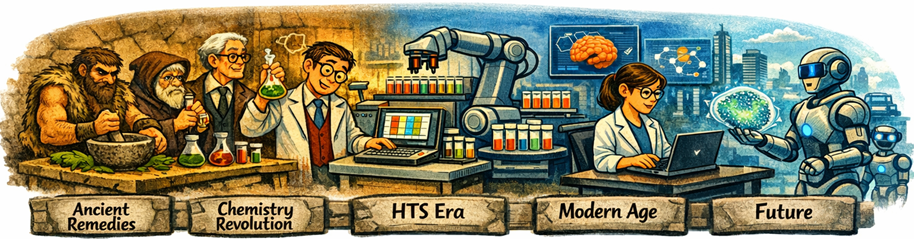
Importantly, small‑molecule drug discovery has never followed a linear trajectory. Instead, it has progressed through iterative reinvention, with paradigm shifts driven by new biological insight, enabling technologies, or limitations of prevailing approaches. Understanding this evolution provides context for current challenges and helps inform future strategy.
Historical Foundations: Empiricism, Phenotypes, Natural Products and the birth of Pharmacology
Early small‑molecule drug discovery was fundamentally phenotype driven, with compounds identified through observable biological or physiological effects rather than defined molecular targets. Natural products dominated this era due to their intrinsic bioactivity and structural diversity, leading to iconic discoveries such as antibiotics, analgesics, and cardiovascular agents. In many cases, mechanisms of action were elucidated only after clinical success. This empirical approach was not naïve but reflected the biological understanding and experimental limitations of the time, when disease was viewed primarily at the organismal or tissue level and tools to isolate discrete molecular drivers were lacking. Importantly, the structural complexity and pre‑validated bioactivity of natural products strongly shaped early medicinal chemistry thinking and continue to influence modern scaffold design, particularly for challenging targets. The formalization of pharmacology in the late nineteenth and early twentieth centuries introduced quantitative concepts such as dose–response relationships and receptor theory, enabling more systematic links between chemical structure and biological effect. However, discovery largely remained function‑first until the maturation of molecular biology.
The Target‑Based Paradigm and Industrialization of Drug Discovery
The latter half of the twentieth century marked a decisive transition toward target‑based drug discovery, enabled by advances in biochemistry, molecular biology, and recombinant technologies. Proteins could now be cloned, purified, and interrogated directly, allowing therapeutic hypotheses to be anchored to specific enzymes, receptors, and ion channels.
This shift transformed medicinal chemistry into a hypothesis‑driven discipline. Structure activity relationships (SAR) became central organizing principles, and potency and selectivity could be optimized with increasing precision. Drug discovery workflows were modularized into target identification, hit finding, and lead optimization, forming the blueprint for modern industrial R&D.
High‑Throughput Screening and Productivity Pressures
High‑throughput screening (HTS), combined with automation and combinatorial chemistry, greatly accelerated early drug discovery by enabling large‑scale testing of chemical libraries. However, these gains did not translate into proportional clinical success. Over time, key limitations emerged poor prediction of in vivo efficacy, target redundancy and pathway compensation, and unanticipated disease complexity highlighting the persistent gap between target engagement and therapeutic benefit, a theme that continues to influence contemporary discovery thinking.
The Contemporary Landscape: Integration, the Modality Expansion and Recalibration
Today’s small‑molecule discovery landscape is defined by integration across disciplines: chemistry, biology, pharmacology, toxicology, data science, and clinical translation. While target‑based approaches remain dominant, their limitations are well recognized particularly the high attrition due to lack of clinical efficacy, incomplete biological understanding, and target redundancy.
Modern programs emphasize:
- Human genetic validation
- Pathway‑level thinking, rather than single proteins
- Target engagement and pharmacodynamic biomarkers
Target selection has become more evidence‑based, but also more conservative, contributing to crowded target spaces (e.g., kinases, GPCRs).
Advances in Medicinal Chemistry and Designing Small Molecules
Medicinal chemistry today benefits from a richer toolbox than ever before:
- Fragment‑based drug discovery (FBDD) allows efficient exploration of chemical space
- Structure‑based design supported by cryo‑EM and fast X-ray crystallography
- Covalent inhibitors, once viewed with scepticism, are now mainstream
- Beyond Rule‑of‑5 (bRo5) strategies tackle challenging targets such as PPIs
Event‑Driven Pharmacology: A Conceptual Shift
One of the most significant modern inflection points in small‑molecule discovery is the transition from occupancy‑driven inhibition to event‑driven pharmacology.
Chemical modalities have expanded to include molecular glues, targeted protein degradation (PROTACs), and constrained peptides, blurring classical boundaries between small molecules and biologics.
Data, Automation, and Industrialization
The current era of small molecule drug discovery prioritizes speed, cost, and success probability, driving automation, centralized DMTA workflows, and AI/ML‑guided design and triage. While AI has not yet transformed clinical productivity, it has clearly improved efficiency in local decision‑making, particularly in hit expansion and lead optimization.
The Future: Convergence, Better Models, and AI as a Scientific Copilot
The future of small molecule drug discovery is likely to be shaped by workflows that start from disease‑relevant phenotypes (cells, organoids, patient‑derived systems) and rapidly converge on MoA using chemical proteomics, genetics, and systems readouts. The renewed emphasis on phenotypic discovery is explicitly tied to its potential for first‑in‑class mechanisms, but modern drug discovery programs increasingly require fast target identification to support medicinal chemistry optimization and translational confidence. Such integration reduces late‑stage attrition by aligning chemical optimization with human biology from the outset.
Structural and systems biology expand “druggability”
Cryo‑EM’s trajectory suggests a future where more targets especially complexes, dynamic assemblies, and membrane proteins become structurally tractable for iterative design. Reviews anticipate increasing integration with computational methods to interpret medium‑resolution maps, address heterogeneity, and raise throughput, allowing structural insights to become routine rather than exceptional.
AI/ML: decision support, not a replacement for scientific judgment
The rise of artificial intelligence (AI) and machine learning is transforming small‑molecule drug discovery, not by replacing chemistry, but by changing how chemical ideas are conceived, assessed, and refined. Traditionally, molecular design relied heavily on a chemist’s experience, intuition, and favoured reaction space, often restricting exploration to familiar scaffolds and synthetic strategies. While this expertise remains essential, it also introduced bias and limited systematic access to the immense chemical universe.
Recent advances highlight AI’s growing impact across target identification, multi‑omics integration, and structure‑enabled workflows, while also underscoring challenges related to interpretability and data quality. When combined with automated synthesis, high‑accuracy structure prediction, and data‑driven retrosynthesis, AI‑enabled design expands chemical space beyond conventional boundaries. These tools uncover unexpected structure–property relationships and propose unconventional disconnections, challenging long‑standing synthetic assumptions. Rather than automating chemistry, this evolution reinvents it, with chemists remaining central but increasingly augmented across the design–make–test–analyze cycle of the small molecule drug discovery.
The next frontier for the small molecule drug discovery: modality blending and property innovation
As proximity‑inducing modalities (PROTACs, molecular glues) proliferate, medicinal chemistry will increasingly focus on balancing event‑driven efficacy with permeability, distribution, and safety. The bRo5 playbook macrocyclization, intramolecular H‑bonding, and natural‑product‑like design will matter not only for classic PPIs but also for degrader property optimization and tissue exposure challenges.
Conclusions
Small‑molecule drug discovery has shown remarkable resilience, remaining central despite rising biological complexity and technical demands. Future impact will come not from abandoning paradigms, but from using small molecules more precisely integrating human biology early, exploring broader chemical space, and balancing advanced technology with strong mechanistic insight.