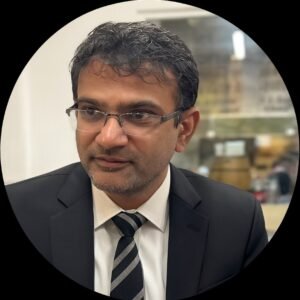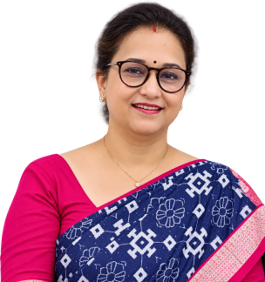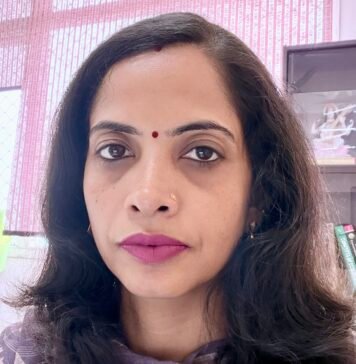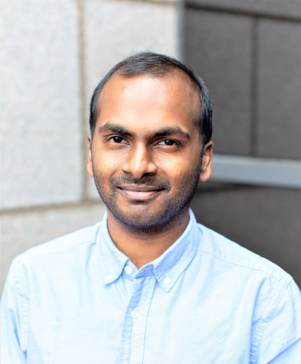
My research journey has been guided by a fascination with how mathematics and statistics can reveal structure and meaning from seemingly chaotic data. Over the years, my interests have evolved around statistical signal processing, distribution theory, and reliability and survival analysis. These areas, though distinct in scope, share a unifying objective-to develop reliable, interpretable, and computationally efficient methods that bridge theoretical statistics with real-world applications. Much of my work has dealt with developing new distributional models such as the generalized exponential family and improving statistical inference under complex censoring and life-testing schemes. These ideas have found applications in fields as varied as communications engineering, reliability assessment, and biomedical research. The satisfaction comes not only from theoretical development but also from seeing how these methods assist in solving practical problems.
“The future statistician must balance computational innovation with theoretical soundness, ensuring models not only fit data but truly explain it.“
Looking ahead, I believe the next decade will be transformative for the statistical sciences. The emergence of data science, machine learning, and artificial intelligence has created vast new opportunities, but also demands renewed emphasis on the core principles of inference and uncertainty quantification. Modern statisticians must strike a balance between computational innovation and theoretical soundness. Integrating classical probability models with data-driven learning approaches-particularly in reliability and survival studies-will be an exciting challenge. At the same time, we must recognize the ethical and interpretational challenges posed by the abundance of data. As models grow in complexity, transparency and reproducibility become essential. The future statistician will not only need technical expertise but also the discernment to judge when a model truly explains, and when it merely fits.
For young scientists in India, this is an especially promising time. Our country is rich in mathematical tradition and is now emerging as a global hub for data-intensive research. I would urge the next generation to cultivate both theoretical depth and computational skill. Learn the mathematics that underpins the methods you use, and at the same time, embrace new computational tools fearlessly. Be patient with research-it often rewards persistence more than brilliance. Most importantly, remain curious, question assumptions, and do not be afraid to cross disciplinary boundaries. The future of statistics in India depends on this spirit of curiosity, collaboration, and integrity. If young researchers can combine creativity with scientific rigor, Indian statisticians will continue to make lasting contributions to global science and technology.