India now has more than 77 million adults living with diabetes, and somewhere between 5% and 14% of these people will develop a foot ulcer that won’t heal on its own. Stalled healing is more than one problem. It’s the simultaneous presence of chronic inflammation, impaired blood vessel growth, oxidative damage, and faulty tissue remodelling. This is precisely why a single-target drug so often doesn’t suffice. In a recent study, we combined transcriptomic data mining and wet-lab cell biology to ask whether a flavonoid that is already part of our everyday diet, luteolin, which can be found in Martynia annua, celery, parsley, thyme, and many other plants, might actually work the way the problem does: on several fronts at the same time.
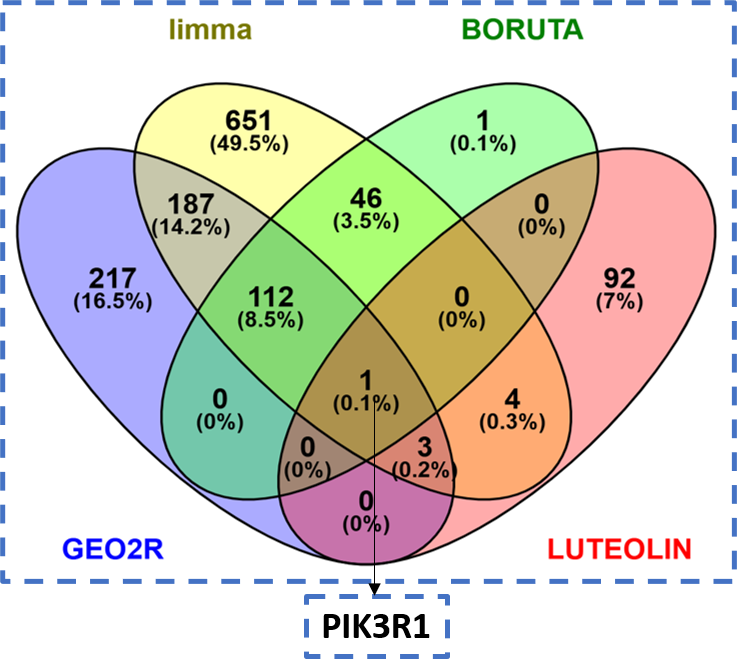
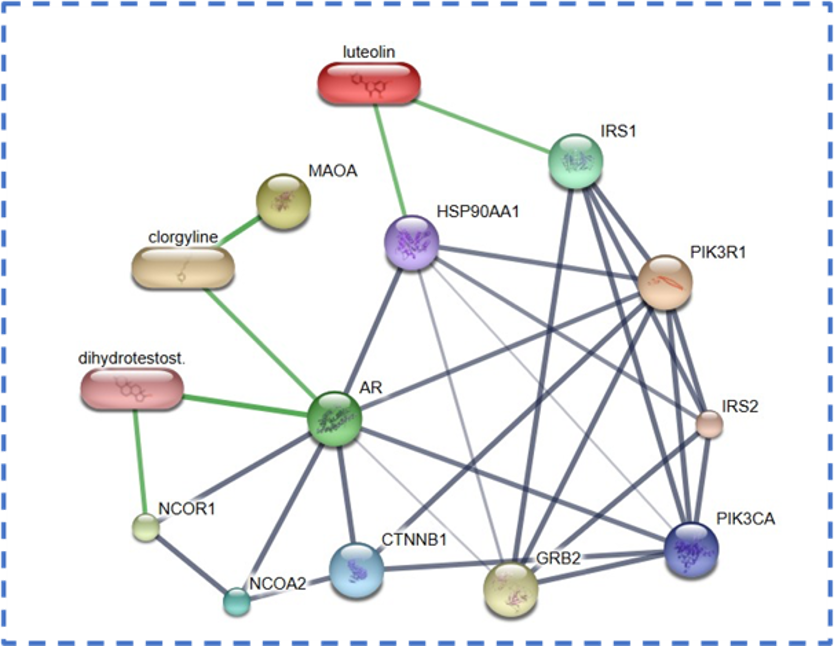
Using three independent datasets of diabetic wound gene expression, we distilled hundreds of dysregulated genes into a small, convergent list. Four completely different analytical approaches statistical differential expression, an independent public database, a machine-learning feature-selection algorithm, and chemical-target prediction for luteolin itself all converged on the same gene: PIK3R1, a regulatory subunit of the PI3K/AKT pathway. Then we tested luteolin directly on human skin fibroblasts under high-glucose stress. It improved cell viability, cut oxidative stress dramatically, accelerated wound closure in a scratch assay by about 40%, and nudged the PI3K/AKT/NRF2 signalling machinery in the direction you would want for healing: more survival signal, less apoptosis, and more antioxidant defence.
The convergence looks satisfying on a page. It is also, we think, a useful case study in where phytochemical wound-healing research needs to go next, because for every question this kind of study answers, it raises two more.
The biggest unanswered question is also the most basic one: does luteolin really bind PIK3R1 inside a living cell, or are we looking at a well-correlated bystander? Docking and molecular dynamics can tell you that a ligand could sit comfortably in a binding pocket; they cannot tell you that it does in the crowded, competitive environment of a real cell. To close this gap, we would need direct evidence of target engagement, which we have not yet obtained, or surface plasmon resonance, isothermal titration calorimetry, cellular thermal shift assays, or PIK3R1 knockdown-and-rescue. Until then, “luteolin targets PIK3R1” is a good hypothesis, not an established mechanism, and the field would do well to treat that distinction more carefully than it sometimes does.
The real breakthrough we need is not a new pathway or a new natural compound. There is no shortage of either. It is cheaper, faster, and more routine access to tools for target engagement and functional validation, so that computational hits no longer die quietly at the hypothesis stage. Today, a lab can generate a confident protein-protein interaction network and a strong docking score in a week, and then spend a year, if it spends the time at all, trying to prove that the interaction is real and functionally load-bearing. Democratising that second step, through shared CETSA or SPR facilities, cheaper knockdown reagents, or better computational proxies for binding, will do more for natural-product drug discovery than almost any single new molecular finding.
The trend we expect to dominate the next few years is the one our own study relied on: combining multiple independent lines of evidence, differential expression, public repositories, machine learning, and compound-target prediction, and trusting only what survives the intersection of all of them. It is statistically crude, but it is a good filter against the single-method false positive that has quietly populated the phytochemical literature over the last two decades. We expect this type of multi-method consensus approach to become a near-minimum standard for target-identification papers, much like power calculations have become standard for clinical trials.
We think the field is moving toward delivery over the next five to 10 years, not just mechanisms. Other groups have already formulated luteolin itself into nanovesicle gels, hydrogels, and dissolving microneedle patches, each addressing a different aspect of the problem: sustained release, biocompatibility, and painless application directly to the wound bed. The real-world approach to a clinic is not a luteolin pill, but a topical formulation, possibly in combination with a second agent hitting a complementary target such as a growth factor or an anti-inflammatory peptide, delivered through one of these platforms, tested first in an actual diabetic animal wound model, and eventually in a trial measuring real wound closure, rather than a signaling marker on a Western blot.
There is a uniquely Indian opportunity worth mentioning here, as the burden of disease is overwhelmingly ours. India has the largest diabetic population in the world, projected to be 134 million by 2045. Plant-derived flavonoids like luteolin will easily meet the supply chain limitations. A validated, well-made luteolin-based wound dressing would be a truly low-cost intervention for the health system most in need. We believe the institutional capacity to translate findings like ours from a 96-well plate into a validated dressing, shared docking and simulation compute, affordable target-validation cores, and GMP-grade phytochemical standardisation is as important a “next step” for the field as any single molecular target.
There are three limitations in particular; firstly, the translation of the findings to pre-clinical and clinical studies is missing. Whether anyone runs it or not, we’re included. Second, a cell line does not completely simulate a human wound itself, although it provides a valuable proof of concept. Third, we do not yet have a joint statistical analysis to determine whether the metabolic signals we found in addition to the protein data—changes in an amino acid (leucine) and a membrane lipid (sphingomyelin) that are known to interact with PI3K/AKT signaling—are downstream effects that we might want to target in their own right, or just correlated noise. Furthermore, whether PIK3R1-centered approaches generalize beyond fibroblasts to the keratinocytes, macrophages, and endothelial cells that a real wound actually depends on, since healing is not a single-cell-type process, and our cell line model was never meant to pretend otherwise.
None of this is to be a criticism of the state of natural-compound wound-healing research today. That’s a pretty good description of science doing what it’s supposed to do: a limited, clearly labeled hypothesis. The honest answer to “what’s next” isn’t a bigger claim, but a narrower, more validated claim.