At first glance, a crystal may seem like one of the simplest forms of matter. Molecules arrange themselves into an ordered structure, the crystal grows, and the story appears to be finished.
But crystals can be surprisingly unpredictable. Two samples can contain exactly the same molecules in exactly the same ratio and still form crystals with different structures, shapes, colours, stability and physical properties. This phenomenon, known as ‘Polymorphism’, is one of the fascinating challenges of solid-state chemistry and is particularly important in pharmaceutical science.
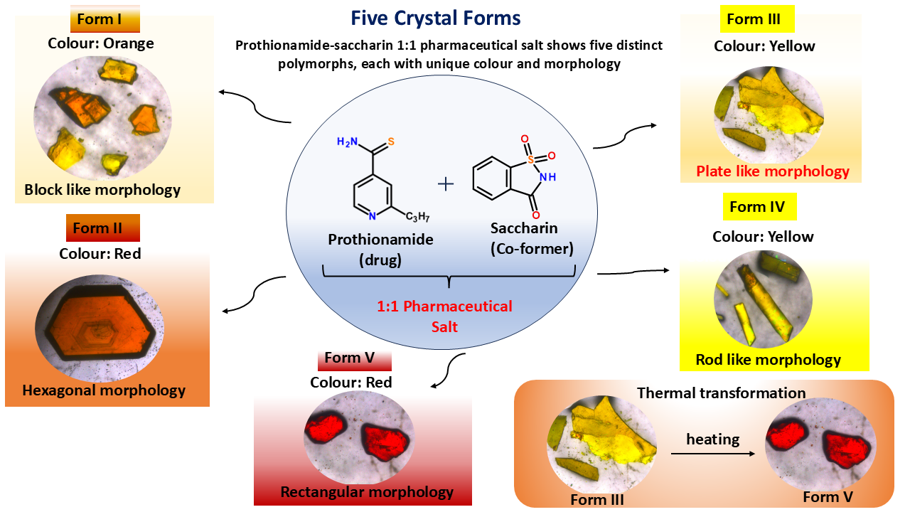
A recent study published in RSC Advances has revealed an unusually colourful example of this phenomenon. Researchers from the Indian Institute of Technology Bhubaneswar have discovered five distinct polymorphic forms of a 1:1 Prothionamide-Saccharin pharmaceutical salt, obtained by carefully changing crystallization conditions. The crystals showed different morphologies and striking red, orange and yellow colours.
Same molecules:different crystals
The central question behind the research is deceptively simple: If we use the same two molecules, why don’t they always make the same crystal? To investigate this question, the researchers selected Prothionamide (PA), an antituberculosis drug, and Saccharin (SA), a generally recognized as safe (GRAS) co-former. When these two molecular components interact during crystallization, they form a pharmaceutical salt with a 1:1 stoichiometric ratio. However, maintaining the same molecular ratio does not guarantee the exact single crystal structure. By controlling the crystallization environment, particularly the solvent and temperature, the researchers isolated five different forms, designated Forms I–V. This is where the chemistry becomes particularly interesting. The five forms had the same overall chemical composition, but their molecules were arranged differently in the solid state. The crystals also developed different shapes, including blocks, hexagonal, plates, rods and rectangular crystals, along with visible differences in colour. In other words, the molecules were the same, but the molecular arrangement was different.
Why molecular arrangement matters
In molecular chemistry, we often focus on what molecules are present. In solid-state chemistry, however, another question becomes equally important: A crystal is an organized three-dimensional assembly of molecules. Small changes in molecular orientation, conformation or intermolecular interactions can alter the entire packing arrangement. This is the essence of polymorphism. In pharmaceutical materials, this distinction can matter because different crystal forms can have different physical properties. Crystal packing can influence properties such as thermal behaviour, stability, solubility and other characteristics relevant to pharmaceutical solids. Therefore, finding one crystalline form does not necessarily mean that the structural landscape of a material has been completely explored. The Prothionamide-Saccharin system provides a particularly clear demonstration of this principle.
One molecular pair, five crystal forms
The five forms were obtained using solution-based crystallization under different conditions. Although all five retained the same 1:1 stoichiometry, single-crystal X-ray diffraction revealed that they possessed different unit-cell parameters and packing motifs. This distinction is fundamental. Imagine five rooms built from exactly the same set of furniture. The furniture itself has not changed, but its arrangement inside each room can be completely different. The same idea applies at the molecular level.
In one crystal form, molecules may adopt one orientation and establish a particular network of intermolecular interactions. In another form, the molecules can change their orientation or conformation, allowing a different packing arrangement to emerge. The researchers found evidence that this molecular flexibility plays an important role in the formation of the five polymorphs.
The flexibility of Prothionamide
One of the important findings of the study was that Prothionamide is conformationally flexible. The molecule can adopt different conformations because portions of its molecular substituent can rotate. Detailed analysis of torsion angles showed that the Prothionamide molecules adopt different conformations in the five crystal forms. This flexibility provides the molecule with several ways of fitting into a crystal lattice. Different molecular conformations can influence how molecules interact with neighbouring molecules, which in turn can produce different crystal packing arrangements. The study identified both conformational polymorphism and packing polymorphism among the five forms, showing that more than one structural mechanism contributes to the observed diversity. This is an important lesson in crystal engineering: molecular flexibility can increase the number of possible ways in which molecules organize themselves in the solid state.
Why are the crystals different colours?
Perhaps the most visually striking aspect of the work is the colour. The five polymorphs exhibited red, orange and yellow colours, making the structural differences visible even before sophisticated characterization was performed. But colour alone cannot tell us why a crystal looks the way it does. To understand the origin of these differences, the researchers investigated the materials using UV-visible spectroscopy and photoluminescence measurements, supported by computational studies. The results demonstrate how changes in the solid-state environment can influence the electronic properties of molecular materials. This is one of the fascinating features of solid-state chemistry. The colour of a material is not determined only by the isolated molecule. The way molecules interact and pack together can also influence how the material absorbs and emits light. Thus, the five crystals provide a visible reminder that molecular organization matters.
Looking inside the crystals
The heart of the investigation was single-crystal X-ray diffraction (SCXRD). For a crystallographer, an apparently simple crystal can contain an enormous amount of information. By analysing how X-rays are diffracted by the ordered crystal lattice, researchers can determine the three-dimensional arrangement of atoms. In this study, SCXRD established that the five materials shared the same overall stoichiometry while possessing different crystal structures. Powder X-ray diffraction further supported the distinction between the forms. Additional techniques, including differential scanning calorimetry (DSC) and variable-temperature powder X-ray diffraction (VTPXRD), were used to investigate their thermal behaviour. The study also examined intermolecular interactions and relative stability using Hirshfeld surface analysis and lattice-energy calculations. Together, these techniques allowed the researchers to move from a simple observation, “there are five different crystals,” to a deeper structural question: What makes each crystal form different, and how stable is each arrangement?
When heat changes a crystal
The crystals also revealed interesting behaviour when heated. Forms I, II, IV and V remained intact under the any sort of thermal conditions. Whereas, Form III transformed into Form V upon heating. This observation provides another glimpse into the dynamic nature of crystal structures. A crystal may appear static, but its molecular arrangement is governed by a balance of intermolecular interactions and thermodynamic stability. When external conditions such as temperature change, one arrangement can become more favourable than another. The transformation of Form III into Form V therefore demonstrates that polymorphs are not simply different static structures. Under suitable conditions, one solid form can transform into another.
Why crystal forms matter for medicines
The importance of this research extends beyond producing colourful crystals.
Pharmaceutical compounds are often developed as solid materials, and their properties depend not only on molecular composition but also on their solid-state structure. When different polymorphs are possible, controlling which form is produced becomes an important part of pharmaceutical solid-state research. For pharmaceutical co-crystals and salts, this becomes even more interesting because more than one molecular component participates in the crystal structure. The discovery of five polymorphic forms in a single Prothionamide-Saccharin system demonstrates how extensive the solid-state landscape of a pharmaceutical material can be. It also highlights a practical challenge:
Changing a crystallization condition can change the crystal that you obtain.
Solvent, temperature, concentration, evaporation rate and other experimental parameters can influence nucleation and crystal growth. Consequently, systematic crystallization studies are essential when investigating pharmaceutical solids.
The hidden complexity of crystals
Chemistry is often taught through molecular structures drawn on paper: atoms connected by lines, functional groups identified by names, and reactions represented by arrows. But once molecules enter the solid state, another layer of chemistry emerges. Molecules have to arrange themselves in three dimensions. They interact with their neighbours. They compete for space. They adopt different conformations. They form networks through hydrogen bonding and other intermolecular interactions. And sometimes, surprisingly, the same molecules can organize themselves in several different ways. The five Prothionamide-Saccharin polymorphs offer a striking example of this hidden complexity.
Looking ahead
The future of pharmaceutical solid-state chemistry lies in moving beyond simply discovering new crystal forms toward predicting, controlling, and deliberately designing them. One of the biggest unanswered questions is whether we can accurately predict the most stable or functionally useful solid form before it is experimentally discovered. Crystal packing depends on a complex balance of hydrogen bonding, π–π interactions, electrostatic forces, molecular flexibility, and solvent effects. Understanding these competing factors remains essential for developing medicines with improved solubility, stability, dissolution, and bioavailability. The next major breakthrough will likely come from combining high-throughput crystallization, advanced X-ray diffraction, thermal analysis, computational modelling, and artificial intelligence. Machine-learning approaches could eventually help researchers identify promising co-formers and predict polymorphic landscapes, while real-time diffraction and spectroscopy could reveal how one crystal form transforms into another during heating, cooling, hydration, or exposure to different solvents. Over the next 5–10 years, I envision pharmaceutical crystal engineering becoming increasingly predictive, automated, and application-driven. Instead of treating unexpected polymorphs as a challenge encountered during drug development, researchers may increasingly use polymorphism as a design tool. The integration of crystal engineering with computational chemistry, AI, advanced characterization, and pharmaceutical development could allow scientists to design solid forms with specific properties before entering the laboratory. Readers should watch for one major shift: the transition from “finding” pharmaceutical crystals to “designing” them. This could fundamentally change how the solid forms of medicines are discovered, optimized, and ultimately developed into more effective and reliable pharmaceutical products.